
 By Chuck Gallagher – Business Ethics Keynote Speaker and AI Speaker and Author
The Pull-Over Moment
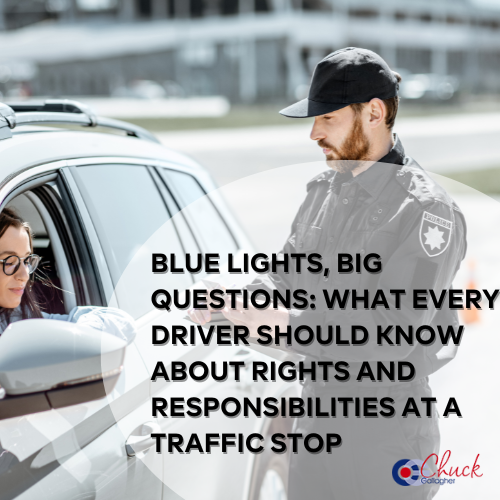
It’s 8:30 p.m., and you’re driving home from a late meeting.
In your rearview mirror—blue lights.
Your pulse quickens. You ease to the shoulder, shift into park, and grip the wheel. The officer approaches slowly, hand near the flashlight on their belt.
“Do you know why I pulled you over?” they ask.
In that split second, your mind races. Do I have to answer that? Do I have to give my license? Can I just remain silent like I’ve seen in those YouTube videos?
This moment is where legal reality, personal rights, and ethical responsibility collide. And what you don’t know could cost you—not just in fines, but in freedom.
Why Miranda Doesn’t Apply Here
Popular belief: The second a police officer starts asking questions, you’re entitled to a Miranda warning.
Reality: That’s not how it works.
Miranda warnings only apply if:
- You are in custody, and
- You are being interrogated about a crime.
A routine traffic stop is legally considered a temporary detention—what courts call a Terry stop—not formal custody. That means:
- No Miranda warning required.
- Officers can ask you basic questions without advising you of your rights.
From an ethical standpoint, this creates a gap between public perception and legal reality—one that’s widened by media portrayals and viral videos.
Identification: Non-Negotiable for Drivers
Here’s the part most people misunderstand:
If you are driving, every state requires you to provide identification when lawfully stopped. This usually means:
- A valid driver’s license
- Vehicle registration
- Proof of insurance
Refusing to provide these can lead to:
- Arrest in many states
- Additional criminal charges (e.g., obstruction or failure to carry license)
Unlike passengers—whose ID obligations vary by state—drivers have no broad “right to refuse” identification. This is a legal duty, not a negotiable point.
Answering Questions: Where Silence Fits In
As a driver, you do have the constitutional right to remain silent beyond the required identification and vehicle documents. That means you are not legally obligated to answer:
- “Do you know why I pulled you over?”
- “Where are you coming from?”
- “Have you been drinking?”
However:
- Remaining silent may influence how the officer perceives the situation.
- Silence should be clear and polite—e.g., “Officer, I choose to remain silent and would like to provide only what’s required by law.”
The legal right exists, but ethically, it’s important to balance assertiveness with respect—because roadside dynamics can escalate quickly.
State-by-State Nuances
For drivers, the core duty—provide license, registration, and proof of insurance—applies in all 50 states.
Where states differ is:
- How quickly you must provide documents
- Whether additional questions are considered part of lawful identification (e.g., name, DOB, address)
- Consequences for failing to provide ID (some states classify it as an arrestable offense; others as a citation)
The Ethical Layer: More Than Just “What’s Legal”
The law gives drivers fewer “silence” options than passengers when it comes to ID. But ethics is about more than compliance:
- Drivers have a responsibility to act in ways that keep encounters safe—for themselves, the officer, and others on the road.
- Officers have a duty to respect rights while enforcing laws.
- Citizens have a shared responsibility to know the rules before the moment of the stop, not during it.
Think of it like corporate governance: the board may have the legal authority to act, but ethical leadership demands transparency, respect, and proportionality.
Practical Roadside Guidelines for Drivers
- Pull over promptly and safely when signaled.
- Stay in the car, hands visible, unless instructed otherwise.
- Provide your license, registration, and proof of insurance when asked.
- Be polite—you can assert rights without hostility.
- If you choose to remain silent beyond required information, say so clearly and respectfully.
- Document the encounter afterward if you believe your rights were violated.
The Takeaway
For drivers, the right to remain silent exists—but it’s narrower than many think. You must identify yourself, and refusing to do so can carry immediate legal consequences. Miranda doesn’t shield you at a traffic stop, and what you say—or don’t say—should be guided by both legal reality and ethical awareness.
When blue lights flash, preparation is your best defense—both for protecting your rights and preserving your integrity.
As always, we welcome your comments and are happy to respond.
Feel free to share your thoughts below.

Define “provide”! Most folks don’t know that you dont have to hand an officer your documents. You CAN crack your window for communication clarity and hold them against the window. The fact that most cops get an attitude, dont know how they violate our rights, dont know the constitution (state or federal)and get ego trips telling us we must do things, just because they are cops, that we aren’t required to do is generally what leads to escalated situations. No cop likes their percieved authority challenged.