
 By Chuck Gallagher – Business Ethics Keynote Speaker | AI Speaker and Author
Narrative Paper
- The Story That Anchors Us
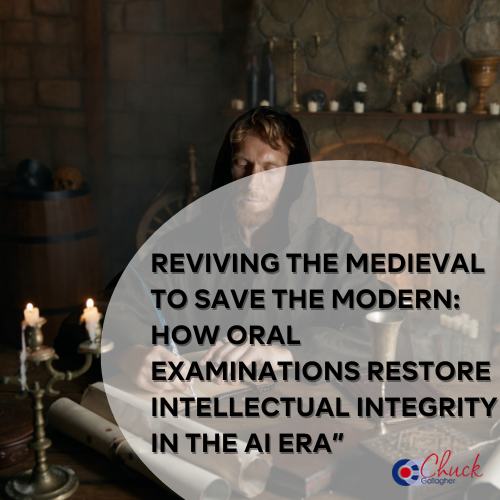
Picture a venerable hall at Oxford—candles flicker on stone walls as a scholar stands before a circle of masters, ready to undergo the viva voce, an oral examination to validate knowledge. Fast-forward to 2025. A student sits at home with the world’s knowledge at their fingertips—but instead of grappling with ideas, they feed prompts into ChatGPT to ghostwrite their essay. The assessment glow of integrity has dimmed in favor of efficiency—and AI’s siren song.
This contrast underlines the central tension: genuine understanding versus outsourced output. The New York Times article “‘Even good students are cheating’: Why US colleges are reviving a medieval solution to outsmart AI” highlights that institutions are increasingly turning to oral exams—centuries-old, intellectually demanding assessments—to restore rigor and protect academic identity.
- The Rise of AI-Enabled Erosion
Since the launch of ChatGPT, virtually overnight, students realized they could outsource everything—from essays to code—undermining the learning process. A 2023 survey found that nearly 90% of college students had used ChatGPT for homework soon after its launch.
Educators report a generational collapse in critical thinking and analytical writing:
“We’re talking about an entire generation of learning perhaps significantly undermined here,” observes tech‑ethics scholar Brian Green.
Meanwhile, AI-detection tools like Turnitin or GPTZero prove unreliable—often mislabeling original work or missing AI-generated content entirely.
- Oral Exams: Medieval Wisdom Meets Modern Ethics
Oral examinations are difficult to fake. They demand fluency, spontaneous reasoning, and intellectual presence—forcing students to inhabit their ideas. They shift the goalposts from product to process, from output to ownership.
Yet resistance persists. Faculty cite challenges in scalability, fairness, and added faculty workload. Students worry about bias and uniformity.
This tension sits at the heart of ethics. Do we choose expedience in enforcement, or invest in human-centered assessments that affirm identity and competence?
- Broader Adaptations: The Blue Book Revival & Beyond
Other analog tactics are also returning. Handwritten in-class essay exams—so-called “blue books”—are resurging for their AI-proof simplicity. For example, demand for blue books has surged significantly at institutions like Texas A&M, University of Florida, and UC Berkeley.
Hybrid strategies appear to be emerging: AI for assistance, analogue for assessment.
- The Ethical Imperative for Business & Education Leaders
As a business ethics keynote speaker and AI speaker and author, this development is deeply instructive. It reminds us that the act of assessment is not just measurement—it’s affirmation of values, intent, and character. In organizations, too, over-reliance on AI without reflective evaluation can erode trust, judgment, and agency.
Strategic takeaways:
- Center assessments on reflective process, not just deliverables—e.g., oral defenses, reflective portfolios, in-person presentations.
- Design AI-inclusive yet integrity-focused assignments—teach students or employees to disclose AI assistance and critically evaluate its role.
- Ensure fairness and equity—recognize diverse learning styles and mitigate bias in high‑stakes settings.
- Scale thoughtfully—leverage AI as facilitator, not substitute, for human-centered learning.
What are your thoughts regarding AI and Education? Share in the comments below.
