
 by Chuck Gallagher — business ethics keynote speaker and AI speaker and author
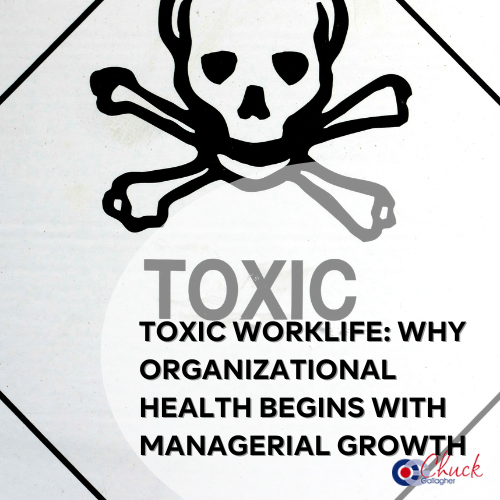
I was talking with a mid-level manager recently who said something that stopped me in my tracks: “I don’t leave my job—I just detach from it.” That detachment didn’t come from a lack of challenge or ambition. It came from a workplace that was suffocating rather than enabling. The recent essay in The CSR Journal titled “Toxic Worklife: Corporate Life, Manager Growth” offers a brutal spotlight on how the very environments we build to develop leaders end up hollowing them out.
The Hidden Crisis in Corporate Growth
Managers—once celebrated as the future of the organization—are being undermined from within. The article chronicles how corporate cultures that focus on growth metrics, market wins, and upward mobility often neglect the human underpinnings of managerial well-being: support, ethical leadership, and meaningful autonomy. The result? A toxic worklife that erodes not only individual growth but organizational vitality.
What struck me most was the paradox: companies invest heavily in leadership development programs, yet many manage environments where the next level of promotion means less support, more ambiguity, and a rapid slide into burnout. That gap isn’t about talent—it’s about environment. And it’s a moral issue as much as it is a performance risk.
Why It Matters for Ethics & Strategy
As a business ethics keynote speaker, I regularly remind organizations: integrity isn’t just about external branding—it’s about the internal conditions under which people work. When a manager is under constant pressure, unsupported, or forced into misaligned incentives, the downstream effects are real:
- Ethical shortcuts become tempting when trust is absent.
- Innovation is stifled when teams fear failure more than they seek growth.
- Turnover rises, and with it, the cost of rebuilding both talent and credibility.
In short, a toxic managerial environment doesn’t just damage individuals—it compromises the organization’s ethical and strategic foundation.
Signs Your Organization May Be Toxic to Manager Growth
Based on the article’s insights and my work with leadership teams, here are questions to discern whether your managers are trapped in toxic worklife conditions:
- Does promotion imply greater influence and greater support—or simply more responsibility without resources?
- Are your leaders encouraged to pause and reflect—or only to sprint faster?
- When mistakes happen, is the reflex to hide or to learn?
- Is a manager’s growth defined solely by output—or also by integrity, wellbeing, and stakeholder trust?
- Do internal rewards reinforce healthy leadership— or reward survival of the loudest?
If the answers lean toward short-term output over long-term growth and wellbeing, you’re glimpsing the edge of a toxic system.
What Leaders Can Do to Reverse the Trend
- Reframe growth as development, not simply upgrade. Promotion should coincide with broader support—coaching, mentorship, and ethical reflection—not just heavier workloads.
- Audit manager well-being. Use surveys, focus groups, and exit interviews to assess whether managerial roles feel enabling or exhausting.
- Align incentives with sustainable leadership, not just measurable results. Metrics should include team wellbeing, ethical compliance, and decision-making quality—not only revenues or efficiency.
- Create space for pause and reflection. Toxic worklife thrives on constant motion. Encourage managers to pause, reflect, and recalibrate.
- Embed ethical conversations into everyday management. Rather than episodic training, make ethics a live dialogue—“How do our decisions impact our people? Are we enabling growth or simply extracting productivity?”
Final Thought
The article reminds us that growth narratives can become chasing narratives—where the next title, next bonus, next metric replace meaningful development. The worklife becomes toxic not because of tasks, but because of disconnection—from purpose, from support, and from the very people we depend on to lead.
For organizations that want to lead ethically, sustainably, and strategically, the real focus must shift from what managers produce to how they grow. Because when managerial growth falters, corporate growth follows.
Call to Action
If you lead or shape managers, ask this: Are we building roles that develop our people or roles that exhaust them? Share one change you will commit to making this quarter to ensure your managerial environment is one of growth, not survival. Leave a comment below—let’s start a conversation about healthier leadership climates.
Related Articles:
Bridging the Ethics–Culture Divide: Why Organizational Integrity Hinges on More Than Policies
The Future Was Always Here: How Ethical Leadership Quietly Overtook the Bottom Line
From Corner Office to Corporate Culture: The Real Role of Leadership in Business Ethics
