
 by Chuck Gallagher — business ethics keynote speaker and AI speaker and author
It began as a service. An adjuster, hired by a homeowner, promised to handle the insurance recovery after damage, to manage the process so the insured wouldn’t have to navigate the paperwork and bureaucracy alone. That’s the promise of the public adjuster—someone trusted to act on behalf of the client.
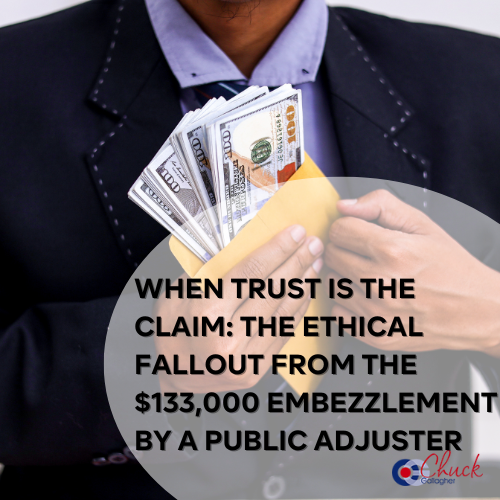
But in the case of 26-year-old Tyler Dionysius Englin of Garner, North Carolina, the promise faltered into betrayal. According to the investigation, he was entrusted with a claim payout of more than $133,000 meant for a client in Catawba County—but the funds were never transferred. Instead, he allegedly pocketed them. NC DOI+2Insurance Journal+2
In my work as a business ethics keynote speaker, I’ve often said: integrity lives in the spaces where nobody is watching. When someone is working for you, the ethical cost of betrayal isn’t only financial—it’s social, relational and systemic. This case isn’t just about embezzlement—it’s about the breakdown of fiduciary duty, the erosion of trust, and the ethical vulnerability in systems built on obligation.
The Case in Brief
Englin, owner of TDE Claims LLC, is facing felony embezzlement charges brought by the North Carolina Department of Insurance. Agents allege that Englin accepted funds for an insurance claim, was entrusted to distribute them to his client, and failed to do so—resulting in $133,097.26 of alleged misappropriation. A bond of $150,000 was set after his arrest on October 30. Hoodline+1
What makes this especially troubling isn’t just the dollar amount—it’s the nature of the role. A public adjuster stands between vulnerable clients and the enormous power of the insurance industry. When that role is corrupted, the consequences ripple far beyond one home or one claim.
Ethical Implications for Business and Leadership
- Fiduciary duty is deeper than contract.
Any business entrusted with someone’s claim, support, or welfare holds a moral and legal duty. When the duty is to serve and protect, but is treated instead as an opportunity to profit, that’s ethical collapse—not a business nuance.
- Trust is the invisible capital.
Money can be re-paid; reputation and trust, once lost, are far harder to rebuild. When a service provider betrays trust, clients often don’t simply lose money—they lose belief in the fairness of the system.
- Culture trumps compliance.
You can have policies, audits, and oversight—but if the executive or owner believes the rules are burdensome rather than foundational, misconduct becomes inevitable. Leadership must embed ethics, not just enforce it.
- Systems of oversight must match the value at risk.
This is a young business owner, an industry with power imbalance, and a large sum involved. The system relied largely on the personal integrity of one individual. That places undue risk on the client—and that’s a breakdown of responsible design.
- The ripple effect is broad.
Every time an adjuster betrays a client, it isn’t an isolated incident. It strengthens cynicism about the overall insurance system. It undermines clients who were acting in good faith and professionals who are upright. The damage is cultural.
What Leaders Should Do Now
- Map your ethical blind spots. Ask: Who holds client funds? What transfer mechanisms exist? What oversight occurs?
- Promote proactive transparency. Encourage employees and service providers to share flag issues early. Use systems—not just suspicion—to detect anomalies.
- Reward integrity, not just achievement. Compensation systems should reflect not only results (claims settled) but conduct (fairness, accuracy, promptness).
- Design for trust. If your organization handles entrusted funds, create separate channels for client verification, independent audits, and prompt reconciliation.
- Communicate the value of trust as a KPI. Make sure your leadership recognizes that credibility is as important as collection, premium, or commission.
Final Thought
This case isn’t only a caution to adjusters—it’s an alert for all professionals who operate in spaces of entrusted power. When you hold someone’s claim, someone’s money, someone’s vulnerability—you’re not just a service provider. You’re a guardian of trust.
And when trust fails, the consequences aren’t just individual—they’re ecological. They ripple through industries, markets, and publics.
Call to Action
If you’re leading an organization or building a service model, ask this: Where in your business is trust assumed but not audited? Where does someone rely solely on the honor of another? Fix that gap this week—because when someone is supposed to do right, you shouldn’t have to hope they will.
Related Articles:
The Danger of Delay: How Embezzlement Grows in the Shadows of Inaction
Trust is Good, Control is Better: Lessons from Kentucky Embezzlement Case
