

 By Chuck Gallagher, business ethics keynote speaker and AI speaker and author
Look around your office. What do you see? Do you see a team driven by a shared sense of purpose, or one running on the fumes of a “hustle at all costs” mentality? For too long, we’ve been sold a broken definition of work ethic-one that champions burnout as a badge of honor and quietly excuses the ethical shortcuts taken to get ahead. But what happens when compliance is mistaken for character? What is the true cost of that one small compromise made under pressure? I can tell you from personal experience: the cost is everything.
This isn’t another lecture on working harder. This is a blueprint for working wiser. Together, we are going to dismantle the dangerous myths of hustle culture and construct a modern framework for professional integrity that will define the leaders of tomorrow. You will discover a clear path forward-one that moves beyond just “working hard” to building a life founded on accountability, transparency, and the kind of lasting success that can never be taken away.
Key Takeaways
- Understand the critical difference between “hustle culture” and a sustainable work ethic built on personal accountability and integrity.
- Recognize the subtle psychological triggers that create the “slippery slope” and learn how to fortify your professional trust before it’s tested.
- Implement a proactive 5-step framework to build an unshakeable ethical foundation, ensuring your choices consistently align with your long-term goals.
- Discover how ethical leadership moves beyond simple compliance to create a high-performance culture that delivers a tangible return on integrity.
Redefining Work Ethic: Beyond the Time Clock
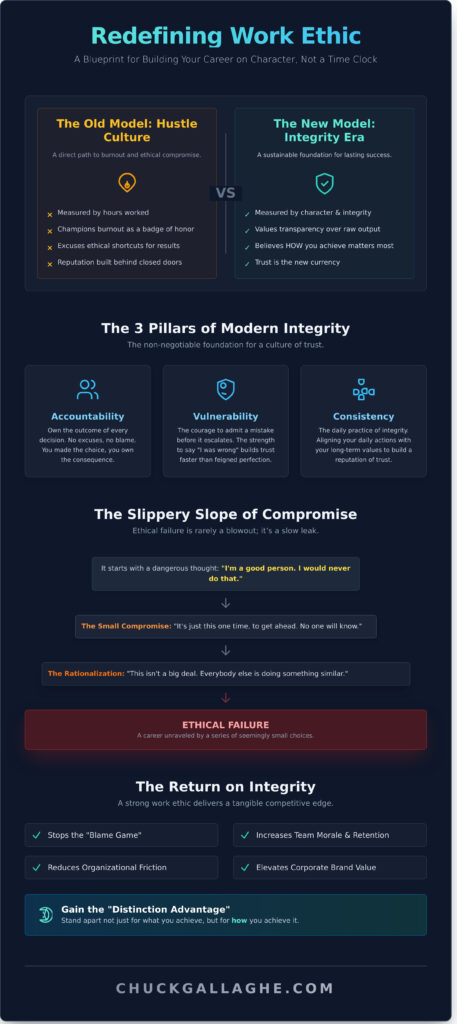
For decades, we’ve been sold a lie. The lie that a strong work ethic means being the first one in and the last one out. That it’s about hustle, grind, and sacrificing everything for the bottom line. But that’s not a work ethic-that’s a direct path to burnout and ethical compromise. A true work ethic isn’t measured by a time clock; it’s measured by character.
It is a profound commitment to personal accountability and the moral clarity to do the right thing, especially when no one is watching. The emerging workforce of 2026 understands this intuitively. They value transparency over raw output because they know that how you achieve results matters more than the results themselves. This shift forces us to confront a simple, yet powerful, reality: every choice has a consequence.
The Evolution of Professional Standards
The old model is broken. The traditional definition of work ethic, often rooted in the idea of sheer diligence as a moral virtue, has given way to the Integrity Era. In a world of digital transparency, your reputation is no longer built behind closed doors; it’s broadcast on a global stage. One unethical shortcut, one moment of poor judgment, can unravel a career in an instant. The most valuable employees won’t be those with the most impressive résumés. They will be the ones whose ethical reliability is beyond question. Why? Because trust is the new currency, and it’s far harder to build than technical skill.
The Three Pillars of Modern Integrity
So, what does this new foundation for professional integrity look like? It’s not complex, but it demands discipline. It rests on three non-negotiable pillars that create a culture of trust and responsibility.
- Accountability: This is about owning the outcome of every decision, full stop. There are no excuses and no one else to blame. You made the choice; you own the consequence.
- Vulnerability: This isn’t weakness; it’s the courage to admit a mistake before it escalates into a catastrophe. It’s the strength to say, “I need help” or “I was wrong,” which builds trust faster than feigned perfection ever could.
- Consistency: Are your daily actions aligned with your long-term values? Consistency is the daily practice of integrity, building a reputation of trust one small, ethical choice at a time.
The Anatomy of a Strong Work Ethic: Every Choice Matters
A high-performance culture isn’t built on mission statements. It’s built on the thousands of individual choices made every single day. The internal drivers of a powerful work ethic-self-discipline, integrity, and a commitment to quality-are the foundational bricks of your organization. When these bricks are solid, the entire structure is strong. When they are weak, it’s only a matter of time before cracks appear.
This isn’t about grand, heroic acts. It’s about the quiet, consistent discipline that builds professional trust. This consistency has a direct and measurable impact on team morale and retention. Why? Because people want to work with colleagues they can count on. They thrive in environments where excellence is the norm, not the exception. Leaders who model this behavior gain the “Distinction Advantage”-they stand apart not just for what they achieve, but for how they achieve it.
Personal Accountability as a Competitive Edge
What happens when someone takes full responsibility for their work? It stops the blame game. It eliminates the wasted energy of finger-pointing and reduces organizational friction to near zero. True accountability is the bridge between intention and results. When each individual owns their role, their deadlines, and their impact, the entire corporate brand value rises. Your reputation becomes synonymous with reliability, a quality customers and clients value above all else.
Building Trust Through Ethical Consistency
Trust isn’t earned in a single moment; it’s forged through a chain of small, ethical decisions. Every choice to be transparent, to meet a deadline, or to admit a mistake reinforces the foundation of integrity. Let’s be honest about the human side of ethics: we are all capable of taking shortcuts. The temptation is always there. The building blocks of an ethical culture are explored in many academic resources on work ethic, but the principle is simple. It starts with one person.
The Slippery Slope: Why Good People Lose Their Way
The most dangerous thought in business isn’t a plan for grand-scale fraud. It’s the quiet whisper: “I’m a good person. I would never do that.” I hear it all the time, and I understand it. I once believed it myself. But ethical failure is rarely a single, catastrophic event. It’s a descent. It’s a slippery slope that begins not with a leap, but with a single, seemingly insignificant step.
This journey downward is almost always fueled by a toxic combination of three elements: immense pressure to perform, a perceived opportunity to cut a corner, and the powerful human need for rationalization. It starts with the seductive lie of “just this once.” But “just this once” is a door that, once opened, is incredibly difficult to close. Every choice has a consequence, and the choice to compromise your integrity, even slightly, sets a new, lower standard for your behavior.
The Rationalization Trap
Rationalization is the internal voice that gives you permission to do what you know is wrong. In high-pressure environments where results are valued above all else, the company culture can inadvertently provide the script for these justifications. This flawed mindset corrupts the very definition of work ethic, twisting it from a principle of integrity into an excuse for achieving goals by any means necessary. Do any of these phrases sound familiar?
- “Everyone else is doing it.”
- “I’m just borrowing it; I’ll pay it back.”
- “They’ll never miss it.”
- “The company owes me for all my hard work.”
A single ethical lapse, born from one of these lies, can inflict irreversible damage on your professional reputation. Trust, once shattered, is nearly impossible to rebuild. The long-term cost of that one shortcut will always outweigh the short-term gain.
Identifying Ethical Blind Spots
Corporate culture becomes the ultimate guardrail or the grease on the slope. A culture that fosters transparency and psychological safety allows people to raise their hand and say, “This doesn’t feel right.” A toxic culture forces them into silence, enabling the slide. Create your own personal “fail-safe”: a trusted mentor you can call, a question you ask yourself before every major decision. Is this a choice I can stand behind? Because a strong work ethic isn’t just about hard work; it’s about holding the line, especially when no one is watching.
A 5-Step Framework for a Sustainable Work Ethic
A strong work ethic is not an accident; it’s a structure you build one choice at a time. Too often, we wait for a crisis to define our standards. We react instead of act. This reactive compliance is the first step on a slippery slope where small compromises lead to catastrophic consequences. The following framework is a proactive roadmap for building an ethical foundation that can withstand pressure, moving your team from simply knowing what’s right to consistently doing what’s right.
Step 1: Define Your Non-Negotiables
What are the lines you will not cross? When faced with a high-pressure decision, your mind will find a thousand reasons to rationalize the easy way out. That’s why you must pre-decide your ethical boundaries before the test ever comes. Establishing a personal code of conduct and ensuring it aligns with organizational workplace ethics provides an anchor in the storm. It transforms a difficult choice into a simple one because the decision has already been made.
Step 2: Practice Radical Transparency
Unethical behavior thrives in the dark. Radical transparency is the floodlight that exposes it. This isn’t just about telling the truth when asked; it’s about creating a culture where information flows freely and openly. When communication is transparent, it eliminates the shadows where poor choices and hidden agendas fester. It builds trust and makes it nearly impossible for a toxic culture to take root.
Step 3: Seek Accountability Partners
We are all masters of self-deception. An accountability partner is the person who has permission to challenge your logic and question your motives. This shouldn’t be a “yes-man” but someone who respects you enough to tell you the hard truth. They are your safeguard against the rationalizations that sound so convincing in your own head but lead to devastating outcomes.
Step 4: Prioritize Long-Term Impact
Every choice is a trade. Often, we are tempted to trade long-term integrity for a short-term gain. A fudged number to hit a quarterly target. A white lie to close a deal. These shortcuts seem harmless in the moment, but they erode the very foundation of your character and your company’s reputation. Ask yourself: will this choice build a legacy of trust or a legacy of regret?
Step 5: Continuously Audit Your Choices
Building an ethical culture is not a one-time event; it’s a continuous process of reflection and refinement. At the end of each week, look back at your decisions. Did your actions align with your non-negotiables? What were the consequences, both intended and unintended? This simple audit reinforces your commitment and turns every experience-good or bad-into a powerful lesson. This ongoing dedication is what strengthens your personal and professional work ethic and forms the core of a truly resilient organization.
Cultivating an Ethical Culture: The Role of Leadership
A company’s culture doesn’t happen by accident; it’s forged, day by day, in the crucible of leadership. The standard you set, the choices you make when no one is watching, and the integrity you model become the unspoken rules for your entire organization. Are you leading with transparency or ambiguity? The Ethical Leader understands this is not about a mission statement on a wall. It’s about building a foundation of trust that underpins a powerful work ethic and drives real-world results. Investing in ethics is not a cost center; it’s your most critical investment. The ROI isn’t just avoiding fines-it’s found in enhanced brand reputation, fierce employee loyalty, and the sustainable profitability that only comes from a culture where people want to do the right thing.
The Impact of an Ethics Keynote
Let’s be honest. Traditional ethics training often fails. It’s a box-checking exercise that inspires more yawns than action. But what if you could replace that boredom with a raw, compelling story that forces self-reflection? That is the power of a narrative-driven keynote. It breaks through the noise, transforming abstract compliance rules into tangible, human lessons about choices and their inevitable consequences. We’ve witnessed the palpable shift in a room after a “Choices and Consequences” session-cynicism melts away, replaced by a renewed sense of personal accountability and a shared commitment to integrity.
Next Steps for Your Organization
A single event can be a powerful catalyst, but lasting change requires integration. How do you embed these principles into your company’s DNA? It begins with a commitment to move beyond the theoretical and into the practical.
- Onboarding: Start new hires with a clear understanding of your ethical framework from day one.
- Ongoing Development: Provide continuous training that reinforces the message that every choice matters.
- Leadership Accountability: Hold leaders to the highest standard, ensuring their actions consistently align with their words.
A dynamic business ethics keynote speaker can ignite this process, sparking the difficult but necessary conversations that lead to profound cultural transformation. Are you ready to take that first step?
Final thought: Your work ethic is your legacy-choose wisely.
Your Professional Integrity is the Sum of Your Choices
The future of work isn’t about hustle. It’s about heart. As we look toward 2026, we see that a strong work ethic is no longer measured by hours logged but by the integrity infused into every decision. It is a foundation built one small, ethical choice at a time, because the slippery slope to compromise is real, unforgiving, and starts with a single misstep. Ultimately, true professional strength is forged not in isolation, but within a culture of accountability actively championed by leadership.
Are you ready to build an unbreakable ethical foundation for your team? With over 20 years of experience as a global ethics consultant and insights featured in major media outlets, Chuck Gallagher doesn’t just talk about theory-he shares the hard-won wisdom from his own journey, detailed in his book, Every Choice Has a Consequence. It’s time to move from conversation to transformation. Bring Chuck Gallagher to your next event to transform your team’s ethical culture.
The choices you make today define the professional you will be tomorrow. Choose with integrity. Choose with courage.
Frequently Asked Questions About Work Ethic
What is the true definition of work ethic?
In 2026, work ethic is less about the relentless grind and more about the integrity behind your contribution. It’s the conscious choice to deliver value, uphold commitments, and act with transparency, whether you’re in an office or working remotely. It is about personal accountability in an age of distraction and automation. Are you building something of value or just checking a box? The choice, and its profound consequences, ultimately define your professional character and legacy.
How does work ethic differ from being a workaholic?
A strong work ethic is about focused, principled effort; workaholism is an addiction to the motion of work, often without purpose. The former builds sustainable value, while the latter leads directly to burnout, broken relationships, and poor decisions. One is a conscious choice for excellence. The other is a slippery slope toward personal and professional collapse. You must ask yourself: is your work fueling your life, or is it consuming it whole?
Can a strong work ethic be taught or is it an innate trait?
Work ethic is not a fixed trait; it is a muscle built through deliberate practice and courageous choices. While some may have a natural inclination, it is ultimately forged in the fires of accountability and mentorship. A company culture that models and rewards integrity can teach anyone the foundations. It’s about building the right habits, one ethical choice at a time. No one is born with it fully formed-it is constructed, brick by brick, upon a foundation of integrity.
What are the 5 pillars of a positive work ethic?
A positive work ethic stands on five foundational pillars. First, Integrity, the non-negotiable commitment to honesty. Second, Accountability, owning your choices and their outcomes. Third, Discipline, the focus to see a task through with excellence. Fourth, Professionalism, showing respect in every interaction. And fifth, Reliability, being the person others can count on without question. These aren’t just words; they are the daily choices that build a reputation of trust and separate true professionals from everyone else.
How do you handle a teammate with a poor work ethic without causing conflict?
Approach the situation with radical transparency, but start with questions, not accusations. Seek to understand their perspective first. Frame the conversation around shared team goals and accountability, not personal blame. For example, “I’ve noticed some deadlines are slipping, which impacts the team’s project. Is everything okay?” This shifts the focus from blame to a mutual problem, turning a potential conflict into a moment of connection and necessary course correction.
What happens when a company’s culture contradicts a strong personal work ethic?
This is a dangerous crossroads where your character is tested. When a culture rewards shortcuts and your principles demand integrity, you face a critical choice. Staying can erode your character, pulling you down a slippery slope where small compromises lead to significant ethical failures. The constant conflict creates immense stress. You must decide if you can be an agent of change or if you must leave to protect the very foundation of your professional identity.
Why is integrity considered the foundation of work ethic?
Integrity is the bedrock upon which a true work ethic is built. Without it, discipline is just motion, and reliability is a hollow promise. It’s the internal compass that ensures your hard work is directed toward an honorable purpose. You can be the most productive person in the room, but if your work is built on deceit or shortcuts, the entire structure will inevitably collapse. Integrity isn’t just part of the ethic; it’s the very ground it stands on.
How can I improve my work ethic after a period of burnout?
Rebuilding after burnout requires grace and deliberate choices, not a desperate sprint. Start with one small, manageable step. Redefine your “why”-reconnect with the purpose behind your work. Set one achievable goal for the day and acknowledge its completion. This isn’t about recapturing old momentum; it’s about building a new, more sustainable foundation for your career. Be transparent with your leaders. Your comeback is a testament to resilience, not a race back to the breaking point.
Related Articles:
Bridging the Ethics–Culture Divide: Why Organizational Integrity Hinges on More Than Policies
Ethics, Sustainability, and Strategy: The Real Pause That Defines Leadership
