

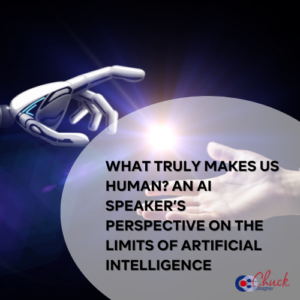
 As an AI speaker and author, I spend a great deal of time discussing how artificial intelligence is transforming industries, shaping economies, and redefining our daily interactions. Yet, amidst the rapid advancement of AI, one crucial question remains: What makes us fundamentally human, and can AI ever replicate that?
Soren Kaplan’s Psychology Today article, What Makes Us Human? How We Differ From Artificial Intelligence, presents six irreplaceable human attributes that AI cannot fully replicate. As someone who explores both AI’s capabilities and its ethical implications, I find these insights particularly relevant—not only for understanding AI’s limitations but also for ensuring that humanity remains at the center of technological progress.
1. Emotional Depth vs. AI’s Emotional Simulation
Kaplan rightly points out that AI can recognize and respond to emotions, but it does not feel in the human sense. AI analyzes patterns in language, tone, and facial expressions, yet true empathy and deep emotional intelligence require lived experiences, something AI will never possess.
From my work in AI ethics, I see this as a critical distinction. AI-powered chatbots may provide companionship, but they lack genuine care. This is why AI in areas like mental health support must be used responsibly—augmenting human efforts rather than replacing them.
2. Creativity: The Human Edge AI Cannot Fully Replicate
AI-generated art, music, and writing have captivated the world, but let’s be clear: AI does not create from inspiration, pain, joy, or personal struggle. It merely remixes existing content based on probabilities.
As an AI speaker, I emphasize that creativity is more than pattern recognition—it’s about original thought, intuition, and breaking convention. While AI can assist artists, musicians, and writers, it cannot replace the human spark that drives true innovation.
3. The Pursuit of Purpose and Meaning
Humans seek purpose. We question our existence, set long-term goals, and search for fulfillment. AI, on the other hand, is purely task-driven. It completes objectives but does not question why they matter.
This distinction is crucial as AI becomes more embedded in workplaces and decision-making. Leaders must remember that AI is a tool—it does not have values, ambition, or a moral compass. It is up to humans to ensure AI serves a greater purpose rather than allowing it to dictate decisions devoid of ethical reflection.
4. Adaptability and Learning Beyond Data
AI learns from massive datasets, but its learning is limited to what it has been trained on. It doesn’t learn from life experiences, mistakes, or personal struggles in the way that humans do.
I often speak about the critical role of human adaptability in an AI-driven world. Our ability to pivot, rethink, and innovate in completely unpredictable situations remains one of our most powerful assets. AI cannot think beyond its programming—it cannot truly improvise.
5. Moral and Ethical Judgment: A Human Responsibility
Kaplan’s article highlights an essential truth: AI has no innate morality. It can identify ethical guidelines, but it does not understand right and wrong.
As an AI ethics consultant, I often warn businesses that relying too heavily on AI for decision-making can lead to unintended ethical dilemmas. Human oversight is not optional—it’s necessary to ensure fairness, accountability, and justice in AI applications.
6. Authentic Relationships: The Human Connection AI Lacks
AI can mimic human interaction, but it will never form authentic relationships. It does not experience love, trust, or loyalty.
As AI continues to advance in customer service, companionship apps, and even therapy, we must ask: Are we using AI to enhance relationships or replace them? Technology should foster human connection, not serve as a substitute.
Final Thoughts: The Future of AI and Humanity
AI is an incredibly powerful tool that will continue to reshape industries, but it remains just that—a tool. Kaplan’s six attributes serve as a reminder that while AI can automate, predict, and optimize, it cannot replace the depth of human experience.
As an AI speaker and author, my message is clear: AI should complement human intelligence, not replace it. The key to a responsible AI future lies in recognizing and preserving what makes us uniquely human. Emotional intelligence, creativity, purpose, adaptability, ethical judgment, and genuine relationships must remain our guiding principles.
In this fast-evolving digital age, the challenge is not just building better AI—it’s ensuring that we remain deeply, authentically human.
