

 By Chuck Gallagher – Business Ethics Keynote Speaker | AI Speaker and Author
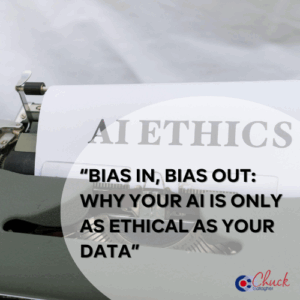
Opening Story: The Credit Score That Never Was
Picture this: A 22-year-old woman, freshly graduated, applies for a small business loan. She’s got a solid credit history, no debt, and a business plan that would make a Shark Tank judge raise an eyebrow. And yet—denied.
Why?
Because the AI model reviewing her application had learned—from historical data—that young women in her zip code were “higher risk.”
No law was broken.
No human made the call.
But injustice? That’s exactly what happened.
And here’s the kicker: The algorithm worked exactly as it was trained.
The Truth About AI Bias
We love to think AI is neutral. Clean. Data-driven. But here’s the uncomfortable truth every executive needs to face:
AI is not objective—it’s a mirror.
And it reflects our past with frightening clarity.
When we train systems on historical data, they learn patterns from decisions that were—intentionally or not—biased. The result? Discrimination at scale.
In the report “Trends in Artificial Intelligence,” one of the most glaring warnings is about unexplainable models trained on skewed or opaque data. Yet organizations still prioritize speed and performance over transparency and fairness.
That’s like building a Formula 1 car with no brakes—fast, but fatally reckless.
What Makes Data Biased?
Let’s break it down ethically and operationally:
- Historical Prejudice – If past hiring, lending, or sentencing decisions were biased, AI will replicate those patterns.
- Sample Imbalance – Underrepresentation of certain groups in training data leads to worse outcomes for those groups.
- Labeling Bias – Human annotators bring their own assumptions into how data is classified.
- Feedback Loops – Biased predictions influence future behavior, which feeds back into training data, amplifying the problem.
Even tools labeled “unbiased” can create downstream discrimination.
AI Speakers and Strategists Must Preach This: Fix the Foundation
As an AI speaker and author, I say this on stage all the time:
“If your data has dirty fingerprints, your decisions will leave scars.”
Ethical AI isn’t just a tech conversation—it’s a boardroom imperative. It starts at the point of collection, not at deployment.
Here’s how companies can improve:
- Perform Bias Audits – Regularly test models against fairness benchmarks.
- Diversify Your Training Data – Proactively include underrepresented groups.
- Red Team Your Systems – Have an ethics board play devil’s advocate before launch.
- Document Data Lineage – Know where your data came from, and how it was shaped.
- Prioritize Explainability – If you can’t explain the decision, you can’t defend it.
Business Ethics Isn’t About Slowing Down—It’s About Building Trust
Speed and scale without ethics create landmines. But when data quality and fairness are part of your DNA?
You earn customer trust. You protect your brand. And you build systems that truly serve.
As Always, Let’s Talk:
We need to stop asking “What can AI do?” and start asking “What should it do?”
Because when your data whispers injustice, your AI shouts it.
