
 By Chuck Gallagher — business ethics keynote speaker and AI speaker and author
A few months ago, I sat across from a leadership team that was excited—almost giddy—about what AI was doing for their organization.
They weren’t wrong.
They showed me how AI was helping them draft emails in seconds, summarize meetings instantly, generate marketing ideas on demand, and even speed up decision-making that used to take days.
And then one executive said something that sounded harmless at first:
“This is saving us so much time… we’re moving faster than ever.”
Everyone nodded.
Everyone smiled.
But inside, I felt something tighten—because I’ve seen this movie before, just with different technology.
Speed is always seductive.
Speed makes leaders feel competitive.
Speed makes teams feel productive.
Speed makes organizations feel like they’re winning.
But speed has a shadow side.
Because when speed becomes the highest value, accountability becomes optional—and that’s where ethical risk quietly moves in.
As a business ethics keynote speaker and AI ethics speaker, this is one of the biggest issues I’m discussing with leaders right now. Not because AI is “bad,” but because the way we use it can either strengthen trust… or slowly erode it.
So let’s ask the real question:
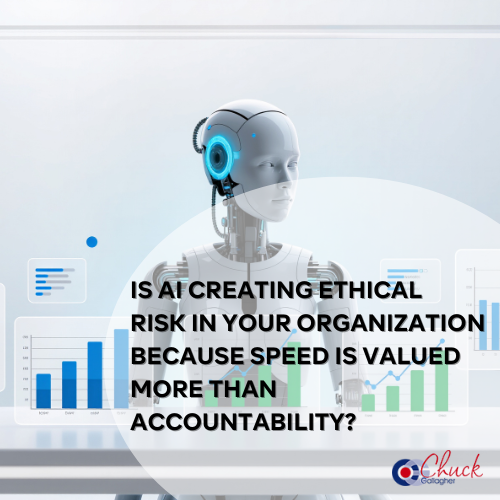
Is AI creating ethical risk in your organization because speed is valued more than accountability?
If you’re not sure, that’s exactly why you should keep reading.
The Real Ethical Problem Isn’t AI — It’s How Organizations Behave Under Pressure
AI didn’t invent ethical shortcuts.
But it makes them easier.
Before AI, a person had to work hard to cut corners:
- fabricate a report
- exaggerate a claim
- rush a decision
- skip due diligence
- avoid hard conversations
- “fill in the gaps” with assumptions
Now AI can generate something that looks complete in seconds.
And that’s where risk increases—not because AI is malicious, but because humans are tired, busy, and rewarded for speed.
AI becomes the tool that helps people do what pressure already pushed them toward.
And that’s the danger.
When the culture rewards speed above all else, AI becomes a shortcut machine.
What Ethical Risk Looks Like When AI Is Moving Too Fast
Ethical risk doesn’t always show up as scandal.
It often shows up as “efficiency.”
Here are the most common ways it appears inside organizations:
1) AI Outputs Get Treated Like Facts
This is one of the most dangerous behaviors I’m seeing.
Someone asks AI a question, gets a confident-sounding answer, and then repeats it like it’s true.
But AI tools can be wrong.
They can “hallucinate.”
They can misinterpret.
They can oversimplify.
They can create citations that don’t exist.
They can produce inaccurate summaries.
And when AI-generated content is treated as fact without verification, ethical risk increases fast—especially in regulated industries.
Accountability question:
Who is responsible when the AI output is wrong?
Because the answer cannot be “the tool.”
2) People Stop Owning Their Decisions
This is subtle, but it matters.
AI can create the illusion that:
- the decision is neutral
- the recommendation is objective
- the conclusion is “data-driven”
- the judgment is outsourced
But AI does not remove human responsibility.
If AI influenced a decision that harmed someone—an employee, a customer, a patient—your organization is still accountable.
Ethical leadership means leaders don’t outsource judgment.
They use tools wisely and remain responsible.
3) AI Is Used “Unofficially” Without Governance
In many organizations, AI adoption is happening in two parallel tracks:
Track A: Official AI initiatives
These are reviewed, approved, and managed.
Track B: Shadow AI
Employees use tools quietly:
- to draft proposals
- write client emails
- generate HR documents
- summarize legal language
- build spreadsheets
- analyze performance data
Not because they’re trying to break rules…
but because they’re trying to keep up.
And when AI use is unofficial, it’s rarely documented, reviewed, or governed.
That’s not just a technology risk.
That’s a leadership and ethics risk.
4) Confidential Information Gets Shared Without Realizing It
This is a major ethical exposure point.
Under pressure, employees will paste content into AI tools that may include:
- customer details
- internal financial information
- employee performance data
- proprietary processes
- confidential project details
Often they don’t even realize they’re crossing a line.
They’re just trying to get the work done faster.
But confidentiality is not optional.
Privacy is not optional.
And trust is not optional.
If your organization claims to protect sensitive information, your AI habits must match your promises.
5) AI Speeds Up Communication — But Weakens Truth
AI can write beautifully.
That’s part of the problem.
Because it can produce content that sounds polished even when it’s:
- incomplete
- inaccurate
- exaggerated
- misleading
- too certain
- missing nuance
This creates ethical risk in sales, marketing, HR, compliance, and leadership communication.
The ethical problem isn’t writing faster.
It’s communicating faster than you can verify.
When speed is rewarded, truth becomes negotiable.
Why Speed Becomes a Cultural Value (Even When Leaders Don’t Mean It To)
Most leaders don’t intentionally create a culture where speed matters more than accountability.
But culture forms through reinforcement.
If employees see that the people who advance are the ones who:
- respond fastest
- ship quickest
- close the deal
- hit the numbers
- produce the output
- “make it happen”
…then the organization quietly teaches a lesson:
“Speed wins. Accountability is optional.”
And AI supercharges that lesson.
Because AI helps people appear productive even when they’re skipping critical steps.
That’s why the ethical issue isn’t the tool.
It’s the environment.
The AI Ethics Question Leaders Must Ask in 2026
If you want one question to anchor this entire issue, it’s this:
Are we using AI to increase capability—or to excuse carelessness?
Because those are not the same thing.
AI used responsibly increases capability:
- better ideas
- faster drafts
- improved analysis
- more consistency
- reduced busywork
AI used irresponsibly excuses carelessness:
- unverified information
- poor decisions
- unclear accountability
- confidentiality breaches
- biased outcomes
- reputational risk
The Accountability Gap: “Who Owns This?”
In many organizations, AI creates what I call an accountability gap.
People say things like:
- “AI wrote it.”
- “The tool recommended it.”
- “It came from the system.”
- “It was just a draft.”
But in ethics, drafts still matter.
Because drafts become decisions.
And decisions become outcomes.
If your organization can’t answer “Who owns this?” then you have risk.
How to Reduce AI Ethical Risk Without Slowing Innovation
Here’s the good news:
You don’t have to fear AI.
But you do have to govern it.
Here are practical steps leaders can implement now:
1) Create an “AI Use Policy” People Can Actually Follow
Not a 40-page document no one reads.
A simple guide that answers:
- What tools are approved?
- What data can be entered?
- What data is prohibited?
- When is human review required?
- Who is accountable for outputs?
If your policy is unrealistic, people will ignore it.
2) Require “Human-in-the-Loop” Verification
AI can assist.
But humans must verify.
Set standards like:
- no AI-generated facts without source verification
- no AI-generated legal, HR, or compliance language without review
- no AI-generated customer communication without accountability
Speed is fine.
Unverified speed is dangerous.
3) Train People on AI Ethics the Same Way You Train Safety
AI ethics training shouldn’t be theoretical.
It should be scenario-based:
- “What do you do if AI generates a confident but questionable answer?”
- “What do you do if someone asks you to paste sensitive data into a tool?”
- “How do you disclose AI use ethically?”
- “What does responsible AI look like in your role?”
Because under pressure, people don’t rise to intention.
They fall to habit.
4) Reward Accountability, Not Just Output
If leaders want ethical behavior, they must reward ethical behavior.
That means praising:
- accuracy
- transparency
- careful decision-making
- documentation
- ethical courage
Not just speed.
If you only reward speed, you’ll get speed—at any cost.
5) Build a Culture Where People Can Say “Slow Down”
This is leadership maturity.
Your culture must allow someone to say:
“Before we send this… we need to verify it.”
“Before we publish this… we need to confirm it.”
“Before we decide… we need human review.”
If people fear being punished for slowing down, you are training them to cut corners.
The Bottom Line
AI can absolutely create ethical risk in your organization—especially if speed is valued more than accountability.
But it doesn’t have to.
The organizations that will win in 2026 aren’t the ones who adopt AI the fastest.
They’re the ones who adopt it the most responsibly.
Because trust is still the ultimate currency.
And ethical leadership still determines whether technology becomes an advantage… or a liability.
As always, I welcome your comments and I’m happy to respond. Feel free to share your thoughts below.
Related Articles:
The Ethics Cauldron: Brewing Responsible AI Without Getting Burned” — A Critical Review
Why Investing in AI Ethics Makes Not Just Moral Sense — but Business Sense
When Mission Meets Market: OpenAI’s For-Profit Pivot and the Ethics of AI-Era Governance
