
 By Chuck Gallagher, business ethics keynote speaker and AI speaker and author
It doesn’t start with a bang. The catastrophic failures that ruin reputations begin with a whisper-a single, seemingly harmless choice to look the other way, to fudge a number, to take a shortcut.
I know, I’ve been there and the outcome isn’t pretty! Almost 40 years ago I was at the top of this slippery slope. Thirty years ago, I was released from prison. Now as a business ethics speaker and author I can speak with authority about how easy it is to go from one small step into an orange jumpsuit.
This is the top of the slippery slope, the point where good people begin a descent they never saw coming. Suddenly, a culture of small compromises has created a crisis, and the check-the-box compliance training you endured offers no real answers. Every choice has a consequence. The question is, are you prepared for them?
This is where the real work of workplace ethics begins-not in theory, but in the trenches of daily decisions. Forget sterile rulebooks. This article provides a practical framework to navigate that dangerous gray area before a choice becomes an irreversible consequence. You will discover how to spot the early signs of ethical decay, lower your fraud risk, and build the kind of profound employee trust that forges the foundation of lasting success.
Key Takeaways
- Move beyond the compliance manual by understanding the crucial difference between merely following rules and building true ethical integrity.
- Recognize the three psychological triggers that create the “slippery slope,” turning small compromises into significant, irreversible consequences.
- Uncover the hidden costs of ethical failure that go beyond fines, including the destruction of employee morale and your competitive advantage.
- Implement a practical framework for strong workplace ethics by establishing “safe-to-speak” channels where concerns can be raised without fear.
What are Workplace Ethics in 2026? Beyond the Compliance Manual
Let’s be clear: workplace ethics are not about a dusty binder on a shelf. Today, it’s the living, breathing intersection where our personal values meet our professional responsibilities. It’s the invisible architecture that determines whether a company thrives for a generation or crumbles under the first sign of pressure. We’ve moved past the era where ethics were a private matter. In a world of radical transparency, what happens in the dark is now broadcast in high definition. The question is no longer if your culture will be exposed, but when.
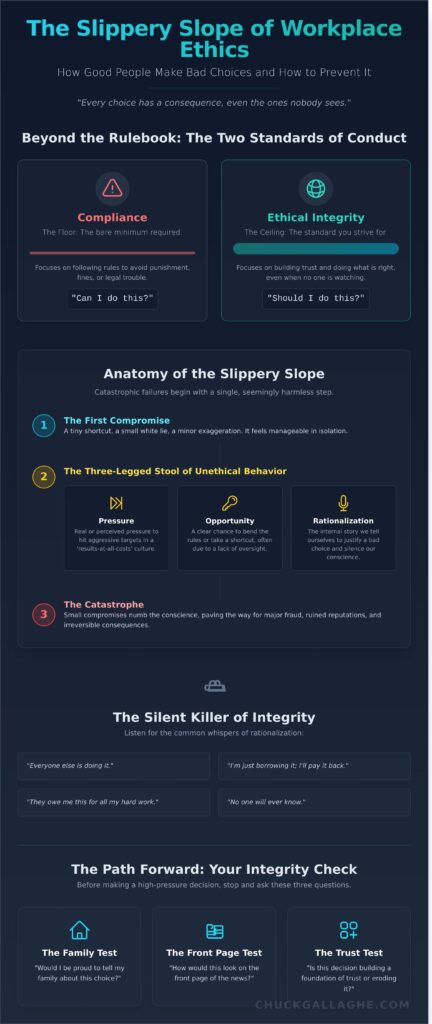
For too long, leaders have confused legal compliance with ethical integrity. They are not the same. Let me repeat, THEY ARE NOT THE SAME! Compliance is the floor-the bare minimum required to avoid fines or jail time. Ethics is the ceiling-the standard you strive for when no one is watching. While a basic Business ethics overview can explain the principles of corporate governance, true integrity is forged in the moments where the rules are silent. It’s the difference between asking, “Can I do this?” and “Should I do this?” Every choice has a consequence, and confusing the two is the first step on a very slippery slope.
The Human Side of Ethics: Why Rules Aren’t Enough
That 50-page code of conduct you spent thousands on? It’s useless if it doesn’t connect with the human heart. Rules without relationship lead to resentment. In a workplace increasingly driven by algorithms and AI, the most crucial ethical tools are empathy and vulnerability. It’s about a leader having the courage to say, “I’m not sure, let’s figure out the right thing to do together,” instead of hiding behind policy.
The Core Pillars: Accountability, Transparency, and Trust
These three principles form the ‘Ethics Triangle,’ the structural foundation for any resilient team. They are inseparable. Without transparency, you can’t have accountability. Without accountability, you can never build trust. Consider this: a manager who meets a legal deadline by pushing their team to the brink of burnout is compliant. But a manager who admits the deadline is too aggressive and renegotiates it is ethical. One checks a box; the other builds a culture. Integrity is what happens in the gap between what you can get away with and what is right.
The Anatomy of the Slippery Slope: How Good People Make Bad Choices
No one wakes up in the morning and decides, “Today, I’m going to become a criminal.” Catastrophic ethical failures don’t begin with a leap off a cliff; they start with a single, seemingly harmless step onto a slippery slope. My own journey from CPA to federal inmate taught me this with brutal clarity. Unethical behavior stands on a three-legged stool: immense pressure (real or perceived), a clear opportunity, and the quiet, corrosive power of rationalization.
The slippery slope isn’t a dramatic drop. It’s a slow, almost imperceptible erosion of your values. It begins with a tiny shortcut to meet a deadline. A small, white lie to a client. A minor expense report exaggeration. Each choice, made in isolation, feels manageable. But these small compromises build a foundation for poor workplace ethics, paving the way for major corporate fraud. They numb your conscience, making the next, bigger unethical choice that much easier to make.
I’ve said it a thousand times, and I will say it again: Every choice has a consequence, even the ones nobody sees.
Rationalization: The Silent Killer of Integrity
Rationalization is the internal story we tell ourselves to make a bad choice feel right. It’s the voice that whispers justifications when our integrity is on the line. Listen closely, and you’ll hear these common refrains:
- “Everyone else is doing it.”
- “I’m just borrowing it; I’ll pay it back.”
- “They owe me this for all my hard work.”
- “No one will ever know.”
High-performers are especially vulnerable, rationalizing shortcuts as necessary evils to hit aggressive targets. Before making a high-pressure decision, stop and check your strong suit. Ask yourself:
- Would I be proud to tell my family about this choice?
- How would this look on the front page of the news?
- Is this decision building a foundation of trust or eroding it?
The High Cost of Compromise: Calculating the Real Consequences
Let’s be clear: the conversation about ethical compromise can’t stop at legal fees and fines. That’s the price of admission. The real cost is paid in a currency you can’t print more of-trust. Every choice has a consequence, and the decision to look the other way or take a shortcut starts you down a slippery slope from which few return unscathed. When strong workplace ethics are abandoned, the fallout goes far beyond the balance sheet.
Ethical companies possess what I call ‘The Distinction Advantage’-a powerful, magnetic force that attracts top talent and loyal customers. When you compromise, you don’t just break a rule; you shatter that distinction. Your best people feel it first. The culture begins to sour, and the proactive ‘Stay Interviews’ you should be having to retain talent become impossible conversations. Why? Because the reason they want to leave is the very integrity you’ve already sacrificed.
Reputational Risk in the Age of Radical Transparency
In today’s world, there are no private mistakes. A single ethical lapse can become a global headline overnight, creating a multiplier effect that decimates customer loyalty. Forget market share or intellectual property; Reputational Capital is the most valuable asset a business will hold in this decade. Once it’s spent, it’s nearly impossible to earn back.
The Financial Reality of Fraud and Misconduct
The numbers don’t lie. The Association of Certified Fraud Examiners’ 2022 report found the median loss per occupational fraud case was $117,000. But the true financial drain lies in the hidden costs:
- Astronomical legal defense fees
- Exhaustive internal investigations
- Productivity lost to distraction and distrust
These are the expenses that never make it to the initial damage report.
*For a deeper look at mitigating these threats, explore our guide on
[Fraud Risk Management](/fraud-risk-management)*
But the steepest price isn’t paid by the company. It’s paid in the mirror. It’s the career you spent a lifetime building, now in ashes. It’s the trust of your family, now fractured. People talk about second chances, but they rarely understand the brutal reality of rebuilding a reputation from zero. A failure in professional ethics is not a business problem; it’s a life problem. Are you prepared to pay that price?
Building an Ethical Framework: Practical Strategies for 2026
A dusty employee handbook on a shelf does not create an ethical culture. It’s a start, but it’s not the structure. Building a resilient ethical framework is an active, daily process of construction. It’s about embedding integrity into the very DNA of your operations, ensuring that your company’s moral compass guides every choice, especially when no one is watching. Every choice, after all, has a consequence.
So, where do you begin? How do you transform abstract values into concrete actions? The foundation of modern workplace ethics rests on four key pillars:
- Step 1: Establish Lived Values. Your core values must be more than words on a wall. They must be visible in how you hire, how you fire, and how you reward your team. Are they discussed in project kick-offs? Are they the final check before a major decision? If not, they’re just decoration.
- Step 2: Foster ‘Safe-to-Speak’ Channels. The slippery slope of misconduct often begins in silence. Employees must have confidential, accessible channels to report concerns without the paralyzing fear of retaliation. This isn’t about creating a culture of tattling; it’s about building a culture of accountability.
- Step 3: Integrate Ethics into Daily Rhythms. Weave ethical questions into one-on-one meetings and performance reviews. Ask, “What ethical challenges did you face this quarter?” or “How did our values guide your approach to that difficult client?” Make integrity a measurable part of success.
- Step 4: Provide Continuous, Narrative-Driven Training. The annual, check-the-box ethics video is dead. Effective training is ongoing, relevant, and human.
Designing Effective Ethics Training Programs
People don’t connect with legal jargon; they connect with stories. The most powerful workplace ethics training uses real-world scenarios and narrative to explore the gray areas where difficult choices are made. By focusing on The Human Side of Ethics, you move beyond compliance and into character development. True transformation happens when employees see themselves in the story. For a deeper dive, explore this Guide to Effective Corporate Ethics Training Programs.
The Path Forward: Becoming a Leader of Distinction
The journey of building an ethical organization moves beyond mere compliance-it’s about forging a culture of integrity. It’s the difference between avoiding penalties and building a legacy. True leadership isn’t found in a rulebook; it’s demonstrated in the daily choices made when no one is watching. Where are the cracks in your foundation? What small compromises today could become the catastrophic failures of tomorrow? This isn’t just theory; it’s the reality of the slippery slope.
Embracing strong workplace ethics is not a burden. It is your single greatest competitive advantage. It builds unbreakable trust with clients, attracts and retains top-tier talent, and fortifies your brand against the kind of crisis that can shatter a company overnight.
Leveraging Expert Guidance for Cultural Transformation
Sometimes, changing a culture requires a voice that can cut through the noise of corporate apathy. An ethics keynote speaker-especially a reformed expert who has lived the consequences of unethical choices-provides a perspective a training manual never will. They expose the hidden fraud risks you don’t see. My framework, detailed at chuckgallagher.com, is built on a simple, powerful truth: Every Choice Has a Consequence.
Taking the First Step Toward Integrity
The time for passive hope is over. The time for action is now. For CEOs and HR directors ready to build an unshakable ethical culture, the first step is a courageous audit:
- Survey Anonymously: Ask your team where they feel pressure to bend the rules.
- Review Incentives: Do your compensation plans accidentally reward unethical shortcuts?
- Assess Leadership: Does your executive team model the behavior you expect from everyone else?
For a deeper dive, explore enterprise-level training solutions at Ethics.pro. But transformation begins with a single, decisive step. The choice is yours. The accountability is, too.
Book Chuck Gallagher for Your Next Ethics Keynote
The Choice is Yours: Building an Ethical Future
The path forward is paved not by rules in a manual, but by the daily decisions we make. Every choice has a consequence. We’ve explored how easily good people can slide down that slippery slope and the devastating, hidden costs of even a single compromise. The foundation of strong workplace ethics isn’t a policy you can mandate; it’s a personal framework built with the bricks of accountability and transparency.
But building that framework is not a journey you have to take alone. How do you transform theory into a living, breathing culture of integrity? With over 20 years of global consulting experience, Chuck Gallagher-author of ‘Every Choice Has a Consequence’ and CEO of Virtual Training Associates-doesn’t just teach ethics; he has lived the severe consequences of their absence. He provides the hard-won wisdom and practical tools to build a culture that withstands pressure.
Hire Chuck Gallagher to transform your corporate ethics culture.
The future of your organization is not yet written. The choices you make today will define its story.
Frequently Asked Questions About Workplace Ethics
What is the difference between workplace ethics and a code of conduct?
Think of it this way. Your code of conduct is the map. It tells you the specific roads you can and cannot take-the explicit rules. Workplace ethics, however, is your compass. It’s the internal guidance system, the character, that helps you navigate when the map is unclear or when you’re tempted by a shortcut. One is a document of rules; the other is the moral courage required to follow them, especially when no one is watching.
How can I report unethical behavior without risking my job?
Speaking up takes courage; the fear of reprisal is real. First, document everything with cold, hard facts-dates, times, and specific actions. Then, use your company’s designated channels, like an anonymous ethics hotline or a trusted HR representative. If those paths feel unsafe, consider seeking external legal counsel. Remember, protecting a company’s integrity often starts with one person’s brave choice. The risk of silence is often far greater than the risk of speaking up.
Can workplace ethics really be taught to adults?
Absolutely. But it’s not about memorizing rules. True ethical transformation comes from understanding the profound consequences behind every choice. Through powerful storytelling and guided self-reflection, we can reframe an adult’s perspective on their own accountability. It isn’t about teaching new values, but about awakening the integrity that already exists and showing them the devastating personal and professional cost of ignoring it. It’s about connecting action to consequence.
What is the most common unethical behavior in the workplace today?
It’s rarely the headline-grabbing fraud. The most common poison is far more subtle: misusing company time, fudging an expense report, or taking credit for a colleague’s idea. These seem small, but they are the first steps on a very slippery slope. Each tiny compromise erodes the foundation of trust and personal integrity, paving the way for larger ethical failures down the road. Every choice, no matter how small, has a consequence.
How do I know if I’m on a ‘slippery slope’ with my own choices?
Ask yourself this: Are you making small exceptions you wouldn’t have made a year ago? Are you justifying actions with phrases like “everyone does it” or “it’s just this once”? That is the whisper of the slippery slope. Here’s another test: Would you be comfortable with your choice being on the front page of a newspaper? If that thought gives you a knot of anxiety, it’s time to stop, reassess, and step back onto solid ground.
What should a company do after an ethical scandal to rebuild trust?
Rebuilding trust is a construction project that starts with demolition. It demands radical transparency and brutal honesty-no excuses, no spin. Leadership must take full, public accountability for the failure. Then, they must implement new, ironclad systems and controls to ensure it never happens again. This isn’t about a press release; it’s about consistent, visible action over time. Trust isn’t reclaimed with words; it’s painstakingly rebuilt with proven, ethical choices.
How does ethical leadership impact the bottom line?
Ethical leadership is not an expense; it is a direct investment in profitability. It builds a culture of trust that boosts employee morale, engagement, and retention-slashing turnover costs. It enhances brand reputation, attracting both top talent and loyal customers. Unethical choices, on the other hand, lead to catastrophic fines, legal fees, and brand damage that can cripple a company’s finances for years. The math is simple: integrity always pays dividends.
Is it possible for a company to have ‘too many’ ethical rules?
It’s a paradox, isn’t it? A company can create a rulebook so dense that it stifles common sense and personal judgment. When compliance becomes a box-ticking exercise, people stop thinking ethically and start thinking defensively. The goal isn’t a mountain of rules. It’s a clear framework built on core principles, empowering employees to make the right choice, not just forcing them to memorize a policy. True workplace ethics is about character, not just compliance.
Related Articles:
Why Every Choice Defines Your Professional Integrity
