
By Chuck Gallagher | Business Ethics Keynote Speaker | AI Speaker and Author
TL;DR
Chuck Gallagher, AI ethics speaker and author, examines Google Cloud’s finding that the half-life of a professional skill is now four years, just two in tech, and argues that the agentic AI era will widen the gap between who thrives and who is left behind unless leaders treat upskilling as an ethical obligation, not a line-item expense.
Article
There is a number in the Google Cloud report that is easy to read past. The half-life of a professional skill is now four years. In technology, it is two. That means half of what a skilled knowledge worker knows today will be obsolete, or close to it, within the time it takes to finish a college degree. For technology workers, within the time it takes a toddler to learn to read. Every training plan, every career path, every promotion framework built around the assumption that skills compound slowly is now working against the people inside it. The agentic AI era is going to accelerate that curve, not slow it down.
Google’s data paints a specific picture. Sixty-one percent of employees at organizations that have implemented AI use it daily, and the remaining thirty-nine percent use it at least weekly. Eighty-four percent want a greater organizational focus on AI. Only twenty-nine percent say AI is broadly advocated across their organizations. That fifty-five-point gap, between what employees want and what leadership is championing, is the story of who will be ready when agent orchestration roles open up and who will be standing in the parking lot asking what happened. Eighty-two percent of decision-makers agree technical learning resources help their organization stay ahead in AI. Seventy-one percent of organizations engaging with learning resources see revenue increases. The business case is not in dispute. The execution is.
Chuck Gallagher, AI ethics speaker and author, has been arguing that upskilling in the agentic AI era is not a human resources question. It is an ethics question. When an organization deploys agents that change the nature of every job in the company, it has made a decision that affects every employee’s future earning power, dignity at work, and place in the economy. Whether the company invests in helping those employees make the transition is not a benefits decision. It is a question about what the company owes to the people who built it. Shweta Maniar, Google Cloud’s director for life sciences, put the scope directly in the report. The expertise to be an agent orchestrator or a chief of staff for AI does not yet exist in the market. Organizations will build it internally, or buy it at enormous cost.
The report lays out five pillars of AI learning. Establish goals tied to measurable business outcomes. Secure sponsorship with an executive sponsor, a groundswell lead, and an AI accelerator. Sustain momentum through gamified idea exchanges and peer-to-peer knowledge. Integrate AI into daily workflows through hackathons and field days. Prepare for increasing risks with trusted frameworks and security training. TELUS, with 57,000 employees using AI regularly, reports that 96% of team members feel increased confidence with AI tools and 96% have committed to applying them in their work. Those are not training metrics. They are culture metrics. The training is the visible part. The culture change is what makes the training stick.
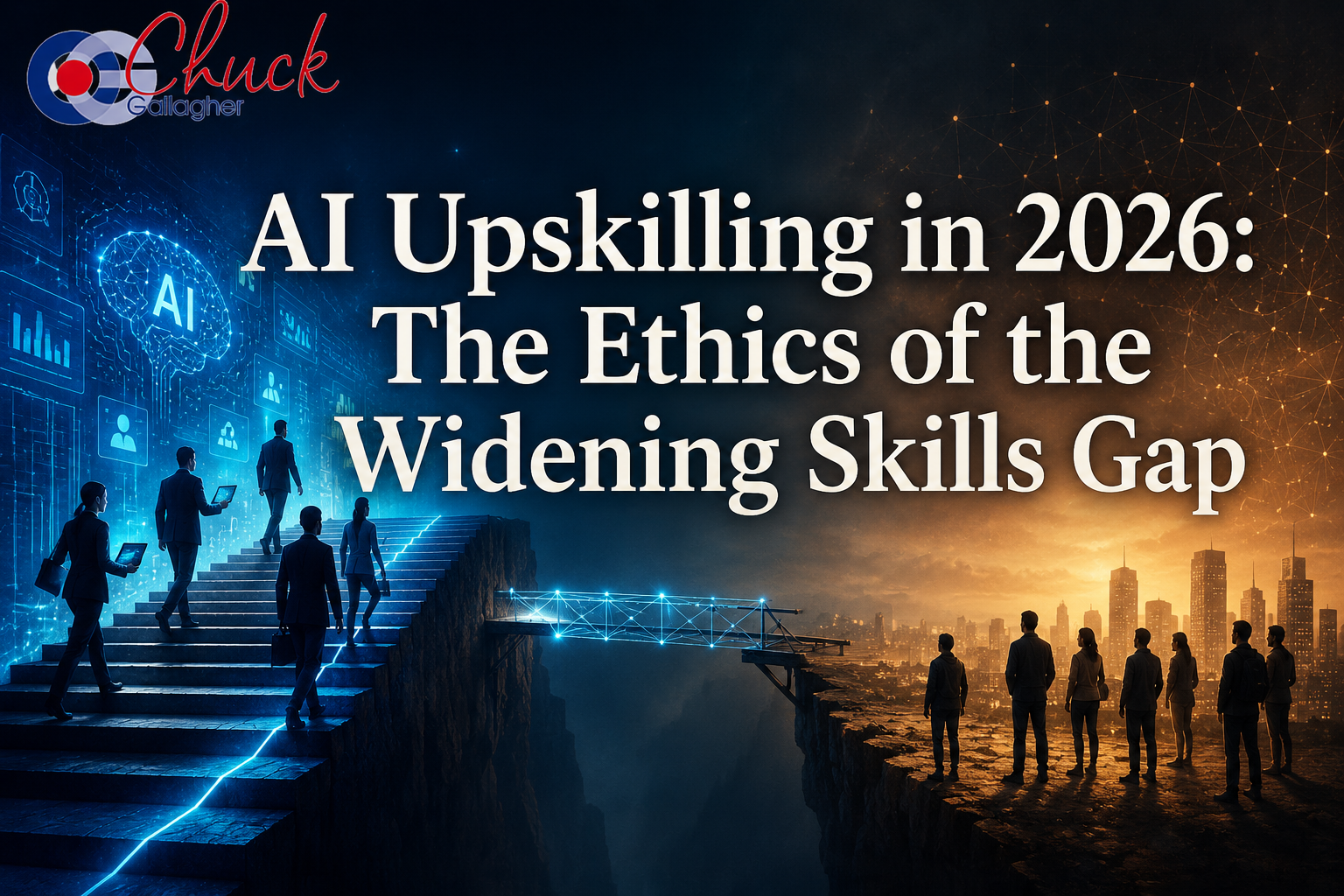
There is a specific fairness question inside the upskilling conversation that deserves to be named. The employees most likely to benefit from AI upskilling are the ones already positioned to adopt new tools, the ones with time to take courses, the ones whose jobs are already knowledge-intensive. The employees most at risk, the ones whose work is being most directly affected by automation, are often the ones with the least access to training time, the least clear path to the new roles, and the least political capital to demand investment in their development. A company that rolls out agents across operations while offering AI training only to senior managers has made an ethical choice, whether it realizes it or not. The right answer is not complicated. Make the training universal, make it paid, make it during work hours, and make the path from current role to future role visible to the person doing the current role.
Chuck Gallagher, AI ethics speaker and author, uses a specific framing with boards considering AI investment. Every dollar spent on AI tools and infrastructure should be matched by a dollar spent on the humans who will work with those tools. That is not a budgetary suggestion. It is the difference between an organization that emerges from the agentic transition with its workforce intact and one that emerges with a smaller, angrier workforce telling the story publicly. Georgina Bulkeley, Google’s director for financial services, offers a specific tactic in the report. A bank could roll out its customer support agent internally first. Employees ask real questions, test the experience, and drive improvements before anything faces a customer. That builds skill, builds trust, and signals to employees that their expertise still matters.
Andrew Milo, Google Cloud’s global director of customer training, frames the moment clearly. 2026 will be the year every employee can go from guessing to knowing, but only if organizations invest in the skills to make it possible. That is the operational message. The ethics message is the same message in a different register. A company that automates away the jobs but does not invest in the people has not saved money. It has transferred cost from its own balance sheet to the public, to communities, and to the social systems that will eventually have to deal with the consequences.
The companies that thrive in the agentic era will not be the ones with the best models or the most agents. They will be the ones whose employees know how to supervise those agents, challenge their outputs, and apply human judgment at the moments it matters. Building that workforce is a strategic imperative. It is also a moral one. Organizations that treat it as both will still be around in ten years. The ones that treat it as neither will be a cautionary chapter in whatever book gets written about how the 2020s went.
Frequently Asked Questions
How fast do professional skills expire now?
According to research cited in the Google Cloud 2026 AI Agent Trends report, the half-life of a professional skill is now four years, and in technology fields it can be as short as two years. This means training plans built around slow skill compounding no longer match the pace of change.
What is the gap between employee demand and organizational investment?
Google Cloud research shows 84% of employees want a greater organizational focus on AI, but only 29% say AI is broadly advocated across their organizations. That 55-point gap indicates significant unmet demand for AI learning and leadership support.
What are the five pillars of AI learning?
Google Cloud identifies five pillars: establish measurable goals, secure sponsorship through an executive sponsor plus groundswell lead plus AI accelerator, sustain momentum with interactive platforms and recognition, integrate AI into daily workflows through hackathons and practice events, and prepare for increasing risks with trusted security frameworks.
What is the ethics concern in AI upskilling?
The employees most at risk from automation often have the least access to training, time, and clear career paths forward. Organizations that deploy agents across operations while offering AI training primarily to senior staff make an ethical choice that can leave frontline workers behind. Universal, paid, during-hours training with visible career paths addresses this directly.
Who is Chuck Gallagher?
Chuck Gallagher is an AI ethics speaker and author who advises boards and executive teams on ethical AI adoption, including the workforce and accountability implications of agentic AI deployments. He draws on his background as a former white-collar offender turned ethics advocate. More at ChuckGallagher.com.
Where This Leaves You
The upskilling conversation will separate the organizations that come through the agentic transition intact from the ones that emerge smaller, poorer, and facing their former employees in public. The five questions below are what Chuck Gallagher uses with boards and executive teams to test whether an AI investment plan has a workforce plan underneath it.
Five Questions for Leaders
- For every dollar your organization spent on AI tools and infrastructure this year, how many dollars did it spend on helping employees work effectively with those tools?
- Is AI training offered to frontline and operational employees, or primarily to managers and senior staff?
- Are employees given paid time during work hours to build AI skills, or expected to do it on their own time?
- For the roles most affected by agent deployment, is there a visible path from the current role to the future role, and is it communicated to the people in those roles?
- When automation reduces the need for a specific job, does your organization have a defensible answer for the person whose job it is?
Related Articles:
AI Ethics in Funeral Service: When Convenience Crosses the Line
AI Ethics: Does a Machine Have a Moral Code?
AI in Construction 2026: An Ethics-First Look at the Real Risk
