
By Chuck Gallagher — Business Ethics Keynote Speaker and Trainer
TL;DR: Artificial intelligence is no longer learning solely from books, websites, and photographs. Today, AI is increasingly trained using detailed, three-dimensional scans of the physical world collected by ordinary people through augmented reality (AR) applications. Chuck Gallagher, business ethics keynote speaker and AI speaker, explores the ethical, business, and national security implications of this rapidly emerging reality.
A recent article in the Global Times caught my attention. Not because of who published it. Because of the larger question it raises. China’s Ministry of State Security warned that certain augmented reality games may be collecting far more information than users realize. Players scanning their surroundings as part of a game could actually be helping build extraordinarily detailed three-dimensional maps of the real world. The ministry cited reports claiming that one major AR company has accumulated nearly 30 billion environmental scans. Some of those scans may be used to train artificial intelligence capable of understanding physical spaces. Thirty billion. Let that number sit for a second.
Whether China’s warning is motivated by legitimate security concerns, geopolitical strategy, or some combination of both isn’t really the point. Strip away the politics, and an important question remains. What are we unknowingly teaching artificial intelligence every time we point our phones at the world around us?
Most people think of artificial intelligence as something that reads documents, answers questions, or creates images. That’s true. But the next generation of AI has to do something much harder. It has to understand the physical world the way you and I do. Robots need to recognize stairs before they climb them. Autonomous vehicles have to interpret road conditions in real time. Drones have to navigate buildings, bridges, and terrain. For any of that to happen, AI needs an incredibly detailed understanding of our environment.
And that’s where augmented reality enters the picture.
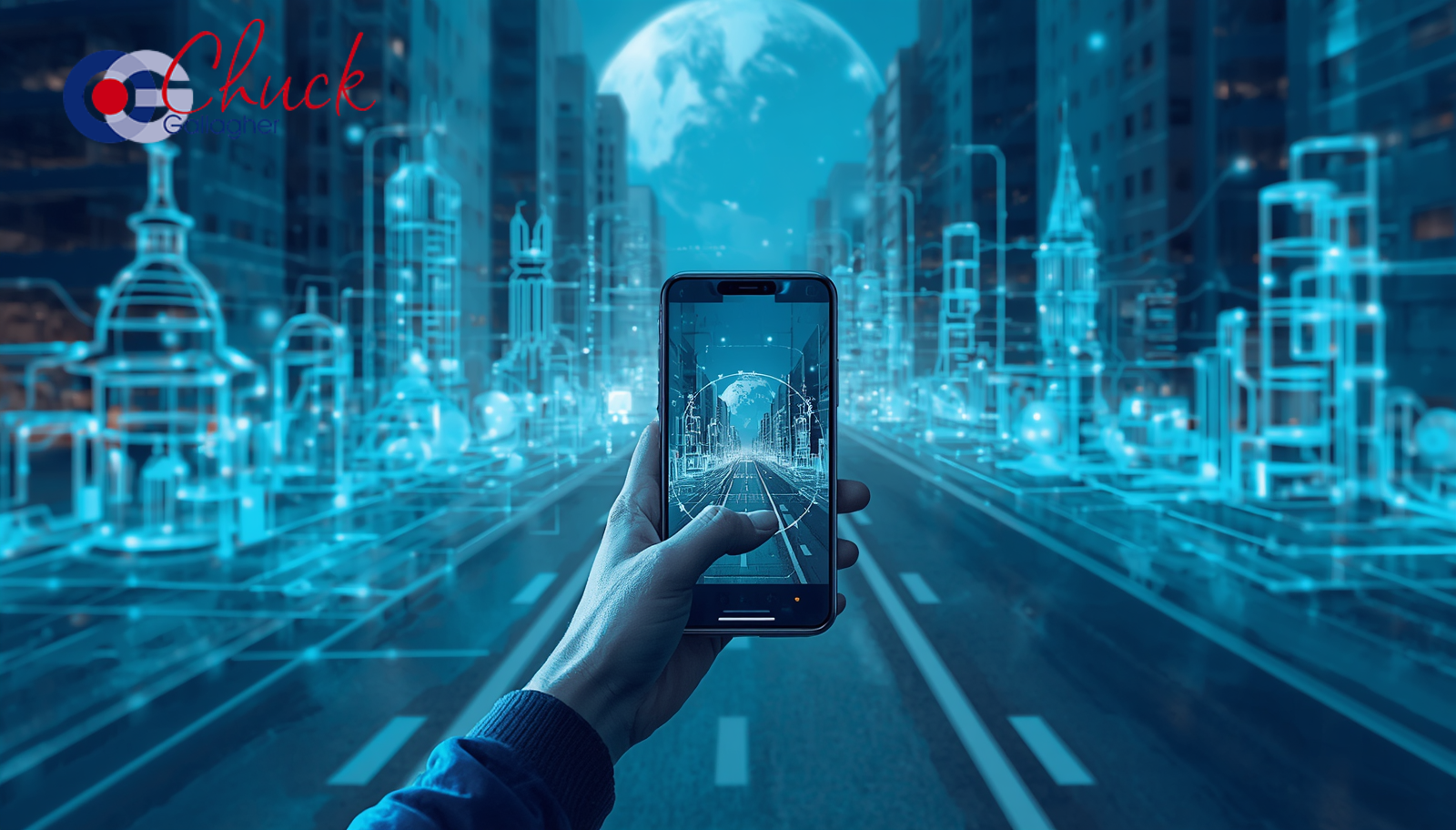
Unlike a simple photograph, an AR application doesn’t just capture what your camera sees. Every scan may include precise GPS coordinates, altitude, compass direction, device orientation, timestamps, depth measurements, and the spatial relationships between objects. It isn’t a flat image. It’s a rich, three-dimensional representation of the world. Collect enough of these scans from millions of users, and you begin building what many researchers now call a Large Geospatial Model. In plain terms, an AI’s understanding of physical reality.
Companies developing augmented reality have been remarkably open about this objective. Niantic, the company behind Pokémon GO and Ingress, has publicly discussed building what it calls a “Large Geospatial Model,” enabling AI to understand and navigate real-world environments. It’s an extraordinary achievement. And it has tremendous potential for robotics, autonomous systems, navigation, education, manufacturing, and healthcare. The technology itself isn’t good or bad. Like every powerful innovation, its impact depends on how it’s used.
What concerns me isn’t the technology. It’s whether people really understand what they’re contributing.
By now, most of us click “Accept” without reading dozens of pages of terms and conditions. We grant camera access, location services, microphone permissions, and background data collection because we want the app to work. Very few of us stop to think about what’s really happening. We’re not just using the application. We’re helping improve it. In some cases, we’re handing over valuable data that trains future AI systems, or supports products and services that don’t even exist yet.
That raises an ethical question every organization should be asking. Can consent really be called informed if the average person has no practical understanding of how their data will be used?
This isn’t the first time convenience has quietly reshaped our expectations of privacy. Google Street View transformed navigation and, at the same time, created one of the world’s largest visual databases. The fitness app Strava unintentionally revealed the locations of military installations around the globe when aggregated exercise data exposed patrol routes and base activity. Facial recognition systems improved because millions of publicly available images became training data. Smart speakers got more accurate because they kept learning from human conversations. Every one of these innovations delivered real benefits. And every one of them raised new ethical questions almost nobody saw coming.
Now we’re entering the next phase.
Artificial intelligence isn’t just learning language anymore. It’s learning geography. It’s learning architecture. It’s learning how cities are built, how warehouses are organized, how airports run, and how people move through physical space. The data we hand over today may one day power delivery robots, autonomous vehicles, emergency response systems, industrial automation, and technologies nobody has dreamed up yet.
This is why governments around the world—not just China—have grown so interested in geospatial data. High-resolution maps have obvious commercial value. They also have strategic importance. Accurate three-dimensional models can improve disaster response, infrastructure planning, military logistics, autonomous navigation, and countless other things. It’s one reason many countries restrict the mapping of sensitive facilities and military installations. The concern itself isn’t new. Here’s what’s new. Ordinary citizens may now be building these datasets simply by playing a game or using an everyday app.
For business leaders, this story reaches far beyond augmented reality. It points to a broader challenge facing every organization that collects customer data. Technology almost always moves faster than public understanding. And the legal right to collect information doesn’t answer the ethical question. The question is whether customers genuinely understand what they’re providing, or how that information may create value years down the road.
Trust has become one of the most valuable assets any organization can hold. Companies rarely lose trust because they collect data. They lose it when customers later discover their data was being used in ways they never imagined. Transparency isn’t merely a compliance issue. It’s becoming a competitive advantage.
As I speak with executives around the world about artificial intelligence, I remind them of something simple. AI is not fundamentally a technology issue. It’s a leadership issue. The algorithms will keep improving. Computing power will keep increasing. Data collection will keep expanding. The real differentiator will be whether leaders build organizations worthy of the trust these tools require. Let me be clear. The tools aren’t the test. The leadership is.
You’ve heard the phrase “data is the new oil.” It’s been popular for a decade now. After reading this report, I wonder if that analogy is already outdated. Maybe the next great resource isn’t data alone. Maybe it’s reality itself. Every image we capture, every environment we scan, every location we visit may add another piece to an artificial intelligence that’s learning to understand—and eventually navigate—the world we live in.
The real question isn’t whether AI will keep mapping our world. It almost certainly will. The question is whether we’ll understand the value of what we’re giving away before the map is finished.
I’d love to hear your perspective. Do you believe consumers truly understand how their data is being used to train artificial intelligence? Where should companies draw the ethical line between innovation and transparency?
Questions You May Be Asking
- Are augmented reality games really collecting 3D mapping data?
- What is a Large Geospatial Model, and why does AI need one?
- Could consumer data collected through AR applications have military or national security value?
- How should organizations disclose AI training practices to users?
- What ethical responsibilities do companies have when collecting spatial data?
Frequently Asked Questions
Can augmented reality applications collect more than photographs?
Yes. Many AR applications capture spatial information such as depth, GPS location, orientation, timestamps, and object positioning to create detailed three-dimensional representations of physical spaces.
Why would AI companies want billions of environmental scans?
These scans help train AI systems to understand, navigate, and interact with real-world environments, supporting applications ranging from robotics and autonomous vehicles to digital twins and navigation.
Is this only a concern raised by China?
No. Governments worldwide recognize the strategic importance of geospatial information. Concerns about mapping sensitive locations, infrastructure, and military facilities have existed for decades and have grown alongside advances in AI.
What is the biggest ethical issue?
The central ethical question is informed consent. Most users understand they are granting permissions to an app, but few understand the long-term value or potential future uses of the data they are contributing.
What should business leaders learn from this?
Organizations should move beyond asking whether they can collect data and begin asking whether customers genuinely understand what they’re contributing. Long-term
Related Articles:
AI Ethics in Funeral Service: When Convenience Crosses the Line
