
By Chuck Gallagher — Business Ethics Keynote Speaker and Trainer
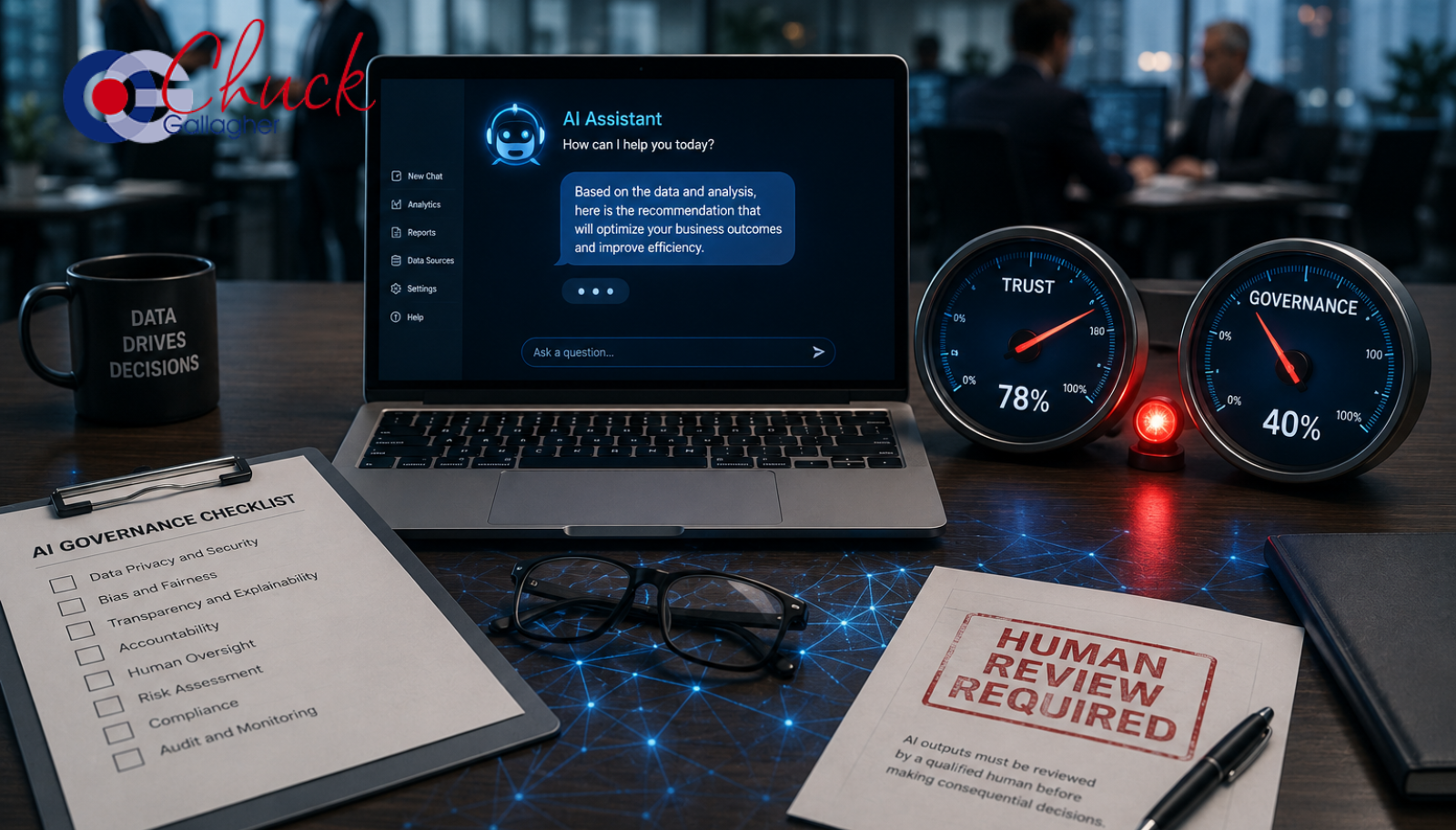
TL;DR A new global study from SAS and IDC called the Data and AI Impact Report: The Trust Imperative found that 78% of organizations claim to fully trust AI, yet only 40% have actually invested in the governance, explainability, and ethical safeguards that make AI trustworthy. Chuck Gallagher, business ethics keynote speaker and AI speaker and author, argues that for small and medium-sized businesses, this gap is not an abstraction — it is an invitation to a category of risk that most SMBs have not budgeted for, planned around, or even recognized.
There is a number in the SAS and IDC Data and AI Impact Report that should stop every business owner in their tracks. Seventy-eight percent of organizations worldwide say they have complete trust in AI. But only 40% have taken the concrete steps — governance frameworks, explainability tools, ethical safeguards — that actually make AI systems worthy of that trust. The gap between those two numbers is not a rounding error. It is a liability.
I have spent decades working with organizations on the relationship between human behavior and institutional failure. The framework I return to again and again involves three forces: need, opportunity, and rationalization. Every major ethical collapse I have studied — and I have studied a great many — follows the same pattern. Someone had a pressing need, found an opportunity to address it quickly, and rationalized away the risks. AI adoption in small and medium-sized businesses is following that same arc right now, and the SAS/IDC research confirms it.
As a Business Ethics Keynote Speaker, This Pattern Is Familiar
As a business ethics keynote speaker, I have argued at ChuckGallagher.com that the most dangerous organizational moment is not when a system fails — it is when a system is trusted before it has earned that trust. The SAS and IDC report, which surveyed 2,375 respondents across North America, Latin America, Europe, the Middle East, Africa, and Asia Pacific, found that 46% of organizations worldwide are experiencing what the researchers call the “trust dilemma” — a misalignment between perceived confidence in AI and the actual reliability of those systems. Nearly half of all AI potential, according to the report, is left untapped because of this gap.
For large enterprises, the trust dilemma is expensive but survivable. They have legal teams, compliance officers, and the financial cushion to absorb the cost of a misstep. Small and medium-sized businesses do not have those buffers. When an AI system makes a consequential error — an inaccurate customer assessment, a flawed financial projection, a discriminatory hiring output — the SMB absorbs the full reputational and legal exposure.
Here is what makes this particularly urgent for SMBs. The report found that organizations which have invested in governance, explainability, and ethical safeguards see significantly higher ROI from their AI initiatives. The trust dilemma is not just an ethical problem. It is a business performance problem. Organizations that get the most from AI are not the ones who adopted it fastest. They are the ones who adopted it most carefully.
Why Do So Many Organizations Trust AI Before It Has Earned It?
The SAS and IDC research reveals a striking psychological finding: organizations trust generative AI — the kind that feels conversational and human — at three times the rate they trust traditional machine learning, even though machine learning is mathematically more transparent and explainable. The researchers describe this as a “humanlike bias.” We trust what feels intuitive, what mirrors how we communicate, what seems responsive and smart. We mistake fluency for accuracy and interactivity for reliability.
This is not a new problem wrapped in new technology. Humans have always been susceptible to trusting confident sources over accurate ones. What AI has done is industrialize that vulnerability. A chatbot that responds in complete, professionally worded sentences feels more trustworthy than a statistical model that produces a score and a confidence interval. The feeling is wrong. And for SMBs whose margins leave little room for consequential errors, feelings are not a governance strategy.
The report also found that 62% of AI users express significant concern about data privacy, and 57% worry about transparency and explainability. Those concerns exist alongside the high trust scores — which tells you something important. People sense the gap even when they cannot articulate it. Intuition is whispering what the governance framework needs to make explicit.
What Should SMBs Actually Do About This?
The SAS and IDC report found that 57% of organizations plan to moderately increase investment in responsible AI, and 25% expect significant increases. The top investment areas include hiring or training experts in AI ethics and compliance, cited by 56% of respondents, building platforms that embed responsible AI principles, cited by 54%, and developing technical capabilities for model explainability and bias detection, cited by 47%. Those are enterprise-scale solutions for enterprise-scale budgets.
SMBs need a more practical starting point. It begins with a single question that every business owner should be able to answer before deploying any AI tool: if this system produces an output that harms a customer, employee, or vendor, do I know what happened, who is responsible, and what I will do next? If the answer to any part of that question is “no,” you have a governance gap. You have not adopted AI irresponsibly. You have adopted it incompletely.
As a business ethics keynote speaker and AI speaker and author, I do not think SMBs need a board-level AI ethics committee to get this right. They need clear, documented answers to three things: what their AI tools are authorized to do, what human oversight checkpoints exist before AI outputs drive decisions, and who in the organization is accountable when something goes wrong. Those three answers are not a compliance exercise. They are a leadership requirement.
Frequently Asked Questions
Q: What is the AI trust gap, and why does it matter for small businesses?
A: The AI trust gap is the difference between how much organizations believe their AI systems are reliable and how much they have actually invested to make them so. According to the SAS and IDC Data and AI Impact Report, which surveyed 2,375 organizations globally, 78% claim to fully trust AI while only 40% have implemented governance, explainability, and ethical safeguards. For small businesses, this gap creates legal, reputational, and operational risk that cannot be absorbed the way enterprise organizations can absorb it.
Q: How common is AI overconfidence among businesses today?
A: Very common. The SAS and IDC report found that 46% of organizations worldwide are experiencing a trust dilemma — meaning their confidence in AI exceeds the actual trustworthiness of the systems they are using. The problem is more pronounced in Asia Pacific and North America, where 47% of organizations face this misalignment. Chuck Gallagher, business ethics keynote speaker and AI speaker and author, notes that this mirrors the same rationalization pattern seen in most major ethical failures: the risk is recognized but minimized.
Q: Why do people trust generative AI more than traditional machine learning?
A: Research from the SAS and IDC Data and AI Impact Report found that organizations scoring low on trustworthiness trust generative AI at three times the rate of traditional machine learning. The reason is psychological rather than technical — conversational AI feels more human, which triggers intuitive trust responses even when the underlying reliability is lower. Machine learning, though mathematically more transparent, does not communicate in ways that feel intuitive, so organizations undervalue its explainability advantage.
Q: What is the business case for AI governance in a small or medium-sized business?
A: The SAS and IDC report found a direct correlation between trustworthy AI practices and ROI. Organizations that invest in governance, explainability, and ethical safeguards consistently outperform those that do not. For SMBs, the business case is straightforward: AI errors are expensive to recover from when you lack the legal and financial buffers that large enterprises maintain. Prevention through governance is measurably cheaper than remediation after a failure.
Q: What three governance questions should every SMB answer before deploying AI?
A: Every SMB should be able to answer three questions before trusting AI with consequential decisions: What is this AI tool authorized to do, and what is it explicitly prohibited from doing? Who in the organization is personally accountable when an AI output causes harm? Can the people affected by AI decisions understand how those decisions were made and challenge them? These questions are not borrowed from enterprise compliance frameworks — they are basic ethical accountability standards that apply to any organization of any size.
Share Your Thoughts
I want to hear from you. If you lead or own a small or medium-sized business, how confident are you that your current AI tools would pass those three governance questions? Not theoretically — actually. Drop your answer in the comments below, and I will personally respond. The conversation that matters most right now is not about which AI tools to use. It is about whether we are using them with the accountability our customers, employees, and stakeholders deserve. The five questions below are offered to extend that reflection.
Five Questions for Further Thought and Consideration
- If your AI system produced a consequential error tomorrow — a wrong recommendation, a flawed customer output, a biased decision — could you explain what happened and who is accountable?
- What is the difference between trusting an AI tool because it performs well and trusting it because you understand how it performs?
- If an AI vendor told you their system was 95% accurate, would that be enough for you to use it in decisions affecting customers or employees? What would the 5% cost you?
- What would it take for your organization to move from reactive AI use — adopting tools because they are available — to intentional AI use, with defined governance before deployment?
- If the trust gap costs organizations nearly half their AI potential, as the SAS/IDC research suggests, what is it costing your business specifically?
Related Articles:
AI Ethics in Funeral Service: When Convenience Crosses the Line
