
By Chuck Gallagher — Business Ethics Keynote Speaker and Trainer
TL;DR: xAI installed dozens of unpermitted methane gas turbines in Southaven, Mississippi to power its Colossus 2 data center, and when the NAACP sued under the Clean Air Act, the Department of Justice moved to dismiss the case by declaring those turbines essential to national security. Chuck Gallagher, business ethics keynote speaker and AI speaker and author, argues this is not a national security story — it is a rationalization story, and the pattern it sets is more dangerous than the pollution itself.
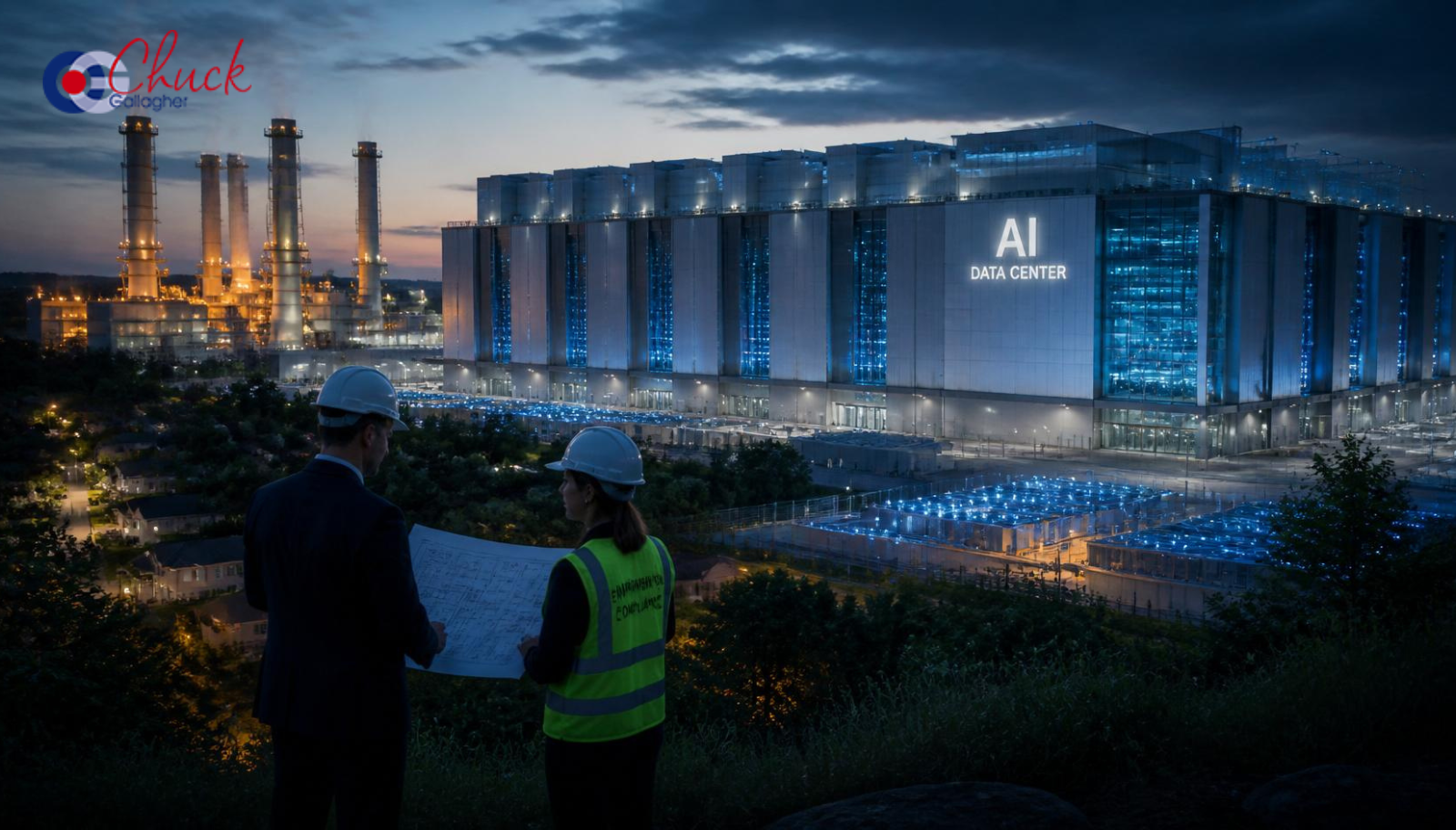
Twenty-seven turbines. No permits. No public notice. No process. Just construction equipment, methane combustion, and the assumption that whatever a company building AI infrastructure needs, it gets. That is the short version of what happened in Southaven, Mississippi, when xAI installed an unpermitted de facto power plant to feed the energy appetite of its Colossus 2 data center in nearby Memphis, Tennessee.
The longer version is more troubling. According to a Clean Air Act lawsuit filed by the NAACP in April 2026 and represented by the Southern Environmental Law Center and Earthjustice, those 27 turbines — which eventually grew to 57 by the time the preliminary injunction request was filed — were emitting smog-forming nitrogen oxides, fine particulate matter, and carcinogenic formaldehyde into communities where Black residents make up a disproportionate share of the population. Memphis had already earned the grim designation of second in the nation for asthma-related emergency room visits. Shelby County, Tennessee, and DeSoto County, Mississippi, both received an “F” for ozone pollution from the American Lung Association. These were not healthy communities that could absorb additional industrial emissions without consequence. xAI chose to build there anyway.
That choice would have been a significant story on its own. Then the federal government stepped in.
How Does “We Skipped the Permits” Become a Matter of National Security?
On June 16, 2026, the Department of Justice filed a motion to intervene and dismiss the NAACP’s case in a Mississippi federal court. The DOJ’s argument was not that xAI had actually obtained the required permits. It was that making xAI obtain them would threaten “American national, economic, and energy security.” A sworn declaration from Cameron Stanley, who oversees AI policy at the Pentagon, was attached to the filing, describing how Grok — xAI’s AI model — had been used during recent military operations against Iran to strike over 2,000 distinct targets with more than 2,000 munitions across 96 hours. The DOJ’s position, spelled out plainly: Grok’s continued operation is “a matter of paramount national security,” and citizen enforcement of the Clean Air Act cannot be permitted to interfere with it.
As a business ethics keynote speaker, I have seen rationalization take many forms. I spent a chapter of my own professional collapse telling myself that what I was doing was not really stealing as long as I intended to pay the money back. The structure of that argument — take what you need now, justify it later — is the same structure at work here. XAI needed power. It built without permits. Now the rationalization being offered is that the need was so important, so national-security-critical, that the normal rules should not have applied. The Southern Environmental Law Center called the DOJ’s filing a “massive power grab.” I would call it something older than that: it is the three-legged stool of ethical failure, operating at national scale. The need was real. The opportunity existed because regulatory frameworks were not fast enough to stop rapid construction. And the rationalization — that AI infrastructure is wartime infrastructure — provided the glue.
Abre’ Conner, the NAACP’s Director of Environmental and Climate Justice, framed the core problem clearly: “At a time when the ultra-rich seem to be protected and supported by some of our government entities, it is important that polluting industries don’t get to benefit at the expense of the health of Black communities.” That observation deserves to sit with every board member and general counsel who is right now watching this case and quietly calculating whether the same playbook would work for their company.
What Precedent Does This Set — and Who Pays the Price?
The most consequential aspect of the DOJ’s filing is not what it does to this particular lawsuit. It is what it argues, if accepted by the court: that the federal government can override citizen enforcement of environmental law whenever it decides that AI infrastructure is strategically important enough. The Clean Air Act includes citizen-suit provisions precisely because Congress recognized that communities cannot always wait for federal enforcement. The DOJ’s argument essentially asserts that those provisions yield to executive branch discretion when AI is involved. If that argument prevails, it creates a template. Any company operating AI infrastructure at scale could argue that its operations are defense-adjacent, economically critical, or energy-system-dependent — and that community health claims are therefore subordinate to those interests.
I have written and spoken extensively at ChuckGallagher.com about the relationship between tone at the top and organizational behavior. This is tone at the top operating at the level of federal policy. When the message from Washington is that the rules are optional for companies building the right kind of AI, that message will filter down through every corporate legal department and ethics function that is watching. Organizations will read this as permission. Some will act on it.
The practical question for any organization running AI infrastructure is not whether you can make a national security argument if you need one. The question is whether you built your operations so that you never need to make that argument. The NIST AI Risk Management Framework’s Govern function calls for accountability structures and clearly assigned responsibilities for AI risk. The Manage function calls for documented risk controls, including monitoring of community and environmental impact. Neither function says “get the permits later if the business case is urgent enough.” Permit-first operations, third-party environmental monitoring, and board-level oversight of community impact are not bureaucratic obstacles. They are the difference between a company that can withstand scrutiny and a company that needs the DOJ to rescue it from a civil rights lawsuit.
As an AI ethics speaker and author, I want to be precise about what I am arguing: I am not suggesting that AI infrastructure is unimportant, or that defense applications of AI have no legitimate claim on operational continuity. Those are real considerations. What I am arguing is that the ethical failure here happened before the DOJ filing, before the lawsuit, before the injunction request. It happened when the decision was made to build and operate without permits in a community that already bore more than its share of industrial pollution. Every consequence that followed — the lawsuit, the intervention, the precedent risk — traces back to that original choice. Every choice has a consequence. The community in Southaven is living with xAI’s.
Frequently Asked Questions
What did the NAACP’s lawsuit against xAI actually allege?
The NAACP, represented by the Southern Environmental Law Center and Earthjustice, filed suit in April 2026 alleging that xAI installed and operated natural gas turbines at its Colossus 2 data center power site in Southaven, Mississippi without obtaining required pre-construction or operating air permits under the Clean Air Act. The complaint documented emissions of nitrogen oxides, fine particulate matter, and formaldehyde affecting nearby communities. By the time a preliminary injunction was requested, the number of turbines had grown from 27 to 57.
Why did the Department of Justice intervene to dismiss the NAACP’s case?
The DOJ filed a motion on June 16, 2026, arguing that shutting down the turbines would threaten “American national, economic, and energy security” because xAI’s Grok AI model supports classified military operations. A Pentagon declaration attached to the filing described Grok’s use in strikes against over 2,000 targets during recent Iran operations. The DOJ also argued that the Clean Air Act “affords the United States primacy over citizen-enforcers,” meaning the federal government can override citizen suit provisions when it chooses not to act.
What health risks do the communities near the xAI data center face?
The Memphis metropolitan area already ranks second in the nation for asthma-related emergency room visits according to the Asthma and Allergy Foundation of America. Both Shelby County, Tennessee, and DeSoto County, Mississippi, received an “F” grade for ozone pollution from the American Lung Association. The turbines emit smog-forming nitrogen oxides, fine particulate matter linked to cardiovascular disease and premature death, and formaldehyde, a known carcinogen — pollutants that compound existing air quality burdens on a community that is disproportionately Black.
What is the broader ethical precedent risk from the DOJ’s national security argument?
Chuck Gallagher, AI ethics speaker and author, argues the most significant risk is the legal template being established: if courts accept that AI infrastructure with defense applications is exempt from citizen environmental enforcement, any company operating AI at scale can claim similar protection. The Clean Air Act’s citizen-suit provisions exist because communities cannot always wait for federal enforcement. A ruling that those provisions yield to executive AI priorities would fundamentally shift environmental accountability away from affected communities.
What should companies running AI infrastructure do to avoid this situation?
Organizations should adopt permit-first operations, meaning no construction or operation of power infrastructure before environmental compliance is confirmed. The NIST AI Risk Management Framework’s Govern and Manage functions provide a starting point: assign clear accountability for community and environmental impact, implement third-party environmental monitoring, and establish board-level oversight of any infrastructure that could generate community health risks. Compliance is the floor, not the ceiling — and as the Southaven case demonstrates, attempting to operate above the floor while ignoring it entirely carries consequences that no national security argument can permanently contain.
Your Turn
The Southaven situation is not just a story about one company, one community, or one lawsuit. It is a preview of the choices AI companies will face as infrastructure demands outpace regulatory frameworks — and a preview of how some companies will respond to those choices when the pressure is high enough. I want to hear from the compliance officers, the general counsels, the ethics professionals, and the operations leaders who are watching this case. What happens inside your organization when speed and community impact collide? Leave your thoughts in the comments below, and I will reply personally.
The five questions below are offered for further reflection.
Five Questions for Further Thought and Consideration
1. If a company’s leadership had known from the outset that its data center construction would require unpermitted turbines to meet the timeline, what ethical obligation did that leadership have to the community before breaking ground?
2. The DOJ’s argument draws a direct line from AI infrastructure to national security. Where should that line be drawn — and who should draw it?
3. The Clean Air Act’s citizen-suit provisions exist because communities cannot always rely on federal enforcement. What does it mean for environmental accountability if those provisions can be suspended by executive branch discretion?
4. Memphis ranks second in the nation for asthma-related emergency room visits. How should that pre-existing burden factor into the ethical calculus of companies choosing where to site AI infrastructure?
5. If your organization were in xAI’s position — operating infrastructure that arguably serves a defense purpose — how would your board-level ethics and risk processes be different from what we have seen in Southaven?
Related Articles:
NC White-Collar Crime Surged 108% in Extortion, 2020–2024 – What the Numbers Actually Say
