
By Chuck Gallagher — Business Ethics Keynote Speaker and Trainer
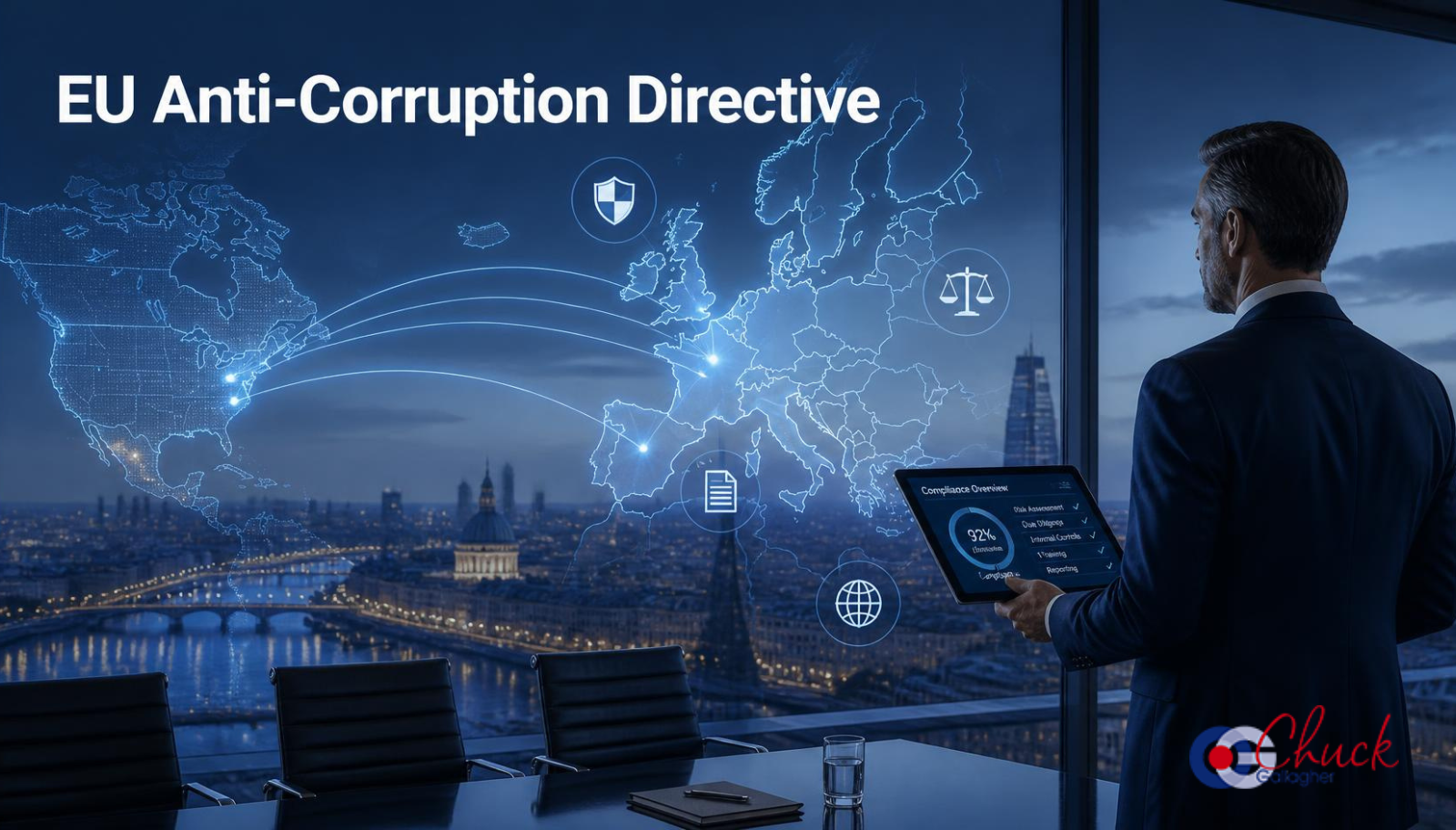
TL;DR: Chuck Gallagher, business ethics keynote speaker, explains how the EU’s new Anti-Corruption Directive reaches American companies doing business in Europe — and why a compliance program that exists only on paper will not be enough.
Picture a quiet dinner in Brussels. A consultant leans across the table and tells a manufacturing executive that he knows someone inside a ministry — a friend, he says — who can move a stalled permit to the front of the line. No guarantee it works. There’s a fee for the introduction, and for the quiet influence that’s supposed to come with it. For years, across most of Europe, a conversation like that one sat in a gray zone. It was legal enough, and common enough, that most people never thought twice about it. The rules have caught up with it now.
As a business ethics keynote speaker, I’ve watched smart people talk themselves into deals like that one. The rationalization is always the same. Everybody does it. It’s just a finder’s fee. Nobody gets hurt. The new rule in Europe was written to end exactly that kind of talk.
The European Parliament and the Council adopted Directive (EU) 2026/1021 on combatting corruption. It came into force on May 31, 2026. Every EU member state except Denmark now has until June 1, 2028 to write it into national law. It replaces an old 2003 framework decision and a 1997 convention that never really did the job. What’s new this time is a single definition of corruption across the bloc, one floor for penalties, and one expectation for how a company proves it’s clean.
What Actually Changed?
The Directive spells out eight offenses that every member state has to make a crime: bribery in the public sector and the private sector, misappropriation, trading in influence, the unlawful exercise of public functions, obstruction of justice, enrichment from corruption, and concealment. A few of those were already on the books in most countries. A few weren’t, or weren’t everywhere. And the definitions are drawn wide on purpose. An “undue advantage” can be money, and it can just as easily be something you could never put a price on. There isn’t a bright line where a harmless gift ends and a crime begins, so a courtesy that raises no eyebrows in one country can put you in front of a judge one border over.
The money gets your attention. For bribery and misappropriation, member states must set maximum corporate fines of at least 5% of worldwide turnover, or 40 million euros. For trading in influence, obstruction, and enrichment, at least 3% of worldwide turnover, or 24 million euros. Worldwide. Not the revenue of the local subsidiary. The whole company.
Does This Reach American Companies?
In my work as a business ethics keynote speaker, this is the question I hear most from executives back home. If I’m a U.S. company, why should a rule written in Brussels keep me up at night? Because it can reach you. Let me be clear about how.
Every member state has to claim jurisdiction when the crime happens on its soil, or when the person who committed it is one of its citizens. That much is ordinary. What isn’t ordinary is that the Directive lets a country reach conduct that happened entirely somewhere else, as long as it was done for the benefit of a company based in that country, or one that’s simply doing business there. That last phrase is where the U.S. companies I talk to get caught flat-footed. Sell into the EU, keep a subsidiary there, run one deal through a European partner, and a bribe paid on another continent can be tried in a European courtroom.
There’s more. The Directive extends to misconduct carried out through information systems used inside a member state — a digital thread that can pull in a company running its data through European servers. So no, this is not only Europe’s problem. If you do business in the EU, it’s your problem too. It doesn’t replace the Foreign Corrupt Practices Act you already answer to. It stacks on top of it, with its own offenses and its own fines.
Why Is Trading in Influence the One to Watch?
Go back to that dinner in Brussels. Trading in influence is the offense with no real match in American or British law. It criminalizes paying — or taking — an advantage to peddle influence over a public official. And here’s the part that catches people. It does not matter whether the influence is real. It does not matter whether it works. The bargain itself is the crime. The consultant does not need a single friend in that ministry. He only needs to sell the promise of one.
I’ve sat across the table from every one of these arrangements. The success fee that only pays out if the government contract comes through. The monthly retainer to a man whose entire value is the phone in his pocket and the numbers stored in it. The consultant who brings nothing to the table but proximity to the right people. None of that was necessarily illegal before. All of it is worth a hard second look now that the promise itself can be the crime.
What Makes a Compliance Program Real?
There’s a break in the clouds, though. A real compliance program counts in your favor. If a company has built something genuine, cooperates when trouble surfaces, and gets ahead of it by disclosing fast, a court is allowed to weigh all of that on the company’s side. But the people who wrote this Directive have seen the dodge coming, and so have I. We think that handing employees an ethics manual to sign means they’ll make good choices. It doesn’t. Not even close. The Directive has a name for the manual nobody follows — window dressing — and it put the warning right in the text.
Years ago I asked the CEO of a large multinational construction company what it was like doing business in China. “We don’t do business in China,” he told me. “We decided long ago that it wasn’t ethical. To do what we do there, we’d have to pay off officials to issue the permits, and that’s a violation of the Foreign Corrupt Practices Act. And we don’t want to break the law.” He walked away from the work. He had put systems in place to keep his people between the ethical lines, even when it cost the company business abroad. That is closer to what the Directive has in mind than any binder ever could be.
Every choice has a consequence. Europe just put a much steeper price on the wrong ones for anyone doing business inside its borders.
Frequently Asked Questions
When does the EU Anti-Corruption Directive take effect?
Technically it’s already in force, but it isn’t binding on companies yet. The date that actually matters to you is June 1, 2028 — that’s when every EU country except Denmark has to have it written into its own national law.
Does the EU Anti-Corruption Directive apply to U.S. companies?
It can. Member states may claim jurisdiction over corruption committed abroad when it benefits a company established in, or doing business in, their territory. If your firm sells into the EU, operates a subsidiary there, or works through European partners, conduct that happens elsewhere can still be prosecuted in Europe. It sits on top of the U.S. Foreign Corrupt Practices Act, not in place of it.
What is “trading in influence” under the Directive?
It’s the crime of paying or accepting an advantage to peddle influence over a public official. What makes it unusual is that the influence does not have to be real or successful — the corrupt bargain itself is enough. There is no direct equivalent in U.S. or U.K. law, which is why I flag it as the offense companies most often miss.
How large are the fines under the Directive?
For bribery and misappropriation, member states must allow maximum corporate fines of at least 5% of worldwide turnover or 40 million euros. For trading in influence, obstruction of justice, and enrichment, at least 3% of worldwide turnover or 24 million euros. The fines are measured against the entire company’s global revenue, not the local unit.
Can a compliance program reduce liability under the Directive?
Yes. A genuine, well-run compliance program can count as a mitigating factor, especially when paired with fast cooperation and self-disclosure. But the Directive explicitly warns against “window dressing” — programs that exist only on paper. Companies have to show the program actually works in practice.
Bring This Conversation to Your Team
Corruption never announces itself as corruption. It shows up as a favor, a fee, a friend who knows a guy. The companies that stay clean are the ones that decided, long before the pressure arrived, what they would and would not do. That decision is culture, and culture is built on purpose. If your team does business in Europe — or anywhere the rules are tightening — this is the moment to pressure-test what you stand for before a regulator does it for you. To bring my message on ethics and consequence to your organization, leadership team, or next event, visit ChuckGallagher.com.
Five Questions for Reflection
- Where in our business does “everybody does it” quietly excuse a choice we would not defend out loud?
- If a regulator asked us to prove our compliance program works, could we — or would we only be able to show them the binder?
- Which of our consultants, agents, and partners are paid for genuine expertise, and which are paid for proximity to the right people?
- What is the honest difference in our culture between a value we have written down and a value we actually live?
- When the pressure to close a deal is highest, what have we decided in advance that we will not do to win it?
