
By Chuck Gallagher — Business Ethics Keynote Speaker and Trainer
TL;DR: Chuck Gallagher, AI ethics speaker and author, examines Connecticut’s newly enacted court rule requiring attorneys and pro se filers to independently verify every citation, legal authority, and piece of evidence produced by generative AI tools — and explains why the threat of case-ending sanctions signals a shift that every legal and compliance professional should take seriously.
“The court is not your quality control department.”
A Middletown, Connecticut tenant wanted to fight a rent hike. The landlord’s lawyers, from Wallingford-based GLG Law LLC, filed a brief in support of eviction. That brief contained fabricated case citations generated by AI. Students at Yale Law School’s Jerome N. Frank Legal Services Organization caught the errors. One cited phrase, according to their brief to the Connecticut Supreme Court, did not appear in the referenced case — nor had any court ever written it. The AI invented it. The attorneys apparently didn’t check.
That case set off a chain reaction that ended on June 23, 2026, when Connecticut state judges issued a formal requirement: every attorney and pro se filer must independently verify all citations, legal authorities, and evidence produced by generative AI tools before submitting anything to the court. Those who don’t face the possibility of case-ending sanctions. Not a warning. Not a fine. Case. Ending.
What Does “Verification Debt” Actually Cost?
As an AI ethics speaker and author, I talk a lot about what I call verification debt — the gap between how fast AI generates output and how carefully humans check it. Every time you accept a citation without confirming it exists, without pulling the actual case and reading what it says, you are borrowing against your credibility. The bill comes due in court. Sometimes it comes due in front of a judge who has already seen this movie and is not in a patient mood.
The Connecticut rule didn’t emerge in a vacuum. The U.S. District Court for the District of Connecticut had already issued a notice to counsel warning that hallucinated legal propositions would “often result in sanctions absent reasonable excuse.” That notice, issued by Clerk of Court Dinah Milton Kinney, made clear the court’s no-tolerance posture applied whether or not AI was involved. In other words, the source of the error was not a defense. “I didn’t realize the AI made it up” was not going to fly.
Now Connecticut’s state court system has matched that posture with a formal rule. What was previously best practice — verify what the machine generates — is now a filing requirement. The gap between ethical obligation and legal obligation has closed. And the legal profession is not the only one watching.
Why HR and Compliance Professionals Should Pay Attention
Here’s the thing. This pattern doesn’t stay in courtrooms. It never does. When a regulator or a judge gets tired of cleaning up errors that professionals should have caught, they formalize the requirement. What was once a professional norm becomes a rule. What was once a rule becomes a baseline for liability. If you are in HR or compliance, look at what Connecticut did and recognize the arc. You use AI to draft policies, generate documentation, summarize employment records. When that documentation is missing, or when it turns out the AI cited a non-existent statute in a termination memo, regulators and opposing counsel tend to assume you weren’t being careful. And sometimes they assume something worse.
Connecticut also enacted a sweeping employer AI law in May 2026 — SB 5, signed by Governor Ned Lamont — requiring companies to disclose when automated decision technology plays a substantial role in employment decisions, and clarifying that using AI is not a defense against discrimination claims. The state is building an accountability framework. Verification isn’t a feature of that framework. It’s the foundation.
What Does a Verification Workflow Actually Look Like?
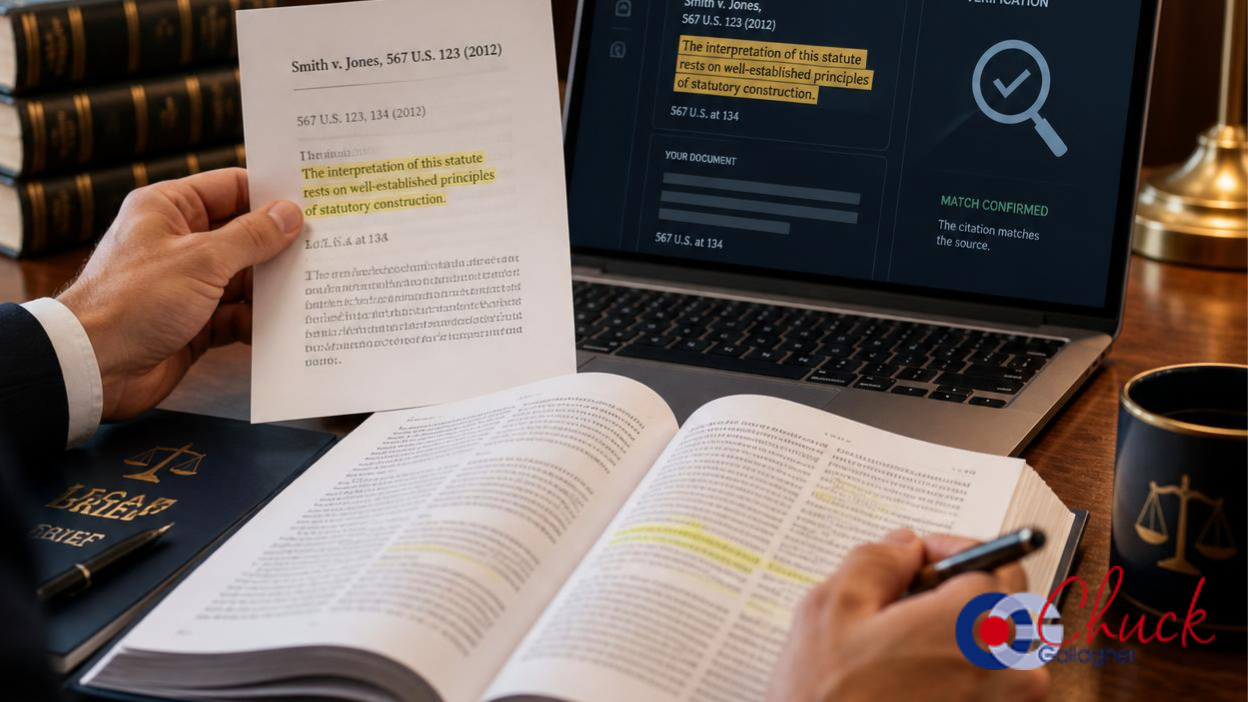
Frankly, the answer is less complicated than people want to make it. If AI produces a citation, you pull the source. You read it. You confirm the proposition the AI attributed to it is actually in there. You document that you did this. If AI drafts a summary of a statute or regulation, you compare it to the primary source. You note the date of the primary source, because statutes change. You create an internal audit trail — not because a regulator asked for it, but because the trail is proof of your professional judgment. Human sign-off is non-optional. Not because the AI is always wrong, but because the professional signature on a filing represents a professional’s judgment, not a machine’s output.
The Connecticut rule is important not just because of what it requires but because of what it signals. Courts are done absorbing the cost of AI errors. They are shifting that cost back to the professionals who submit the work. Malpractice exposure rises. Sanction risk rises. And the reputational hit from having hallucinated citations caught by a Yale Law student and reported to the state’s highest court — well, that kind of thing follows a firm for a long time.
The Ethical Baseline Was Always There
Let me be clear about something. This rule doesn’t create a new ethical obligation. It formalizes one that was already there. Connecticut adopted the ABA’s amendment to Rule 1.1, Comment 8, which requires attorneys to keep current with the benefits and risks of technology relevant to their practice. That standard has always implied that using a tool you don’t understand well enough to check is a competence problem. The new court rule makes that implication explicit and attaches a concrete consequence to ignoring it.
You know what I tell people when they ask whether they should trust AI output? I tell them to trust it the same way they’d trust a very fast, very confident research assistant who has never been to law school, doesn’t always know when it’s making things up, and cannot be held responsible for what it hands you. You’re still responsible. You were always responsible. Connecticut just made sure you can’t forget it. Visit ChuckGallagher.com to learn more about building ethics and accountability into AI-assisted work across legal, HR, and compliance functions.
Frequently Asked Questions
Q: What does Connecticut’s new AI court rule actually require?
Connecticut state judges issued a rule effective June 2026 requiring all attorneys and pro se filers to independently verify every citation, legal authority, and piece of evidence generated by AI tools before submitting any filing to the court. Violations can result in case-ending sanctions.
Q: What happens if a lawyer submits an AI-generated citation that turns out to be fabricated?
Under Connecticut’s new rule, the consequences can include dismissal of the case or other case-ending sanctions. Courts have signaled that claiming ignorance about AI behavior is not a reasonable excuse. Malpractice exposure and bar referral are also on the table.
Q: Is this rule only relevant to Connecticut attorneys?
No. The pattern Connecticut is following — moving from professional expectation to formal court requirement — is spreading nationally. Multiple federal districts, including the District of Connecticut, have already issued notices or orders addressing AI citation accuracy. Attorneys in all jurisdictions should be developing internal verification workflows now.
Q: How does the Connecticut AI court rule relate to employer AI obligations?
Connecticut’s accountability push extends beyond courtrooms. The state’s SB 5, signed in May 2026, requires employers to disclose when AI plays a substantial role in employment decisions and clarifies that using AI is not a defense to discrimination claims. Together, these measures reflect a state-level framework that treats verification and accountability as non-negotiable.
Q: What should a law firm or compliance team do right now to address AI citation risk?
Chuck Gallagher, AI ethics speaker and author, recommends three immediate steps: establish a cite-check workflow that requires pulling and reading every primary source an AI references; require human sign-off before any AI-assisted submission is filed or submitted; and create an internal audit trail documenting what was checked and when. The audit trail is not bureaucracy — it is proof of professional judgment.
A Note to Our Readers
The Connecticut court rule is a preview, not an outlier. Every organization using AI to generate documents, research, or evidence is now operating in an environment where verification is a legal and ethical baseline — and regulators are paying attention. If you’d like to bring a candid, experience-grounded conversation about AI accountability to your legal, HR, or compliance team, Chuck Gallagher speaks to audiences who need more than theory. Reach out at ChuckGallagher.com.
Five Discussion Questions
- What is the difference between AI-generated content that is useful and AI-generated content that creates liability? Where does your organization currently draw that line?
- The GLG Law case involved attorneys who admitted they “did not notice” AI had altered the brief. How do you build a review culture that catches what oversight is supposed to catch?
- Connecticut’s rule shifts the cost of AI errors from the court back to the professional who submitted the work. What comparable cost-shifting should compliance and HR professionals anticipate in their own regulatory environments?
- If verification is the ethical baseline, what does a verification workflow look like in practice for your organization’s most common AI-assisted tasks?
- The Connecticut AI court rule and SB 5 together suggest a state building a layered accountability framework for AI. How should organizations operating in multiple states prepare for regulatory divergence?
