
By Chuck Gallagher — Business Ethics Keynote Speaker and Trainer
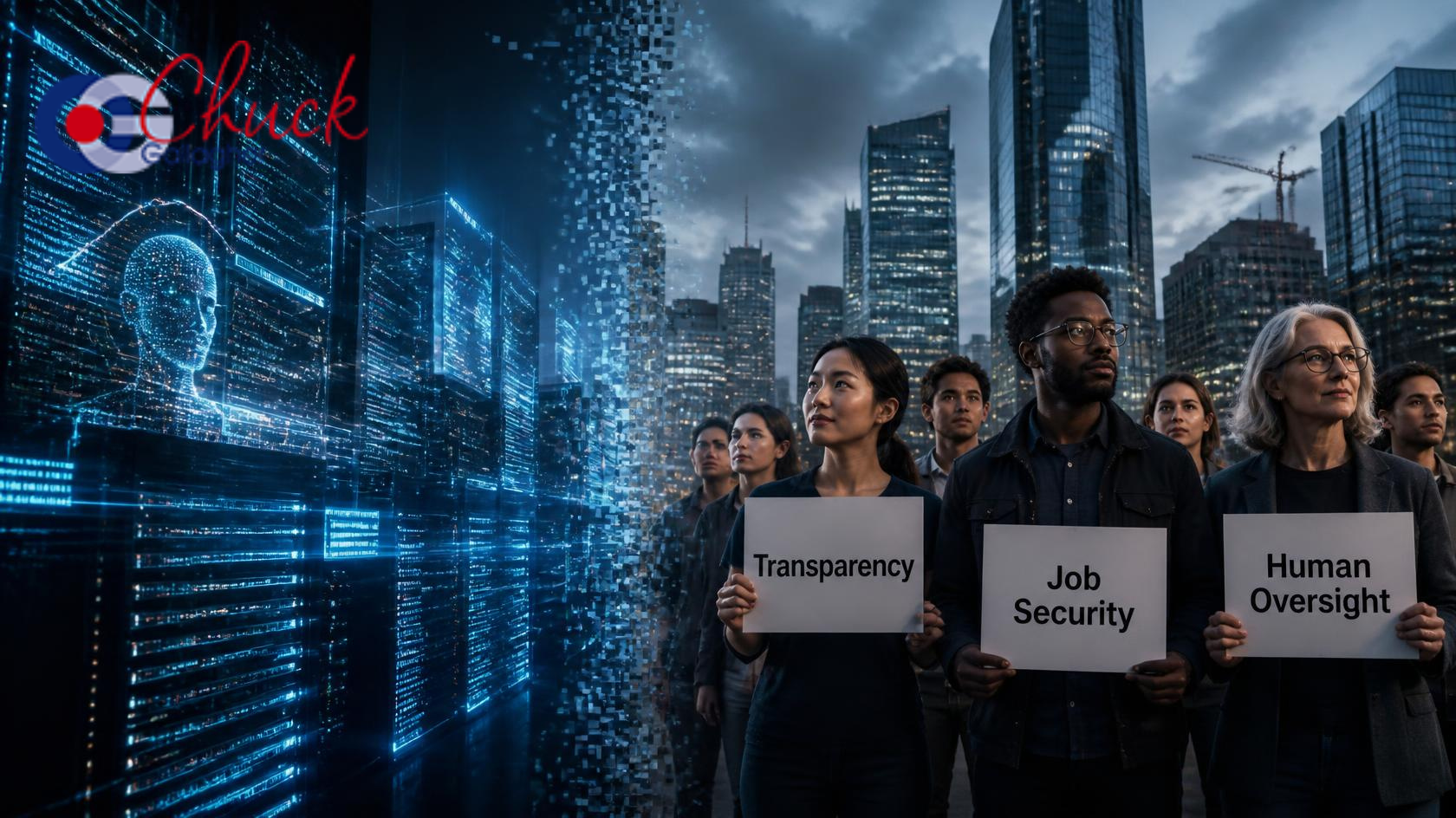
At noon on Thursday, roughly a hundred people stood on a strip of grass in Mountain View, the Googleplex on one side and the visitor center on the other. Matching black shirts. White cardboard signs lettered in black marker. “Googlers for Job Security.” Someone unrolled a banner covered with names—4,500 of them, coworkers who signed a petition asking the company for some assurance they’d still be employed next quarter.
Nobody standing out there was an outsider protesting the AI boom from the sidewalk; these were the people building it.
Think about that for a minute.
What Were Google’s Workers Actually Asking For?
Not much, as demands go. Voluntary exit offers before layoffs. Guaranteed severance standards. An end to performance rating quotas. The option to take severance as extended paid leave. Parul Koul, a Google software engineer, is president of the Alphabet Workers Union. She told the crowd that workers want the security to do their best work, rather than spend their days in a fear-driven environment, pitted against colleagues, never sure how much longer the job will last. The union has about 1,400 members. The petition carried 4,500 names.
About twenty workers carried the petition to the offices of Google Cloud CEO Thomas Kurian and senior vice presidents Rick Osterloh and Nick Fox. Nobody was in. They left copies outside the doors. At Sundar Pichai’s office, a member of his team accepted it. Google didn’t comment. As an AI ethics speaker and author, I’ve watched organizations arrive at this exact spot. More than once. The people closest to the work name the consequence long before the people signing the checks will. That’s not a Google problem so much as a human one, and it’s older than software.
Is This Only Happening at Google?
No. And the pattern outside Google is sharper.
In April, Reuters reported that Meta was installing software on U.S. employees’ work computers to capture mouse movements, keystrokes, and screenshots across work applications, all of it feeding AI training. The program is called the Model Capability Initiative. The internal memo told staff this was where every Meta employee could help the company’s models improve simply by doing their daily work. The goal is agents that complete computer tasks on their own. More than 1,600 workers signed a petition against it. In June, Meta said employees could pause the collection for thirty minutes at a time. Thirty minutes.
Now read the sequence. Capture the keystrokes. Train the agent. Then, starting May 20, lay off roughly 8,000 people—about 10% of the workforce—while moving some 7,000 others onto AI-focused teams. Meta framed the cuts as the way to fund an AI buildout guided at $115 billion to $135 billion in capital spending this year. Fourth quarter revenue was a record $59.89 billion.
Then it moved to a courtroom. On July 13, twenty-six Meta employees sued in federal court in Oakland. They allege Meta used internal AI systems, keystroke and activity-monitoring data, AI token-usage dashboards, and algorithmically assisted performance rankings to decide who got cut—and that those scores, by design, can’t be accumulated by someone on protected medical or parental leave. Separations were set to begin July 22. Meta says the claims lack merit and that workforce decisions were made by people, not AI. These are allegations. A court will sort it out. But look at what’s alleged. The measuring stick was the product.
Oracle tells a plainer version. In April, more than 600 laid-off Oracle workers signed a letter asking for better severance and longer healthcare. Their claim was that they’d been used to train AI systems and then let go. Oracle replied that it would accept only individual letters. They sent those. Nothing happened. At Google DeepMind, about 300 UK workers joined the Communication Workers Union, and in April, 98% voted to seek recognition for roughly 1,000 staff, largely over military AI contracts.
The executives aren’t hiding the math. Salesforce CEO Marc Benioff said his support organization went from 9,000 heads to about 5,000 because, in his words, he needs less heads. Support costs fell 17%. Amazon cut 14,000 corporate roles in October and 16,000 more in January, after CEO Andy Jassy told employees that generative AI and agents would mean fewer people doing some of the jobs done today. Stanford’s 2026 AI Index found employment for software developers ages 22 to 25 down nearly 20% since 2024.
Why Does This Keep Taking the Same Shape?
Here’s the pattern, stripped down. You start out contributing to a system, and nobody makes a thing of it—just do your daily work. The system gets better because you feed it. Then, all of a sudden, the system is the thing measuring you, and that measurement decides whether you stay. Nobody in that chain has to be a villain. Not one. That’s what makes it worth studying.
The worst ethical failures inside American companies never announce themselves. Typically, there’s never a pivotal moment, just a series of small, reasonable decisions, each defensible on its own, easily dismissed as benign until together they’ve paved the way. I know that ground personally. Every choice has a consequence. It doesn’t care whether the choice felt small when you made it.
Notice how modest that Mountain View petition is. Every demand on it asks for the same thing. How powerful it would be if a person could see the potential consequences before making a choice, rather than after. That’s the whole ask. Nobody asked anybody to stop.
What Does Honest AI Leadership Look Like Right Now?
It looks like disclosure that costs you something. In January of 1987, I was two months behind on my house payment, and nobody knew. Not my partners. Not my clients. Not my wife. And frankly, I preferred to keep it that way. I lived by the old adage with a new twist — what you don’t know won’t hurt me. So when a company runs an AI-assisted score on its own people and never mentions it, I know what I’m looking at. I’ve been the one who preferred you didn’t know.
The AI score sees what it sees. It doesn’t see the engineer on medical leave, the parent on a twelve-week absence, or the quiet one who fixes everybody else’s mistakes and never logs a token. Let your people know it exists. And, if that pains you, then perhaps you have a problem that needs to be fixed. If you’re honest and transparent, no one should object.
The Googlers on the grass weren’t asking anybody to stop the machine. They built the machine. They wanted the truth about what it’s pointed at. That’s a low bar. Somebody ought to clear it.
Frequently Asked Questions
Why are Google employees protesting AI if they build it?
They aren’t, exactly. The rally outside Google’s Mountain View headquarters was about job security. The petition collected 4,500 signatures and called for voluntary exits before layoffs, guaranteed severance standards, and an end to performance-rating quotas. Their worry is simple enough. The efficiency they’re producing gets converted into headcount reductions, and nothing gets added on the other side to protect the people producing it.
Can a company legally use AI to decide who gets laid off?
A federal court is about to tell us. Twenty-six Meta employees sued in Oakland on July 13, alleging the company used internal AI systems, activity monitoring, AI token-usage dashboards, and algorithmically assisted rankings to pick who got cut, and that the process disproportionately hit people on medical and parental leave. Meta says the claims lack merit and that its decisions were made by people, not AI. Nothing’s been proven yet, but the case is a preview of where this fight is headed, and I’d watch it.
Is it ethical to have employees train the AI that may replace them?
It depends almost entirely on disclosure. As an AI ethics speaker and author, I draw the line at whether a person can make an informed choice about their own participation. Capturing keystrokes and screen activity to train agents is a defensible business decision—but do it while calling the whole thing routine work, never mentioning that the agent is aimed at tasks those employees perform today, and now you’ve got a problem.
How many tech jobs have actually been cut because of AI?
Companies rarely label a cut as AI-driven. Close to 400,000 tech workers have been laid off since the start of 2025. Amazon has taken out more than 30,000 corporate roles across two rounds. Meta cut about 8,000 in May. And Stanford’s 2026 AI Index found employment for software developers ages 22 to 25 down nearly 20% since 2024. It seems that many companies are laying off workers and blaming AI, as it’s an easy excuse to remove bloat from their ranks and have a reason.
What should a company do before deploying AI in workforce decisions?
Disclose the system before you use it, not after somebody sues. Employees ought to know what’s being measured and what the metric can’t see. Publish that part. Then build a human review that can override the score for somebody on protected leave or accommodation. Remember — no override, no protection. If you couldn’t stand in a room full of your own workforce and explain the method out loud, you’ve got no business running it in a spreadsheet.
Take the Next Step
Every organization deploying AI in workforce decisions is making a choice right now, whether it’s naming that choice or not. I work with boards, executive teams, and conferences on exactly this problem—how to adopt powerful technology without quietly outsourcing your ethics to it, and how to tell your people the truth before the consequences arrive, rather than after. If your leadership team is having this conversation, or avoiding it, bring in somebody who has lived the cost of a small, reasonable-seeming decision. I have. Learn more or book a conversation at ChuckGallagher.com.
