
By Chuck Gallagher — Business Ethics Keynote Speaker and Trainer
TL;DR: Chuck Gallagher, business ethics keynote speaker, argues that Dolly Parton’s career — from refusing Elvis Presley’s manager in 1974 to paying day-one tuition for Dollywood’s seasonal workers — shows that ethical consistency and commercial success were never the competing priorities most leaders assume them to be.
Why Did Dolly Parton Tell Elvis Presley No?
The phone rang the night before the session. It was 1974. Dolly Parton was twenty-eight years old, and Elvis Presley was about to record her song.
She had already said yes. She had told everybody she knew. Then Colonel Tom Parker, Presley’s manager, called with a condition nobody had mentioned. Elvis did not record anything unless Parker’s side took half the publishing.
She said no.
Then she cried all night. She has told the story many times over the years — people around her said she was out of her mind, that it was Elvis Presley, that she ought to hand over the whole thing and be grateful for the privilege. She told Parker it was the most important copyright in her publishing company and she could not do it. Presley never recorded the song.
Eighteen years later, Whitney Houston recorded “I Will Always Love You” for The Bodyguard. It spent fourteen weeks at number one and sold more than twenty-four million copies. Dolly Parton owned every word of it.
What Would That Decision Have Meant If Whitney Houston Never Called?
Here is where most people tell this story wrong. They tell it as a payday. Girl says no to the King, girl gets rich, moral of the story is hold on to your copyrights.
That is not the moral.
The moral is that she was right in 1974, not in 1992. She made that call with no idea Whitney Houston would ever be a factor, no idea The Bodyguard would ever be written. She made it in the dark, crying, with people she trusted telling her she was a fool. As a business ethics keynote speaker, I have watched a great many people stand in that same room — the one where the right answer costs something real and the wrong answer is standing there with its hand out, being reasonable about it. Most of them fold. She did not.
The consequence came later. It always does. But the choice got made long before the consequence was visible, and that is the only place a choice ever gets made.
Did Her Giving Ever Function As Marketing?
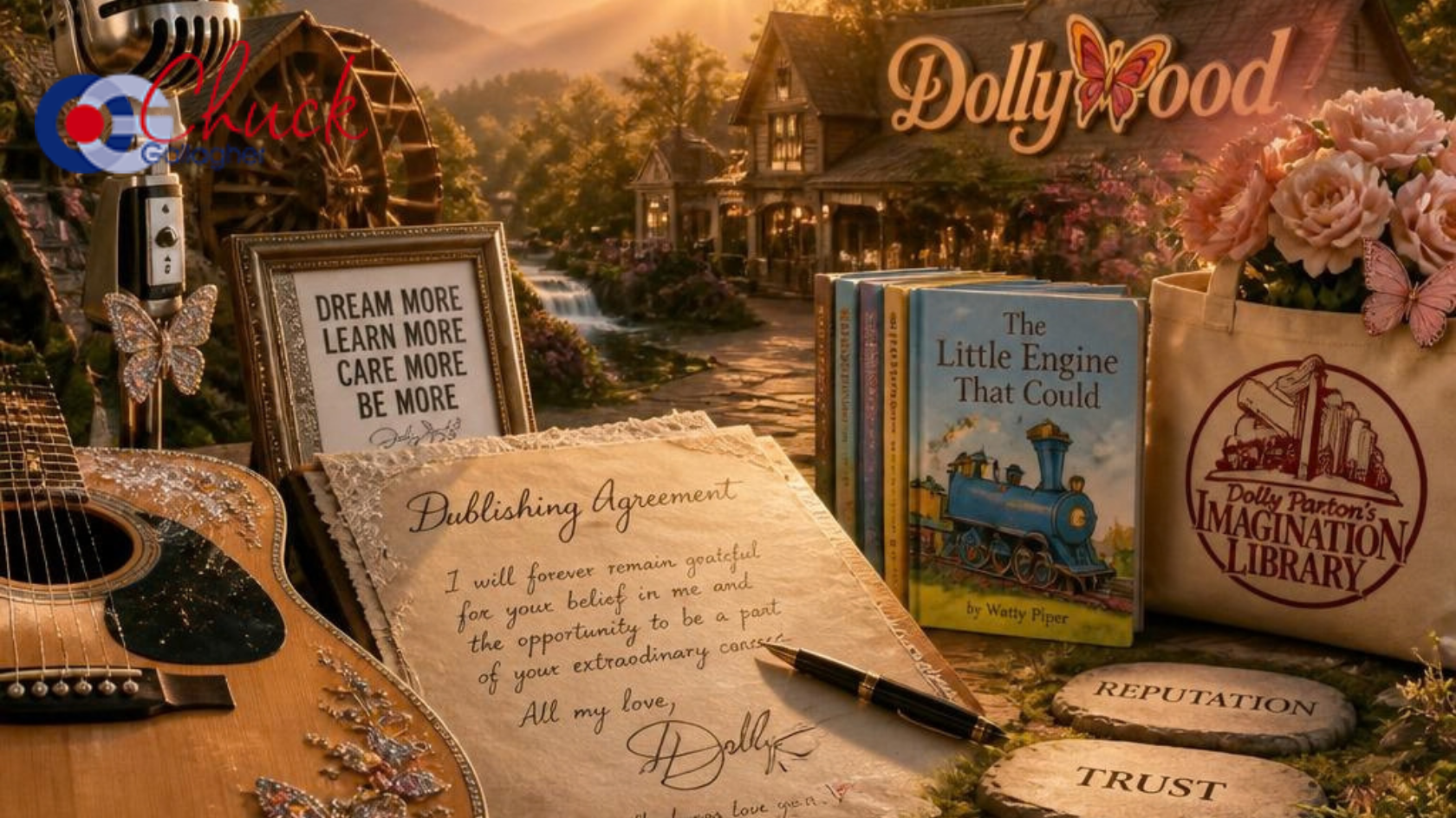
In 1995, Parton started mailing free books to children in Sevier County, Tennessee, her home county, because her own daddy could not read. That is the whole origin story. One county. One reason.
Dolly Parton’s Imagination Library has since delivered more than 300 million books to children across the United States, Canada, the United Kingdom, Australia and Ireland. It grew because it worked, not because somebody drafted a purpose statement and stapled it onto a brand.
You know exactly what I mean here. We have all sat through a company’s values presentation. The slides are gorgeous. Nobody in the room believes a word of it, including the person reading it aloud. The reason it never lands is that the values showed up after the business did, and people can smell that from a mile off.
Hers showed up first.
Can You Take Care of People and Still Run a Profitable Business?
Dollywood opened in Pigeon Forge in 1986, and plenty of people thought it was a foolish bet on a stretch of mountain road. Four decades later it anchors an operation that has done some genuinely uncommon things for the folks who work there. In 2022, through parent company Herschend’s GROW U program, Dollywood began covering 100 percent of tuition, fees and books for employees pursuing a degree — seasonal, part-time and full-time alike, eligible from the first day on the job. About 11,000 employees across the company’s attractions qualified. Workers get a free meal every shift. There is a family healthcare center on park property.
None of that is charity. Turnover costs money. Absenteeism costs money. A worker who can see a doctor without losing a shift shows up more often and stays longer. The claim that a company has to choose between its people and its numbers has always been a lazy claim, and that park in the Smokies has spent forty years quietly refuting it.
Why Is Your Reputation Not Something You Get to Write?
The Foundation for a Better Life runs a public service billboard campaign called Pass It On. One photograph, one value in block letters, one short line. Dolly Parton has one. The value is KINDNESS. The line reads: Find the good in everybody.
Sit with what that required of her. She did not buy the space. She did not write the copy, approve the message or hire anybody to place it. Somebody else needed a face for kindness, went looking, and picked her — confident that a driver doing seventy on the interstate would glance up and need no further explanation.
That is the part most of us have backward. Self-promotion is not telling people who you are. It is behaving the same way, for long enough, that other people say it for you in rooms you are not standing in.
As a business ethics keynote speaker, I spend most of my working life on the other side of this — with people whose small compromises stacked up quietly until there was no honest version of them left to go back to. I know that road better than most. What makes Parton worth studying is not that she was a saint. It is that she was consistent, and consistency compounds. Both directions.
She died on August 25, 2026, at eighty years old, at the Vanderbilt-Ingram Cancer Center in Nashville, after what her team described as a brief battle with cancer. What she left was not the fortune, though there was one. It was a word. She spent sixty years earning it, in heels and rhinestones, while giving most of the rest away.
Every choice has a consequence. She just happened to make good ones for a very long time.
Frequently Asked Questions
Why did Dolly Parton refuse to let Elvis Presley record “I Will Always Love You”?
In 1974, Presley’s manager Colonel Tom Parker called Parton the night before the scheduled session and told her that Elvis’s side took half the publishing on anything he recorded. Parton had written the song as a farewell to Porter Wagoner and had already taken it to number one on the country chart. She refused to give up half the copyright and pulled the song, and Presley never recorded it.
How much was that decision ultimately worth?
Whitney Houston recorded the song for The Bodyguard in 1992. Her version spent fourteen weeks at number one and sold more than twenty-four million copies, with Parton holding the publishing throughout. The return was enormous, but it arrived eighteen years after the decision that made it possible.
What is Dolly Parton’s Imagination Library?
It is a book-gifting program Parton launched in 1995 in Sevier County, Tennessee, mailing a free book each month to children from birth to age five. She started it because her father could not read. The program has since delivered more than 300 million books to children in the United States, Canada, the United Kingdom, Australia and Ireland.
What benefits does Dollywood offer its employees?
Through Herschend’s GROW U program, launched in 2022, Dollywood covers 100 percent of tuition, fees and books for employees pursuing further education, with eligibility starting on day one and extending to seasonal and part-time staff. Employees also receive a free meal each shift and access to a family healthcare center on park property. As a business ethics keynote speaker, I point to Dollywood often, because it is one of the few places where the people-versus-profit argument gets settled by the numbers instead of by a speech.
What can business leaders actually learn from Dolly Parton’s ethics?
She protected the value of her work before she had any way of knowing what it would be worth. Her giving started small and personal rather than as a campaign. And she let her reputation be written by other people instead of by her own marketing. None of that requires talent — it requires consistency.
Bring This Conversation to Your Team
The distance between the choices Dolly Parton made and the ones that end careers is not talent and it is not luck. It is whether a person settles what they will and will not do before the pressure arrives, back when the answer is still cheap. That is the work I do with organizations — helping leaders and teams see the small decisions clearly while they are still small, before the consequence shows up to explain them. If you are planning a conference, a leadership retreat, or an ethics and compliance program and you want a session your people are still arguing about at dinner, start at ChuckGallagher.com.
Five Questions for Reflection
1. Parton made the Elvis decision without any way of knowing it would ever pay off. When did you last make a costly right decision with no guarantee of reward, and what did it actually cost you?
2. Her giving began in one county, for one reason, before anyone was watching. Do your organization’s stated values predate its marketing, or were they written to match it?
3. Dollywood’s investment in its workers has a business case underneath it. Name one thing your organization does for its people that would survive a hard look at the numbers — and one thing that would not.
4. If somebody else had to pick one word for you, in a room you were not standing in, what word would they reach for? Is it the word you would have chosen?
5. Consistency compounds in both directions. Where in your own work has a small, repeated compromise quietly started adding up?
