

By Chuck Gallagher — Business Ethics Keynote Speaker and Trainer
TL;DR: Chuck Gallagher, AI ethics speaker and author, breaks down how “pig butchering” investment scams work, why artificial intelligence has made them dramatically harder to spot, and the small, unglamorous habits that stop them before the money moves.
A man in Troy, Michigan drove to a meeting spot and handed a stranger a bag. Cash one time. Gold bars another. He did it eight times between March and May, according to Troy police.
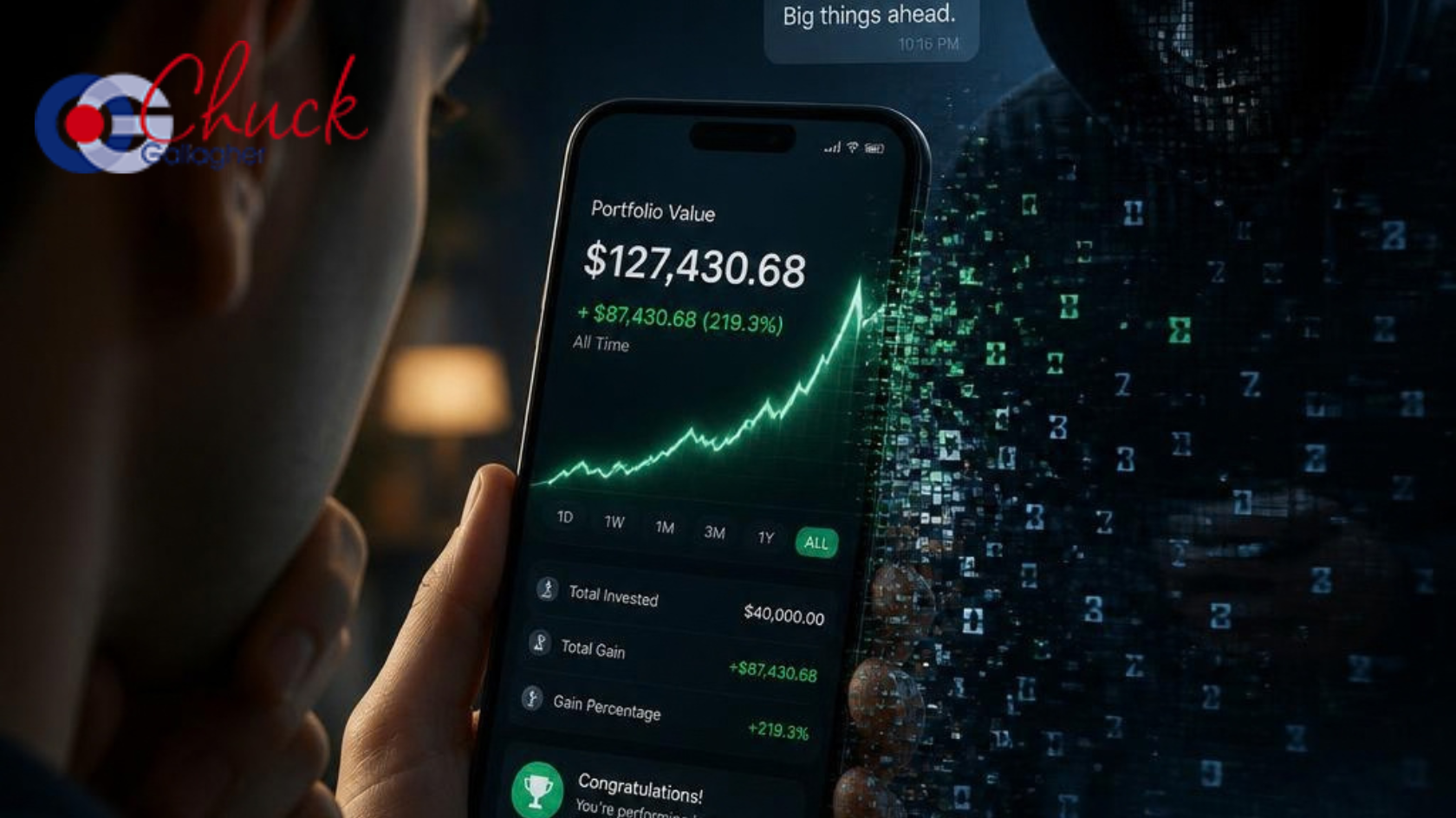
He was not careless. He was cultivated. Earlier in the year he joined an online messaging group that traded talk about health and money. Before long the regulars let him in on a secret. They had access to an artificial intelligence program that could predict which way certain stocks were headed. U.S. stocks. Chinese stocks. A machine that never guessed wrong. He invested, and a website showed his balance climbing past $33 million.
Then he tried to withdraw. He was told he would first need to send $89,700 before his own funds could be released. That is when the fog lifted. He called police, who arranged a controlled handoff at a local bank and arrested a 32-year-old man when he arrived to collect. Oakland County prosecutors charged Yanling Xie with false pretenses of $100,000 or more. Those are allegations, not findings. What is not in dispute is the figure Troy detectives gave in court: roughly $520,000 gone.
The $33 million was pixels. The gold was real.
What Is a “Pig Butchering” Scam?
The name comes from the criminals themselves, and it tells you exactly how they see the person on the other end. You fatten the pig before the slaughter. The scheme runs in phases. First contact through a text, a dating app, a group chat, a wrong number that is not a wrong number. Then weeks or months of actual relationship. Then a modest investment that pays out fine, because letting you win early is cheap. Then a bigger one. Then the withdrawal that never comes. Then silence.
As an AI ethics speaker and author, I get asked whether AI invented this crime. It did not. Confidence fraud is older than the wire and older than the telephone. What AI removed was the last bottleneck.
What Did AI Actually Change?
On July 29 the U.S. Senate Special Committee on Aging held a hearing with a blunt title: The AI Deception Machine. Paul Benda, who runs risk, fraud and cybersecurity for the American Bankers Association, testified that generative AI is not replacing traditional scams. It is industrializing them. A criminal can now produce a convincing voice, video, photograph or entire online persona with almost no technical skill and almost no money.
That matters more than it sounds. The old limit on this crime was labor. One con artist could only hold so many conversations, and clumsy grammar or a stolen photo gave him away. Now the grammar is flawless, the personas hold up across six months, and one operator can run dozens of relationships at once. A bipartisan committee report released the same day tied $893 million in losses to AI-enabled scams across more than 22,000 complaints. Chairman Rick Scott said Americans over sixty lost $7.7 billion to scams in 2025.
Why Do Careful People Hand Over Gold Bars?
Because the pitch is not aimed at your greed. It is aimed at your isolation. Benda told senators the emotional bond these crews build can make intervention extraordinarily difficult, even when family members or bank employees see the warning signs plainly. And the criminals plan for that. They coach targets not to tell family, framing secrecy as intimacy or as financial sophistication.
Let me be clear. Secrecy is the tell.
I understand the machinery better than I would like to. I was a CPA and a tax partner once, and I made choices that ended with me walking into federal prison. Need, opportunity, rationalization. That is the formula I teach now for how decent people end up doing indecent things. A pig butchering crew does not wait for those three to line up. They manufacture all three. They create the need with a return your retirement account will never produce. They supply the opportunity with a slick platform. And they hand you the rationalization already assembled: everybody is doing it, and you are sharp enough to see what others miss.
What Actually Prevents This?
Slow down. That is not a slogan. It is the whole defense. FINRA advises that you should not trust an unexpected text or direct message from a stranger, and that a message appearing to come from a celebrity you follow deserves the same suspicion. Be wary when a new online friend starts asking about your finances. Before money moves, run the promoter through FINRA BrokerCheck for registration and disciplinary history. A promised high return paired with pressure to act right now is the oldest red flag there is.
Then tell one person. Not the group chat. One person outside the situation who will ask rude questions. Almost every one of these cases contains a moment where somebody nearly spoke up. The teller who hesitated. The daughter who thought the story sounded off. The entire secrecy script exists to close that window before it opens.
Here is the part that worries me most. In July the FINRA Investor Education Foundation released research from a nationally representative survey of 1,509 American adults, asking them to name fraud schemes in their own words. Half named identity-based fraud. Only 14 percent named imposter-based fraud, the exact category covering someone who pretends to be a trusted friend or firm. Meanwhile 72 percent said they had been targeted at some point. We are being hunted with a weapon most of us cannot name.
As an AI ethics speaker and author, I spend a lot of time in rooms where people want to discuss what AI might do someday. This is what it is doing now, to somebody’s father, in a bank parking lot in a town like yours. The technology did not make anyone dishonest. It made dishonesty cheap, fast and fluent.
Every choice has a consequence. That includes the small one you make when a stranger online asks you to keep something quiet. Get that one right, and the rest of it never happens.
Frequently Asked Questions
What is a pig butchering scam?
A pig butchering scam is a long-form investment fraud in which criminals build a personal relationship with a target over weeks or months before steering them into a fake investment platform. The name refers to fattening an animal before slaughter, and the criminals coined it themselves. Small early “returns” build confidence, larger deposits follow, and the money disappears when the victim tries to withdraw. The Troy, Michigan case cost one man roughly $520,000 in cash and gold bars.
How does AI make investment scams harder to spot?
Artificial intelligence removes the tells people were trained to look for. Generated photos, cloned voices, deepfake video and fluent messaging let a criminal maintain a believable persona across months at almost no cost. As Paul Benda of the American Bankers Association testified before the Senate Special Committee on Aging in July, generative AI is not replacing old scams so much as industrializing them. One operator can now run dozens of victims at once.
What are the warning signs of a pig butchering scam?
The clearest signal is secrecy. If you are told not to discuss the investment with family, a spouse or your bank, that instruction is the scam protecting itself. Other markers include unsolicited contact from a stranger or supposed celebrity, a new online friend asking about your finances, guaranteed or unusually high returns, pressure to act quickly, and a requirement to send additional money before you can withdraw your own funds.
Can you get your money back after a pig butchering scam?
Recovery is rare and should never be assumed. Funds are typically converted to cryptocurrency, gold or cash and moved through layered accounts and couriers within days. Report the loss immediately to local police, the FBI Internet Crime Complaint Center at IC3.gov and your financial institution, because speed occasionally allows a freeze. Be especially wary of anyone who contacts you afterward promising to recover your money for a fee. That is often the same network running a second pass.
How can I verify an investment promoter before sending money?
Use FINRA BrokerCheck to confirm whether a promoter is or ever was a registered investment professional and to review any disciplinary history. As an AI ethics speaker and author, I tell audiences that a two-minute search beats a two-year regret every time. Verify the platform independently rather than through links the promoter provides, and speak to one trusted person outside the conversation before any funds move.
Before You Go
Fraud prevention is not a technology problem waiting on a technology fix. It is a human problem that shows up in banks, in break rooms, in families and in boardrooms, and the organizations that handle it well are the ones that have talked about it out loud before it happens. That is the work I do with companies, associations and financial institutions: helping people recognize the moment a choice turns, whether they are the target of a scheme or the person quietly rationalizing one. If your team, your members or your clients need that conversation before the next parking lot handoff, start at ChuckGallagher.com.
Five Questions for Reflection
1. Who in your life would tell you the truth about a financial decision you had already made up your mind about — and when did you last give them the chance?
2. If someone asked you to keep a financial arrangement secret from your family, how long would it take you to recognize that request as the warning it is?
3. The criminals in these schemes create need, opportunity and rationalization on purpose. Where in your own work have you watched those three quietly line up?
4. Only 14 percent of Americans named imposter-based fraud when asked to list scams. What would it take for your organization to close that gap for its own people?
5. What small choice, made today, would make you harder to cultivate six months from now?
