
By Chuck Gallagher — Business Ethics Keynote Speaker and Trainer
TL;DR: Chuck Gallagher, AI ethics speaker and author, argues that the ethical failure in AI chatbot privacy isn’t that companies scan conversations for dangerous behavior — it’s the gap between disclosures that are technically accurate and users who have no idea what they agreed to.
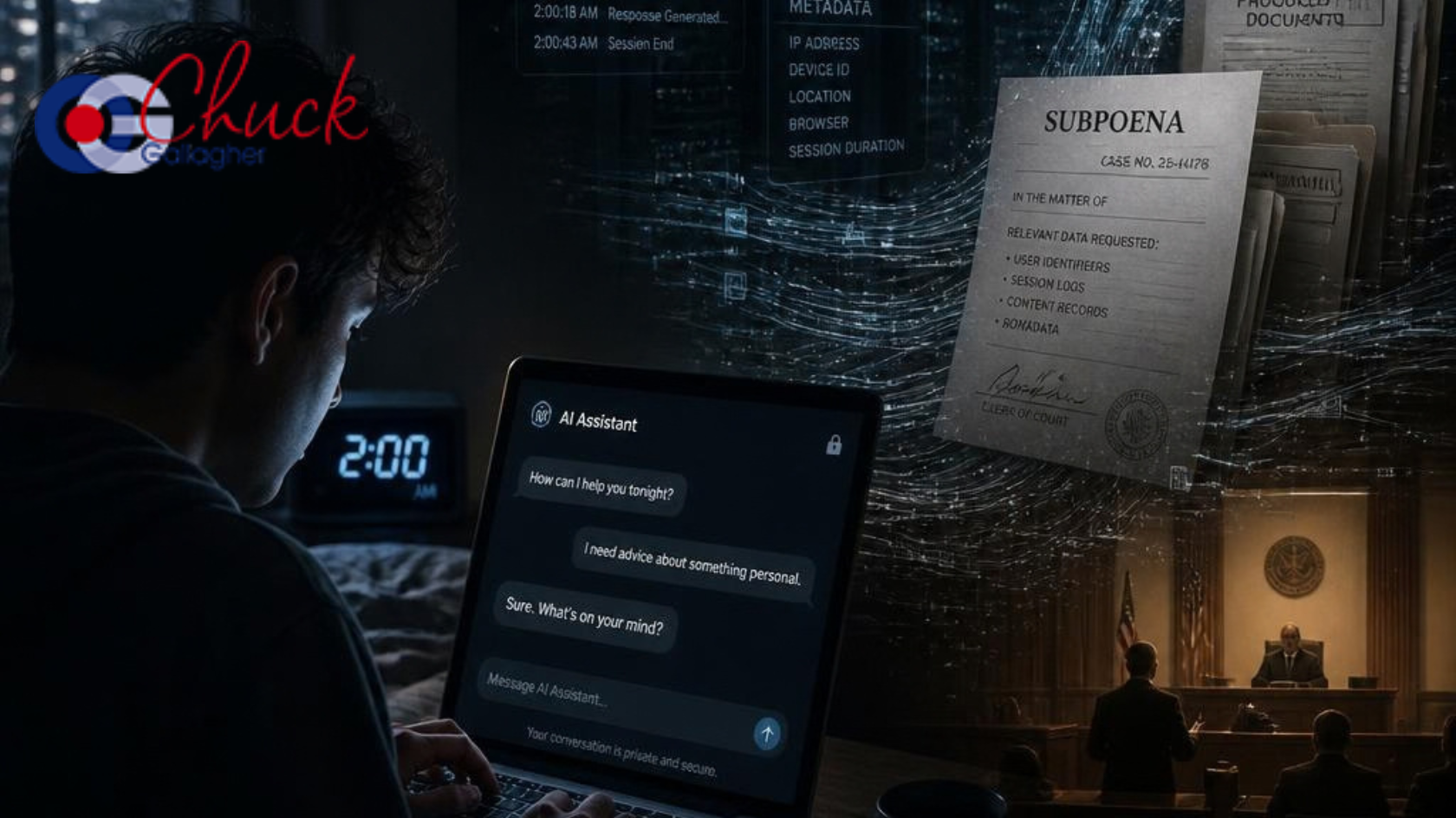
It’s a little after two in the morning and somebody is typing something into a chat window that they have never said out loud to another person. Not to a spouse. Not to a pastor. Not to the therapist they’ve been meaning to call for eight months.
The answer comes back patient and immediate and without a raised eyebrow anywhere in it. And for a few minutes it feels like the safest room that person has been in for a long time.
It isn’t a room. It’s a server.
What Did the Washington Post Actually Find?
The Washington Post published a piece over the weekend on what actually happens to those conversations, and the reporting is worth sitting with. A Post review of public records and local news coverage found chatbot transcripts cited in about a dozen court cases over the past two years — criminal prosecutions, custody disputes, corporate litigation. In most of them, nobody hacked anything. The transcripts came off the user’s own phone or laptop. In one Missouri case a man agreed to let an officer search his phone without a warrant. In a Michigan case, a defense lawyer volunteered his client’s devices as a gesture of transparency.
Jen King, a privacy researcher at the Stanford Institute for Human-Centered Artificial Intelligence, put it about as plainly as it can be put: unless you’re using a temporary or incognito chat inside a browser that isn’t tracking you, you cannot be confident the conversation stays private. OpenAI and Anthropic both say deleted chats come off their servers within thirty days in most cases. That’s a retention policy. It is not a promise about a screenshot, a subpoena, or a phone in an evidence bag.
Why Does a Chatbot Feel Private When It Isn’t?
As an AI ethics speaker and author, this is the part I find most interesting, and it has nothing to do with technology. It has to do with why the illusion works so well.
A chat window borrows the grammar of intimacy. It’s one-on-one. It responds in the second person. It doesn’t flinch, doesn’t interrupt, doesn’t tell your sister. Every social cue that normally makes a person hesitate before confessing is absent, and people disclose accordingly. That’s not a flaw in the user. It’s what the interface is built to produce.
But the absence of judgment is not the absence of a record. Those are two completely different things, and we have quietly agreed to treat them as one.
Is It Wrong for AI Companies to Scan for Dangerous Behavior?
Now, before this turns into an easy story about surveillance, let’s be fair to the other side.
OpenAI has said it uses software to scan conversations for signs of dangerous behavior and route them to trained human reviewers. If a reviewer concludes a conversation shows an imminent and credible risk of harm to other people, the company says it may report the user to law enforcement. In one Florida case reported by the Post, a man allegedly spent months telling a chatbot about plans to harm his former girlfriend. The company flagged the conversations and alerted the FBI, which passed them to local police. That matter remains an allegation until a court rules.
So tell me what you would rather have happened. Nobody wants to live in a world where a company reads months of detailed plans to kill somebody and files it under none of our business. The scanning is defensible. I’d go further — in that scenario, not scanning would be the ethical failure.
The ordinary channel is widening too. OpenAI’s transparency data shows it disclosed information from more than eighty accounts in response to government and law enforcement requests in the second half of 2025, more than four times the figure for the same period a year earlier.
So Where Is the Actual Ethical Failure?
So if the scanning isn’t the ethical problem, what is?
The gap. The distance between what people believe is happening and what is actually happening. A DuckDuckGo survey this year found that roughly three-quarters of respondents didn’t know chatbot conversations could be subpoenaed, and more than half didn’t know their chats train the models by default.
Every one of those facts is disclosed somewhere. That’s the part that should bother you. It’s all in the policy, technically available, legally sufficient, and functionally invisible. Consent that is true on paper and false in practice isn’t consent. It’s paperwork. And I have watched that exact pattern show up in nearly every serious ethics failure I’ve ever studied — nobody lied, the disclosure existed, and not one person who mattered actually understood the arrangement.
There’s a legal edge to this too. In February, a federal judge in New York rejected a financial executive’s argument that his conversations with an AI model about defense strategy deserved the kind of protection a lawyer’s advice would get. The judge found that talking to a chatbot is not the same as talking to an attorney. That man was convicted in May. Whatever you think a chat window is, the courts have started telling us what it isn’t.
What Should You Do About It?
Two practical things, and then one that matters more.
First: assume anything you type could someday be read by a stranger with a badge or a subpoena. Not because it probably will be, but because that assumption costs you nothing and the alternative can cost you everything. If you’re using an account your employer pays for, the employer can generally see it. As an AI ethics speaker and author, my advice to leaders is simpler still — tell your people plainly what is monitored and what isn’t, in words a tired person can understand on the first read.
Second, and this is the one I’d underline. If you’re carrying something heavy enough that two in the morning and a chat window is the only place it comes out, that’s not a technology problem. That’s information about your life. A machine can hold what you say. It cannot sit with you. Tell a person — a friend, a counselor, a pastor, somebody with a pulse who can look you in the eye tomorrow.
Every choice has a consequence. Typing is a choice.
Frequently Asked Questions
Are my AI chatbot conversations private?
Not in the way most people assume. A Washington Post review found chatbot transcripts cited in roughly a dozen court cases over the past two years, usually retrieved from a user’s own phone or computer rather than from the company. Stanford privacy researcher Jen King has noted that unless you’re using a temporary or incognito chat in a browser that isn’t tracking you, you cannot be confident a conversation stays private.
Do AI companies scan conversations for dangerous behavior?
OpenAI has said it uses software to scan conversations for signs of dangerous behavior and routes flagged material to trained human reviewers. If a reviewer determines a conversation shows an imminent and credible risk of harm to others, the company says it may report the user to law enforcement. Practices vary by company, so check the specific provider’s published policy rather than assuming.
Can chatbot conversations be used against me in court?
Yes. In February, a federal judge in New York ruled that a financial executive’s conversations with an AI model about defense strategy did not carry the protection that attorney-client communication would. Chatbot logs have also surfaced in custody disputes and corporate litigation, often through device searches or civil discovery. This is general information, not legal advice — anyone facing an actual legal matter should consult an attorney.
Does deleting a chat actually remove it?
OpenAI and Anthropic both say deleted conversations are removed from their internal servers within about thirty days in most cases. That’s a server retention policy, not protection against a screenshot, a copy on a synced device, or a phone already in an investigator’s hands.
What’s the real ethical issue with AI privacy?
Chuck Gallagher, AI ethics speaker and author, argues the problem isn’t that companies scan for danger — refusing to act on credible threats would be its own ethical failure. The problem is the gap between disclosure and understanding. A DuckDuckGo survey found most respondents didn’t know their chats could be subpoenaed or that chats train models by default. Consent that is technically accurate and practically invisible isn’t consent.
The pattern underneath this story is one every organization will recognize: a disclosure that was technically made, technically accurate, and never actually understood by the people it affected. Chuck Gallagher speaks to companies, boards, and associations about how ethical failure really happens — not through lies, but through gaps everyone was too busy to close. To discuss a keynote or workshop on AI ethics, privacy, and the choices behind the technology, visit ChuckGallagher.com.
Five Questions for Reflection
1. What have you typed into an AI tool that you would not want read aloud in a courtroom?
2. Where in your organization does a disclosure exist that nobody actually understands?
3. If a company can prevent a violent act by reading a private conversation, should it? Where exactly is your line?
4. Why is it easier to tell a machine the truth than to tell a person? What does your answer say about the people around you?
5. What’s the difference between consent and paperwork in your own business practices?
