

By Chuck Gallagher — Business Ethics Keynote Speaker and Trainer
TL;DR: Chuck Gallagher, business ethics keynote speaker, argues that the Justice Department’s lawsuit against Washington, D.C.’s attorney discipline office raises a question every organization faces: a rule enforced unevenly stops being a rule and starts being a weapon.
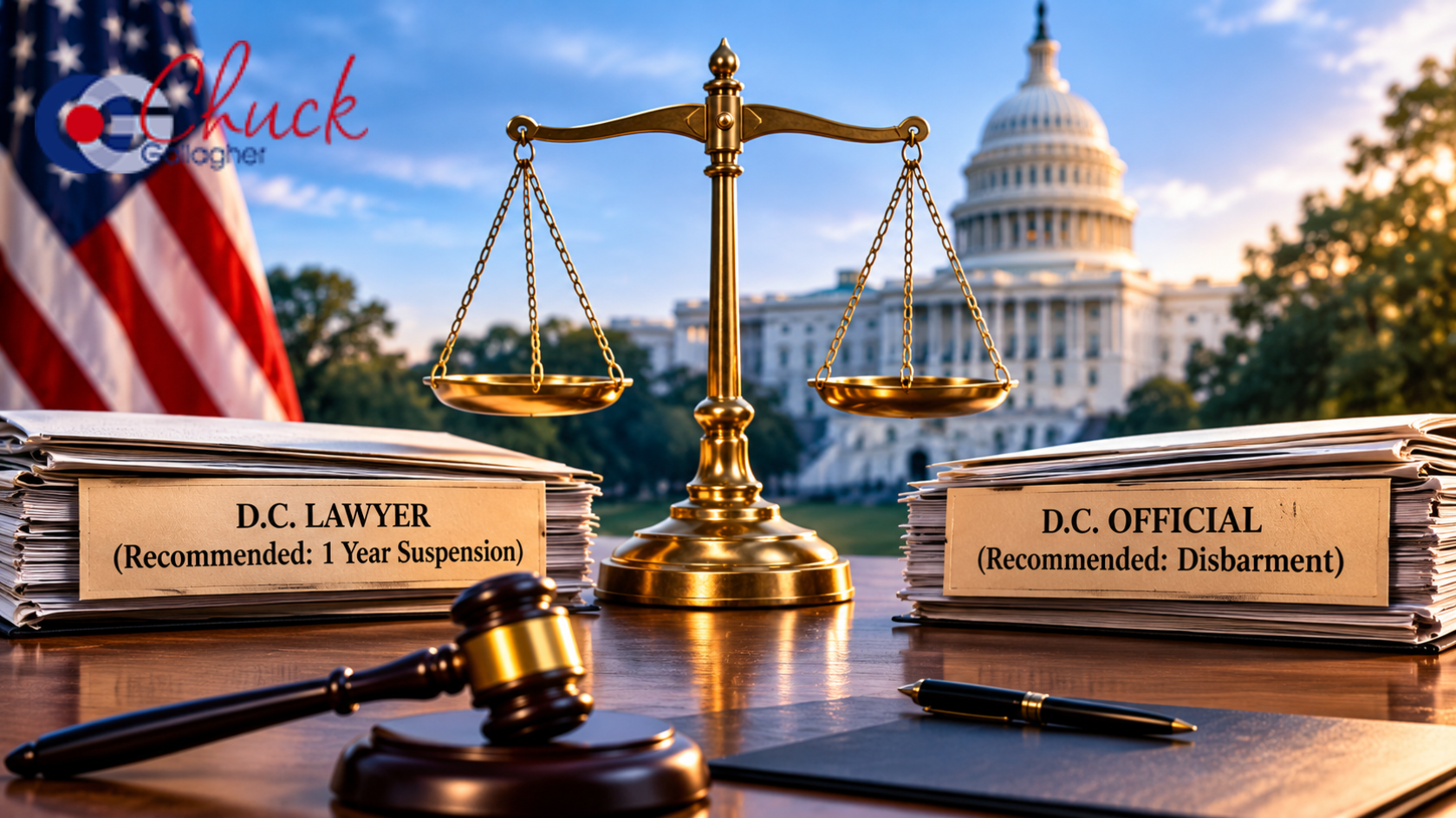
Two files sit side by side on a desk in Washington. In the first, a former FBI attorney pled guilty to a felony. He falsified a document that ended up before a federal court. The recommended discipline was a one-year suspension, applied retroactively. In the second, a former Justice Department official wrote a draft letter that, by most accounts, was never sent outside the department. The recommended discipline was disbarment.
Same office. Same city. Very different outcomes. That contrast sits at the center of a lawsuit the U.S. Department of Justice filed on May 13, 2026, against the District of Columbia Office of Disciplinary Counsel, the D.C. Board on Professional Responsibility, and the D.C. Court of Appeals.
I have a personal stake in how consequences get handed out. As a business ethics keynote speaker, I spend most of my time telling audiences that every choice has a consequence. I learned that the hard way. Poor choices cost me my CPA license and put me in federal prison. I fessed up. I don’t dispute a day of it. But here’s what I learned from the inside. People can accept a consequence. What they cannot accept is a consequence that seems to depend on who they are rather than what they did.
What Is the Justice Department Actually Claiming?
The lawsuit grows out of the disciplinary case against Jeffrey Bossert Clark, who served as an assistant attorney general during President Trump’s first term. A 104-page Report and Recommendation from the Board on Professional Responsibility, dated July 31, 2025, concluded that Clark was prepared to have the department make false statements about its investigation into the 2020 presidential election, and it recommended disbarment. According to a column by attorney Francis G.X. Pileggi in The Bencher, published by the American Inns of Court, that recommendation came despite internal dissent and centered on a draft that was circulated internally and never finalized.
The DOJ’s complaint makes two constitutional arguments. First, it says disciplining a federal lawyer for internal executive branch deliberations violates the Supremacy Clause, because it amounts to local regulation of the federal government. Second, it says the proceedings intrude on the core powers the president and the attorney general hold under Article II. The department asks the court to void the investigation and permanently block discipline against Clark based on his government work. It also points to social media posts by an ODC prosecutor mocking conservative Supreme Court justices as evidence of bias.
What Do the Disciplinary Authorities Say in Response?
Don’t get me wrong. There is another side, and it deserves a fair hearing. The defendants, represented by a team that includes former Solicitor General Elizabeth Prelogar, have moved to dismiss. According to Bloomberg Law, they argue the administration lacks standing because it is challenging a hypothetical sanction that may never be imposed. Clark remains cleared to practice in D.C., and the Court of Appeals, which alone can disbar a lawyer, has made no misconduct findings. The board’s report also states that Clark kept pushing to send the letter after being told it contained misrepresentations. As of mid-September, the motion had been fully briefed but not decided.
So no court has ruled on the merits. Let me be clear about that. Whatever you think of Clark, or of the election dispute behind his case, the question the lawsuit raises reaches well beyond one lawyer.
Why Does Uneven Enforcement Damage an Ethics System?
Ethics rules work only when people believe the rules apply the same way to everyone. The moment a rule looks like it bends depending on who is being judged, it stops shaping behavior and starts producing resentment. People stop asking whether something is right and start asking who is sitting on the panel.
Pileggi points to data that should trouble anyone in the legal profession, regardless of party. Surveys of lawyers at the largest firms show political donations favoring Democratic candidates by roughly 12 to 1. He also cites reports on the 65 Project, a group formed to file bar complaints, whose targets appear to be lawyers aligned with the current president. Neither fact proves misconduct by any disciplinary office. Together, they describe a profession where the people filing complaints and the people judging them may share the same politics. Now, the way I see it, that’s a perception problem at minimum. And in ethics, perception carries a whole lot of weight.
What Can Leaders Outside the Legal Profession Learn From This?
I see the same pattern in corporate compliance departments. A salesperson gets fired for padding an expense report, while a top producer gets a quiet warning for the same thing. Leadership calls it judgment. Everyone else calls it favoritism. You know exactly what I mean. Within a year, the ethics hotline goes silent, because employees have decided the system is rigged.
In more than 1,500 programs as a business ethics keynote speaker, I have watched this play out in boardrooms and break rooms alike. The fix is not softer rules. It is documented standards, comparable cases reviewed side by side, and decision-makers who would reach the same result if the names on the file were swapped. A simple test helps. If the person in front of you belonged to the other team, would the consequence be the same?
Does Even Enforcement Mean Excusing Misconduct?
No. Pileggi makes the point directly: the rules must be enforced, and they must be enforced evenly and impartially, without regard to anyone’s political views. If Clark did what the board found, consequences should follow. If the FBI attorney’s felony warranted more than a retroactive suspension, that should have been said as well. Fairness doesn’t lower the bar for anybody. It holds everybody to the same one.
The court will decide the constitutional questions. The rest of us can decide something simpler. Every choice has a consequence. The question this case asks is whether the consequence follows the choice, or follows the chooser.
Frequently Asked Questions
Why did the Justice Department sue the D.C. Office of Disciplinary Counsel?
On May 13, 2026, the U.S. Department of Justice sued the D.C. Office of Disciplinary Counsel, the D.C. Board on Professional Responsibility, and the D.C. Court of Appeals over disciplinary proceedings against former Justice Department official Jeffrey Clark. The complaint argues the proceedings violate the Supremacy Clause and Article II of the Constitution by regulating internal executive branch deliberations. It also alleges disparate treatment of government lawyers based on the administration they served.
Why was Jeffrey Clark recommended for disbarment?
A 104-page report from the D.C. Board on Professional Responsibility, issued July 31, 2025, found that Clark was prepared to have the Justice Department make false statements about its investigation into the 2020 presidential election. The conduct centered on a draft letter that was circulated internally and never sent in final form. The board recommended disbarment, but only the D.C. Court of Appeals can impose that sanction.
What do D.C. disciplinary authorities argue in response to the DOJ lawsuit?
The defendants have moved to dismiss, arguing the administration lacks standing because no sanction has actually been imposed on Clark. They note that Clark remains cleared to practice law in D.C. and that the Court of Appeals has made no misconduct findings. The board’s report also says Clark kept advocating for the letter after being told it contained misrepresentations.
What is the disparate treatment claim in the DOJ lawsuit?
The complaint contrasts the disbarment recommendation for Clark with a retroactive one-year suspension recommended for a former FBI attorney who pled guilty to falsifying a document submitted to a federal court. The DOJ argues that gap reflects unequal treatment of lawyers depending on which administration they served. The complaint also cites social media posts by an ODC prosecutor as evidence of bias.
Why does consistent enforcement matter in an ethics program?
Chuck Gallagher, business ethics keynote speaker, teaches that people can accept a consequence but will not accept one that depends on who they are rather than what they did. When rules bend for some people and not others, employees stop reporting problems and stop trusting the system. Consistent standards and side-by-side review of comparable cases are what keep an ethics program credible.
If your organization has rules on paper that bend in practice, that gap is exactly where trust leaks out. I work with leadership teams, compliance officers, courts, and professional associations to build cultures where consequences follow choices, not titles or politics. I’m Chuck Gallagher, and you can bring that conversation to your next meeting, conference, or leadership retreat by visiting ChuckGallagher.com.
Five Questions for Reflection
1. If the names on two disciplinary files in your organization were swapped, would you reach the same outcome in both cases? How would you know?
2. Should internal drafts and deliberations that never leave an organization be subject to discipline? Where would you draw that line?
3. How much should the personal views of the people who enforce rules factor into whether the enforcement is fair?
4. What does a consequence that fits the choice, rather than the person, look like in your workplace?
5. When did you last see a rule enforced differently for a top performer, and what did that teach the people who were watching?
