
 By Chuck Gallagher, business ethics keynote speaker and AI speaker and author
Another mandatory meeting invite. The subject line? Ethics. You can almost hear the collective sigh from across the organization. We’ve all sat through those sessions-the dry, check-the-box presentations that feel more like a legal shield than a genuine effort to build character. But what happens when the box is checked and the real test comes? That one small choice on a Tuesday afternoon can start a slide down a very slippery slope, leading to consequences that can shatter reputations, destroy trust, and cost millions.
I’ve lived the negative consequences! Spending time in federal prison is not fun. When I say “Every Choice has a Consequence”, that’s real. Ethics training, however, does not have to be boring!
The hard truth is that most corporate ethics training fails because it aims for compliance, not transformation. It speaks to the head but forgets the heart. In this article, we will tear down that outdated model. You will discover how to transform this critical process from a disengaging requirement into a powerful catalyst for organizational integrity and personal accountability. We’ll provide a framework for making difficult choices under pressure, empowering your team to build a foundation of trust that is truly unshakable. Because every choice has a consequence.
Key Takeaways
- Understand the ‘slippery slope’ of ethical decay and why good people, not just ‘bad apples,’ make poor choices under pressure.
- Move beyond simple compliance to build a resilient culture of integrity where ethical behavior becomes second nature.
- Discover the key components of high-impact ethics training, including interactive scenarios that prepare your team for real-world ‘gray area’ dilemmas.
- Learn how to measure the true ROI of integrity with clear KPIs that demonstrate the tangible business value of a strong ethical culture.
What is Ethics Training and Why Does It Matter?
Let’s be clear: the days of “check-the-box” ethics seminars are over. Gone. In a world driven by social media and radical transparency, a single poor choice can ignite a firestorm, unraveling decades of brand trust in minutes. Effective ethics training is no longer a defensive legal maneuver; it’s a proactive strategy designed to align individual choices with core organizational values. The entire game has shifted from teaching employees what to do to empowering them with how to think when they find themselves standing at a moral crossroads. The real question isn’t whether your team knows the rules. It’s what they choose to do when the rules are silent and the pressure is on.
The Core Purpose: Beyond Legal Protection
Modern ethics training is the immune system of a healthy corporate culture. It is the internal force that protects the organization from decay. This foundation of trust isn’t a soft skill; it’s a hard asset that accelerates the speed of business and attracts the right people. Today’s top-tier talent isn’t just looking for a paycheck; they are searching for purpose and are drawn to organizations where they can do their best work without compromising their personal integrity.
Ethics vs. Compliance: A Critical Distinction
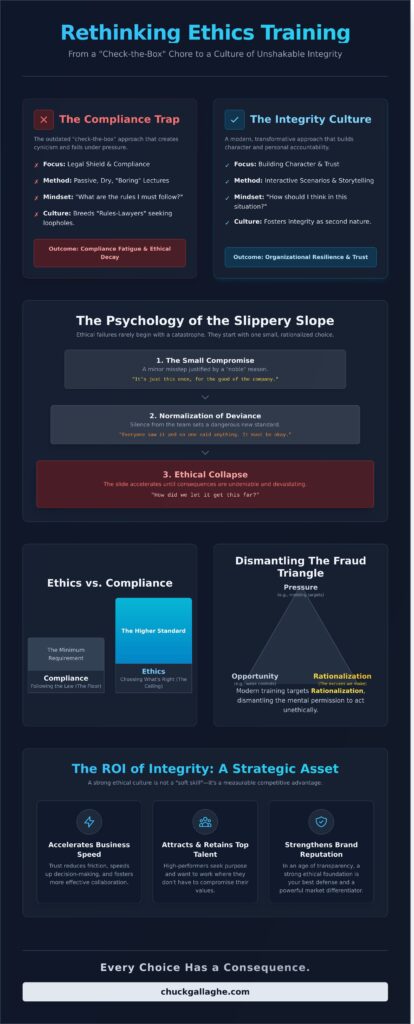
Many leaders mistakenly believe these terms are interchangeable. They are not. Compliance is about following the law-it’s the absolute floor, not the ceiling. Ethics, however, is about choosing the right path when the law offers no guidance. Relying solely on compliance creates a dangerous “rules-lawyer” culture, where people search for loopholes instead of upholding principles. A truly ethical framework integrates the foundational principles of business ethics with the emotional intelligence to apply them, ensuring your code of conduct is a living document, not just a dusty binder on a shelf.
The Psychology of the Slippery Slope: Why Ethics Training Fails
Catastrophic ethical failures rarely begin with a criminal mastermind. They begin with a small compromise. A single step onto a very slippery slope. I know, because I lived it. Most ethical disasters aren’t the work of inherently bad people; they are the result of good people who make a series of poor choices under pressure. They justify the first small misstep with a seemingly noble reason: “It’s for the good of the company,” or “We have to hit our numbers.”
What happens next? Silence. When a team sees a small boundary being crossed and says nothing, a dangerous precedent is set. This is the normalization of deviance. The unethical slowly becomes the standard. Each subsequent choice becomes easier to justify, and the slide accelerates until the consequences are undeniable and devastating. Every choice has a consequence, and it starts with the one you think doesn’t matter.
The Fraud Triangle and Choice
The classic Fraud Triangle identifies three conditions for ethical collapse: Pressure, Opportunity, and Rationalization. While organizations work to limit opportunity and ease pressure, the most powerful lever we can pull is rationalization. This is where your mind gives you permission to do what you know is wrong. Effective training dismantles these excuses before they take root, providing better mental frameworks and solidifying a commitment to integrity as a core component of fraud risk management strategies.
Why ‘Boring’ Training Is Actually Dangerous
Let’s be blunt: boring, check-the-box training is worse than no training at all. When employees click through slides they don’t read, it sends a powerful message that leadership doesn’t truly value integrity-it only values compliance. This breeds cynicism and compliance fatigue, making people more likely to cut corners. The key to making an ethics training program stick is narrative. Storytelling creates an emotional connection, and as a comprehensive meta-analytic review of ethics instruction confirms, active and engaging methods are vastly superior to passive lectures.
Key Components of a Modern Ethics Training Program
Let’s be honest. Most corporate ethics programs are designed to fail. They are sterile, rule-based exercises that check a box for compliance but do nothing to build an ethical foundation. A high-impact ethics training program isn’t about memorizing a handbook; it’s about wrestling with real-world dilemmas. It moves from theory to practice by forcing uncomfortable, necessary conversations about the ‘gray areas’ where character is truly tested. This requires more than an annual seminar. It demands continuous reinforcement and, most importantly, visible participation from the very top. If leadership isn’t in the room, are you building a culture or just an alibi?
Human-Centric Content vs. Rule-Centric Content
Rules don’t create integrity; people do. The most effective tool for teaching personal accountability is storytelling. When a leader stands before their team and shares a moment of vulnerability-a time they faced an ethical crossroads and what they learned-it transforms the conversation. This isn’t about HR modules; it’s about the human side of ethics. It’s about understanding the internal pressures and rationalizations that lead good people down the wrong path. Every choice has a consequence, and hearing that truth from a personal perspective, not a policy document, is what makes the lesson stick.
This human-centric approach directly confronts the quiet, internal justifications that begin the ethical slide. It’s never one catastrophic decision that brings a person or a company down. It’s a thousand tiny compromises. That’s the devastating reality of what researchers call The Slippery-Slope Effect, where minor misdeeds psychologically pave the way for major ones. An effective ethics program exposes this pattern, teaching employees to recognize the first step off the ethical path, not just the cliff at the end.
Technology and Accessibility
In today’s global workplace, technology is a critical partner. Modern online compliance training platforms can offer incredible flexibility and reach, delivering consistent messaging across continents. However, they risk becoming another check-the-box exercise if not used correctly. The key is to blend technology with human interaction. Use micro-learning-short, targeted video messages or scenarios sent via email or Slack-to keep ethics top-of-mind without causing burnout. This ensures the conversation is ongoing and accessible, whether your team is in a boardroom in New York or a home office in Singapore.
Measuring the ROI of Integrity: Is Your Training Working?
They say you can’t put a number on culture. They’re wrong. Every choice your team makes leaves a data point-a positive one or a negative one. The real question is, are you tracking the right things? An effective ethics training program isn’t just a box-ticking exercise; it’s an investment in your company’s foundation. And like any investment, it must have a measurable return. The truth is, high ethical standards don’t just prevent disaster-they build a powerful, long-term financial advantage.
Quantitative Metrics for Ethics
Numbers don’t lie. They tell a story about the real-world impact of your training. Start by looking at:
- Completion vs. Comprehension: Are employees just clicking through slides, or are they truly absorbing the material? Use scenario-based quizzes to measure understanding, not just attendance. A 100% completion rate means nothing if the lessons don’t stick.
- Internal Reporting Channels: An increase in reports to your ethics hotline isn’t always a bad sign. It can signal a rise in trust-a belief that concerns will be heard and handled with integrity. Analyze the nature of these reports to see if your training is empowering people to speak up.
- The ‘Distinction Advantage’: A strong ethical reputation is a tangible asset. It attracts top talent, builds customer loyalty, and can directly boost your brand’s market value. This isn’t soft stuff; it’s your competitive edge.
Qualitative Feedback and Cultural Shifts
Beyond the spreadsheets, you need to listen to the whispers in the hallway. This is where you measure the human impact. Use anonymous employee sentiment surveys to gauge the level of ‘psychological safety.’ Do your people feel safe enough to challenge a questionable directive from a superior? Their answer is your reality. You’ll know the training is working when the phrase “Every choice has a consequence” moves from a poster on the wall to a shared language used in team meetings. Remember, a single employee choosing to report a compliance issue instead of ignoring it can save a company millions in legal fees, regulatory fines, and shattered public trust.
So, where do you begin? The first step is a comprehensive ‘Ethics Audit’ to identify the cracks in your current ethics training strategy before they become catastrophic failures. It’s a choice to be proactive, to build on solid ground rather than waiting for the slippery slope to give way. If you’re ready to truly measure the integrity of your organization, let’s talk about what’s possible.
The ‘Every Choice Has a Consequence’ Framework
Standard corporate training often treats ethics as an academic subject-a list of rules to be memorized for a compliance quiz. But ethics isn’t a theory. It’s the sum of thousands of individual choices made by real people under real pressure. This is where a radically different approach is needed, one grounded not in theory, but in lived experience.
My story is not one of academic perfection. It’s a story of a CPA and business owner who made a series of poor choices that led to the loss of my business, my reputation, and my freedom. I ended up in federal prison. Sharing that fall-the vulnerability, the regret, the harsh consequences-creates a bridge of trust that no PowerPoint presentation can match. It shifts the conversation from a lecture to a raw, human dialogue about the slippery slope of unethical decisions. When employees see the real-world fallout, the abstract rules suddenly carry profound weight.
The journey from incarceration to becoming a global consultant is a testament to the power of accountability and second chances. It proves that ethical recovery is possible. Your organization can move beyond the rulebook and build a foundational culture where people are empowered to make the right choice, even when no one is watching. This is the future of effective ethics training.
Bringing Chuck Gallagher to Your Organization
Inviting a business ethics keynote speaker into your company is about more than a single event; it’s an opportunity to reset your cultural compass. Programs are customized for the unique pressures of your industry, from finance to healthcare, ensuring the message resonates deeply with your team. By blending immersive live sessions with accessible virtual keynotes, we can create a powerful, ongoing conversation that drives lasting behavioral change and reinforces integrity at every level.
Next Steps: Auditing Your Current Program
Is your current program truly working? It’s time to ask the hard questions. Every leader should ask their team today:
- Does our training inspire action or simply check a compliance box?
- Are we building a ‘culture of compliance’ or a true ‘culture of ethics’?
- How do we know our people will make the right choice under pressure?
Answering these questions is the first step in transforming your organization. Ready to build a stronger ethical foundation? Book a consultation with Chuck Gallagher to transform your ethics training program.
Your Next Choice: Building a Legacy of Integrity
Moving beyond compliance is no longer an option-it’s an imperative for survival and growth. We’ve seen that the difference between a thriving, transparent culture and one on the edge of a slippery slope is not chance; it’s choice. Effective ethics training isn’t about memorizing rules, but about embedding the core principle that every decision has a consequence. It is the conscious act of building a framework of integrity that empowers every team member to navigate complex moral dilemmas with clarity and courage.
With over 30 years of hard-won experience helping Fortune 500 companies, author and global keynote speaker Chuck Gallagher provides more than just a program-he delivers a profound perspective on transformation. His message, forged from personal failure and professional redemption, resonates from the boardroom to the front lines. Are you ready to stop checking boxes and start building real accountability? Transform your culture with Chuck Gallagher’s ethics training programs.
The foundation for a stronger, more resilient business is laid one choice at a time. Choose to build one that lasts.
Frequently Asked Questions About Ethics Training
Is ethics training legally required for all businesses?
While not a blanket federal mandate for every company, many industries like finance and healthcare have specific legal requirements. More importantly, the U.S. Federal Sentencing Guidelines heavily consider a robust ethics program when determining penalties for misconduct. So, is it required? The better question is, can you afford the consequences of not having it? It’s a foundational choice for corporate survival and integrity, moving beyond mere compliance to build a culture of accountability.
How often should employees undergo ethics and compliance training?
Think of ethics like a muscle; it weakens without regular exercise. Annual training is the industry standard, and for good reason. It serves as a vital recommitment to the company’s core values and a reminder that the ethical “slippery slope” is always present. New hires should be trained immediately upon onboarding to set the right tone from day one. Remember, every choice, every single day, has a consequence that builds toward your company’s future.
Can ethics training actually prevent fraud and embezzlement?
Let’s be radically transparent: no training program is a magic bullet that can stop a determined criminal. I know this from personal experience. However, effective ethics training is a powerful deterrent. It builds a culture of accountability where people know what to look for, understand the consequences, and feel empowered to speak up. It dismantles the rationalizations that are the first step on the dangerous path to fraud and corporate disaster.
What are the most common topics covered in an ethics class for employees?
A solid program moves beyond theory and into the real-world choices employees face daily. Key topics typically include navigating conflicts of interest, understanding the company’s code of conduct, and recognizing bribery and corruption. It also covers critical areas like data privacy, preventing harassment to build a respectful workplace, and the responsible use of company assets. Each topic is a potential crossroad where a single choice can have massive consequences for everyone involved.
How do you make ethics training engaging for a remote workforce?
The key is to transform passive screen time into an active, human experience. Ditch the monotonous videos. Instead, use interactive scenarios that force real-time decision-making. Leverage live polls, virtual breakout rooms for small group discussions, and compelling, story-driven case studies. The goal isn’t just to transfer information; it’s to provoke self-reflection and create a shared sense of responsibility, no matter the physical distance between team members.
What happens if an employee fails their ethics training assessment?
A failed assessment shouldn’t be seen as a final judgment but as a critical red flag that requires a conversation. The first step is typically remedial training and a re-test. However, it’s also an opportunity for a manager or HR to connect directly with the employee. Is there a lack of understanding or a deeper issue? This is a moment for coaching and reinforcement, ensuring the ethical foundation is truly solid before a real-world test presents itself.
How does ethics training differ for executives versus entry-level staff?
The core principles are the same, but the focus and stakes are vastly different. For entry-level staff, the ethics training centers on understanding specific policies, identifying red flags, and knowing how to report concerns. For executives, it’s about leadership. Their training focuses on setting the “tone at the top,” navigating complex gray areas, and building an organizational structure where integrity is non-negotiable. Their choices don’t just affect them; they shape the entire culture.
Related Articles:
Workplace Ethics in 2026: A Framework for Choices and Consequences
When Ethics Oversight Shrinks, Trust Shrinks Faster
