
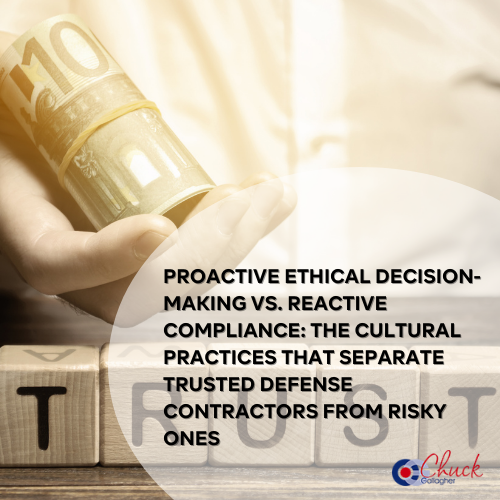
By Chuck Gallagher — Defense Ethics Keynote Speaker and Trainer
I recently sat in a conference room with a defense contractor’s leadership team that had just finished an internal compliance briefing. The numbers looked good. Training completion rates were high. Policies were up to date. The hotline was posted. The cybersecurity controls were documented. From the outside, it looked like a disciplined organization.
Then I asked a question that changed the temperature in the room:
“What cultural practices do you have in place that reinforce proactive ethical decision-making… rather than reactive compliance?”
There was a pause. Not because they didn’t care. Not because they weren’t smart. But because it exposed a gap most organizations don’t recognize until pressure reveals it.
They had compliance.
But they didn’t yet have ethical muscle memory.
And in defense contracting, where the landscape is constantly evolving and the stakes are national in scale, that difference matters more than most leaders want to admit.
Compliance reacts. Culture anticipates.
Reactive compliance is what happens when an organization waits for the next rule, the next audit, the next customer inquiry, or the next crisis to “get serious” about ethics.
It’s the organization that tightens controls only after something goes wrong.
It’s the team that updates policy after a close call.
It’s the manager who suddenly becomes obsessed with documentation only when the government asks for it.
Reactive compliance isn’t always bad. Sometimes it’s the only way an organization learns. But it’s also a warning sign: it means the company is relying on external pressure to do what internal character should already be doing.
Proactive ethical decision-making is different. It’s the ability to make the right call before anyone is watching, before anyone is demanding proof, and before the consequences arrive.
Proactive ethics isn’t about fear of getting caught.
It’s about commitment to being worthy of trust.
The ethical gap that policies can’t close
Most defense contractors have policies. Many have training. Some have sophisticated compliance teams. And yet, ethical failures still happen.
Why?
Because ethics doesn’t collapse in policy manuals.
Ethics collapses in moments.
It collapses in the moment a program manager is under pressure to hit a milestone.
It collapses in the moment someone discovers a cyber gap but doesn’t want to escalate it.
It collapses in the moment an employee is tempted to “charge time somewhere.”
It collapses in the moment a subcontractor delivers something questionable and the team debates whether to accept it “just this once.”
That’s where culture matters—because culture is what determines how people behave when the right choice is inconvenient.
That’s why I tell defense organizations:
I don’t deliver ethics training. I build ethical decision-making reflexes under pressure.
Because if your ethics program only works when the environment is calm, you don’t have an ethics program.
You have paperwork.
Proactive ethics is a daily practice, not a quarterly initiative
When I ask leaders what they do to reinforce proactive ethics, they often point to things that are important—but incomplete:
“We have an annual training module.”
“We have a code of conduct.”
“We have a reporting hotline.”
“We do internal audits.”
“We have compliance reviews.”
Those are necessary.
But proactive ethical decision-making is reinforced by cultural practices that shape behavior in real time, inside real teams, under real pressure.
It isn’t a once-a-year reminder.
It’s the way leadership talks.
It’s what gets praised.
It’s what gets punished.
It’s what gets escalated.
It’s what gets buried.
And it’s what gets repeated until it becomes instinct.
The cultural practices that build proactive ethical decision-making
Let me give you the cultural practices that, in my experience, separate trusted defense contractors from organizations that are always one bad day away from a major issue.
1) Leaders reward early truth—even when it hurts
In reactive cultures, bad news is treated like betrayal. It’s seen as negativity. It’s treated as a disruption.
In proactive cultures, early truth is treated as professionalism.
Because leaders understand something crucial:
The earlier you know, the cheaper it is to fix.
When leaders consistently respond to concerns with curiosity instead of anger, employees stop hiding problems and start bringing them forward early. That single cultural practice prevents more ethical failures than any policy ever will.
2) “Pause points” are built into the work—not bolted on later
Most organizations build controls around decisions after the fact.
Proactive organizations build “pause points” into the process.
Before a proposal goes out.
Before a subcontractor is approved.
Before a major milestone is certified.
Before a system is declared secure.
Before a deliverable is shipped.
These pause points are not bureaucracy. They are intentional moments where teams are trained to ask:
“Are we being accurate?”
“Are we being transparent?”
“Are we being defensible?”
“Are we being honest about risk?”
Reactive organizations rush through those moments because they feel like friction.
Proactive organizations protect those moments because they understand they prevent catastrophe.
3) Leaders don’t just say “integrity”—they define what it looks like under pressure
Every organization says it values integrity.
But proactive cultures define integrity behaviorally.
They teach people what to do when the pressure hits:
- What do you say when a leader wants reassurance but the data isn’t clean?
- What do you do when a subcontractor misses a requirement but the schedule can’t slip?
- How do you escalate a concern without becoming “the problem person”?
- How do you document reality without creating panic?
This is where most ethics programs fail.
They teach rules.
But they don’t teach scripts.
And under pressure, people don’t rise to their intentions.
They fall to their habits.
4) Middle managers are trained as ethical multipliers, not operational enforcers
If you want proactive ethics, you cannot build it only at the executive level.
Culture is transmitted by middle management.
That’s where the real decisions are shaped.
Middle managers are the ones who translate leadership intent into daily behavior. They set the tone for whether speaking up is safe. They determine whether documentation is respected. They decide whether the team takes shortcuts or holds the line.
If middle managers are only trained on performance metrics, then ethics will always be reactive.
But if they’re trained as ethical multipliers—leaders who protect truth, reinforce standards, and coach decision-making—ethics becomes proactive.
5) Ethical questions are normalized in operational meetings
Proactive cultures don’t isolate ethics into compliance meetings.
They integrate ethics into operational rhythm.
That means in program reviews, leaders ask questions like:
“Where are we exposed?”
“What assumptions are we making?”
“What are we not saying out loud?”
“What would we do differently if this decision became public?”
“Are we trading truth for speed?”
Those questions don’t slow performance.
They prevent failure.
And over time, those questions become part of the culture’s instinct.
6) The organization builds “psychological safety with accountability”
Proactive ethics doesn’t mean being soft.
It means being safe enough for truth and strong enough for standards.
Employees must feel safe to report mistakes and concerns early, but they must also understand that standards are non-negotiable.
When safety exists without accountability, people get careless.
When accountability exists without safety, people get silent.
Proactive ethics requires both.
7) The company reinforces ethics through storytelling—not slogans
Posters don’t build culture.
Stories do.
Proactive organizations tell real stories internally about:
- someone who spoke up early and prevented a problem
- a leader who chose transparency even when it cost them
- a team that stopped the line rather than ship uncertainty
- a moment when integrity mattered more than the metric
Stories teach employees what the organization truly values.
And stories travel faster than policies ever will.
The bottom line: proactive ethics is a competitive advantage
Defense contracting is entering a new era of scrutiny, accountability, and evolving expectations.
The organizations that thrive will not be the ones with the most impressive policy binders.
They will be the ones with cultures that hold up when pressure hits.
Because in the end, the government doesn’t just buy products.
It buys trust.
And trust is built through proactive ethical decision-making—day after day, decision after decision, long before anyone is forced to prove it.
If you’re a defense contractor leader, I want to leave you with a simple but challenging question:
Does your organization wait for compliance pressure to behave ethically… or does it practice ethics before it’s required?
If you want to build an ongoing ethical awareness program that strengthens decision-making under pressure and turns ethics into a lived culture—not a reactive response—I’d love to help.
As always, I welcome your comments and I’m happy to respond. Feel free to share your thoughts below.
Related Articles:
