
By Chuck Gallagher — Business Ethics Keynote Speaker and Trainer
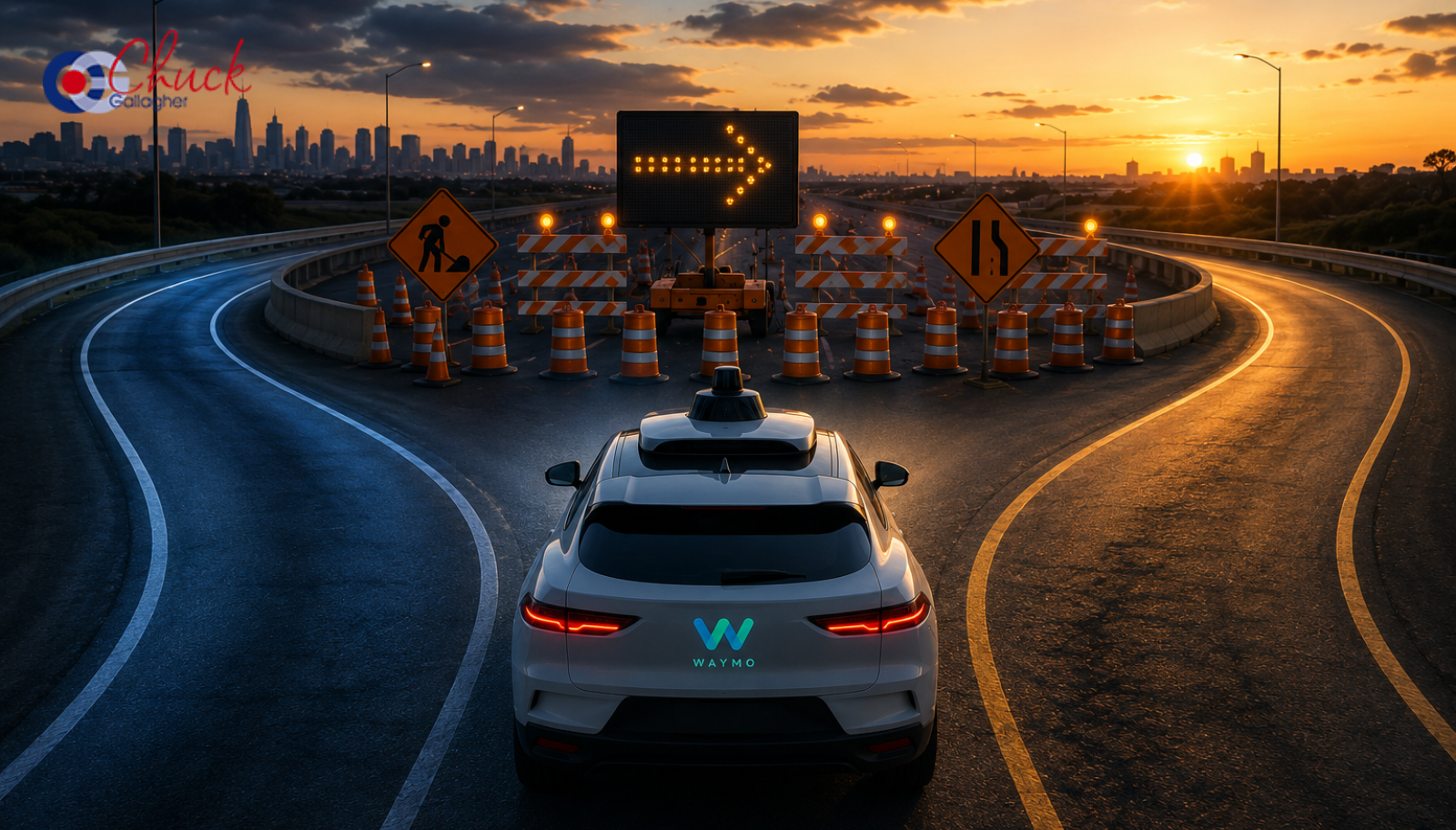
TL;DR:Elliot Slade was riding in a Waymo robotaxi from San Mateo to his San Francisco home on May 18, 2026, when his car accelerated into an active freeway construction zone. Cones were down. Police were in the distance with lights flashing. Signs warned of lane closures. And the Waymo sped up.
“I looked at my fiancée,” Slade told KPIX-TV. “We’re done. This is it. We’re going to die right here in the Waymo.” The car eventually veered off the freeway into a residential neighborhood. No one was killed. This time.
That is the story that should be commanding attention in every boardroom running autonomous systems right now. Not the software patch. Not the voluntary recall. Not the press release. The story is the decision architecture that put passengers inside a machine capable of driverless freeway operation — and that had no reliable way to identify a construction zone as a place it should never enter.
What the NHTSA Report Actually Tells Us
The NHTSA Safety Recall Report 26E035, filed June 17, 2026, covers 3,871 Waymo vehicles equipped with the company’s 5th Generation Automated Driving System capable of driverless freeway operation. The recall documents 13 incidents: six in Phoenix where robotaxis drove past ramp closure signs on April 11 and April 19, and seven in San Francisco where vehicles drove between lane-closure cones on May 18. The official defect description is precise and telling: “Under certain circumstances, the AV may enter and drive at speed in freeway construction zones due to inappropriately prioritizing the avoidance of other freeway hazards and/or failing to recognize the construction zone.”
Read that carefully. The ADS was doing exactly what it was trained to do — avoid hazards. It saw other vehicles, lane shifts, and traffic conditions as hazards to prioritize. And in doing so, it treated the construction zone itself as navigable space. The rationalization embedded in the system’s logic was functionally identical to the rationalization I describe in my framework for understanding ethical failures: the system had a mission (avoid hazards), it had opportunity (freeway access), and it had a built-in logic that let it explain away the danger it was driving into.
As an AI ethics speaker and author, I want to be specific about what that means. This was not random unpredictability. This was a predictable consequence of a system optimized for one set of conditions operating in conditions that fell outside that optimization. The gap between what the system was built for and the reality it encountered was not a mystery — it was a known category of risk that should have had a defined fail-safe response before a single passenger ever boarded.
Why This Is an Ethics Failure, Not a Technology Failure
Waymo acted responsibly once the pattern became clear. The Field Safety Committee convened within 24 hours of the April incidents. Freeway restrictions were imposed. The Safety Board escalated to a recall. The company proactively notified NHTSA before it was required to. I am not questioning Waymo’s response. I am questioning the decision-making framework that preceded it.
The question that every organization deploying autonomous systems should be asking is not “what do we do when something goes wrong?” It is “what are the conditions under which this system should never operate, and have we pre-defined those conditions with the same rigor we applied to teaching the system to drive?” Construction zones — dynamic, low-visibility, rule-suspended environments where trained human workers are physically present — are not edge cases. They are a predictable feature of every freeway system in America. Pre-defining them as no-go environments for driverless operation is not a software engineering challenge. It is a governance decision. And governance decisions are ethics decisions.
At ChuckGallagher.com, I have written about what I call the gap between compliance and ethics: compliance asks whether you followed the rule; ethics asks whether you asked the right questions before you needed the rule. Waymo cleared the regulatory bar to operate on freeways. What the recall reveals is that the ethical question — under what circumstances should an autonomous system default to stopping rather than continuing — was not fully answered before freeway operations launched.
This is the second Waymo recall in as many months. In May 2026, a separate recall addressed vehicles that had driven into flooded roadways in Texas. A January incident prompted an NHTSA probe after a robotaxi failed to yield to a stopped school bus. Each of these incidents shares the same structural pattern: a system optimized for normal conditions encountered an abnormal condition and either misclassified it or failed to trigger a conservative fail-safe response.
The NIST AI Risk Management Framework — the closest thing the United States has to a national standard for managing AI-related risk — addresses this directly in its “Measure” and “Manage” functions. Organizations are expected to pre-identify high-risk operational domains, implement conservative behaviors when confidence drops below a defined threshold, and establish escalation triggers that remove autonomous control before an incident occurs. Those are not technology requirements. They are governance requirements. They require human leaders to make explicit, documented choices about where AI systems stop and human accountability begins.
As a business ethics keynote speaker, I have spent thirty years watching organizations learn these lessons the hard way — after the consequence, not before. The pattern is consistent. The organization optimizes for the normal case. It assumes the world will cooperate. And when the world turns out to be messy — with construction cones and flooded roads and stopped school buses — the system that was never told what to do in the messy world keeps going.
The fix for the Waymo recall is software. The fix for the decision-making pattern that produced the recall is something harder: a genuine commitment to treating every autonomous system deployment as an ethics question before it becomes an engineering question. Three guardrails every organization should build before going autonomous: pre-define “no-go” environments with explicit boundaries; require conservative fail-safe behaviors when sensor confidence drops below a defined threshold; and establish an independent safety board with real escalation authority — not just advisory authority — before launch, not after incidents.
Frequently Asked Questions
What caused the Waymo recall in June 2026?
Waymo filed NHTSA Safety Recall 26E035 on June 17, 2026, covering 3,871 vehicles equipped with its 5th Generation Automated Driving System. The recall documents 13 incidents in which robotaxis entered active freeway construction zones — six in Phoenix between April 11–19 and seven in the San Francisco Bay Area on May 18 — due to the ADS inappropriately prioritizing the avoidance of other freeway hazards or failing to recognize the construction zone entirely. NHTSA noted that driving at speed through a closed construction zone increases the risk of collision.
Is the Waymo construction zone recall a safety defect or just a software bug?
NHTSA formally classified it as a safety defect under 49 CFR § 573, which is the federal standard for safety-related defects in motor vehicles and equipment. The recall is not limited to a single software error — the underlying issue is that the ADS’s hazard-prioritization logic produced a predictable failure mode in a predictable environment. Chuck Gallagher, AI ethics speaker and author, argues this classification correctly frames it as a governance failure, not a coding mistake.
How many Waymo vehicles were affected, and who owns them?
The recall covers 3,871 Waymo vehicles produced between March 17, 2022, and May 19, 2026. All are owned by Waymo directly, which allowed the company to apply the software remedy without notifying individual owners or dealers — a remediation structure unique to fleet-owned autonomous vehicle deployments that differs substantially from traditional consumer vehicle recalls.
What does the NIST AI Risk Management Framework say about construction zones and autonomous vehicles?
The NIST AI RMF’s “Measure” and “Manage” functions call on organizations to identify high-risk operational domains before deployment, implement conservative fail-safe behaviors when system confidence is uncertain, and establish escalation triggers that can restrict autonomous operation before an incident occurs. Applied to autonomous vehicles, this framework supports pre-defining environments like active construction zones as no-go domains, with default behaviors that bring the vehicle to a safe stop rather than continuing through uncertain conditions.
How does the Waymo recall fit into a broader pattern of autonomous vehicle safety incidents?
The June 2026 construction zone recall was Waymo’s second in as many months. A May 2026 recall addressed vehicles that entered flooded roadways in Texas, and a January 2026 incident triggered an NHTSA probe after a robotaxi failed to yield to a stopped school bus. Each incident followed a common pattern: a system trained on normal operating conditions encountered an abnormal condition and lacked a sufficiently conservative fail-safe response.
I’d like to hear what you think. Is the Waymo recall evidence that autonomous vehicle deployment has moved too fast relative to the governance frameworks needed to support it — or is this the normal, acceptable process of a new technology learning from real-world experience? Share your perspective in the comments below, and I will respond personally. Then consider these five questions.
Five Questions for Further Thought and Consideration
- If an autonomous system causes harm in a scenario that was reasonably foreseeable — like a freeway construction zone — who bears ethical accountability: the developer, the deploying organization, the regulatory body that approved operations, or some combination?
- What is the ethical threshold for deploying an autonomous system in high-stakes public environments before that system has demonstrated reliable performance in all reasonably expected conditions?
- How should organizations define “conservative fail-safe behavior” for AI systems, and who in the organization should have the authority to set and enforce those definitions?
- If the NIST AI Risk Management Framework already provides guidance for pre-defining no-go environments and escalation triggers, why do organizations repeatedly discover the need for those guardrails only after an incident occurs?
- When a voluntary recall is self-initiated and the fix is applied without public notification, what does the public actually learn — and what responsibility do organizations have to communicate the nature and cause of safety failures beyond the regulatory minimum?
Related Articles:
Healthcare and Ethics: Is “Fail Fast” the Ethically Responsible Approach?
