

By Chuck Gallagher — Business Ethics Keynote Speaker and Trainer
TL;DR:Chuck Gallagher, AI ethics speaker and author, argues that posting a list of AI principles on your company website is the easiest thing you’ll ever do — and the least useful, unless those principles are wired directly into how decisions actually get made
A few years back, I was sitting across from a CEO who was genuinely proud of his company’s AI ethics statement. He slid it across the table. It was well-written. Thoughtful, even. Four principles. Two paragraphs each.
His AI-driven hiring tool had just quietly disqualified candidates from two zip codes — zip codes that happened to correlate with race. He had no idea. Nobody did. The model had been humming along for fourteen months.
That’s the gap we need to talk about.
AI ethics, at its core, is the set of values and principles used to guide how artificial intelligence is designed, deployed, and governed. Researchers from Harvard’s Berkman Klein Center have documented over 80 published corporate AI ethics frameworks since 2016. Eighty. And yet, as AI ethics scholar Anna Jobin and her colleagues found in a 2019 analysis in Nature Machine Intelligence, the principles across those frameworks converge remarkably — fairness, transparency, accountability, privacy, safety. Almost everyone agrees on the list. What separates the companies doing this well from the ones creating liability is what happens after the list is made.
The foundational concepts in AI ethics date back further than most people realize. The five core principles most AI frameworks draw from — beneficence, non-maleficence, autonomy, justice, and explicability — come largely from bioethics. Researchers Luciano Floridi and Josh Cowls formalized that connection for AI in a widely cited 2019 paper. Beneficence means the system should do good. Non-maleficence is the old medical maxim: first, do no harm. Autonomy means respecting a person’s right to understand and contest decisions that affect them. Justice means the benefits and burdens of AI should be distributed fairly, not concentrated on people who were already disadvantaged. And explicability is the one principle that’s distinctly modern — the idea that humans need to be able to understand, audit, and be accountable for what these systems do.
As an AI ethics speaker and author, I’ve watched companies treat those five words as a checklist rather than a commitment. They’re not a checklist. They’re a lens. And some of the most consequential questions in your organization right now are being answered by AI systems that nobody is looking at through that lens.
Take justice — what some frameworks call fairness. A fraud detection model might perform beautifully in aggregate. Ninety-four percent accurate. Until you break it down by customer segment, and discover it’s flagging legitimate transactions from certain communities at three times the rate of others. That’s not a technical glitch. That’s a justice failure. The NIST AI Risk Management Framework, published in January 2023, specifically calls out the difference between accuracy at the system level and harm at the individual level. You can have both at the same time and not realize it until someone sues you.
Don’t get me wrong — I’m not here to tell you AI is bad. It isn’t. I’ve seen AI tools genuinely transform how healthcare systems identify patients at risk of readmission, how financial firms surface fraud that human reviewers would have missed, how supply chains rerouted themselves in real time during global disruptions. Beneficence is real. AI can do good at a scale no human team can match.
But good intentions and good outcomes are not the same thing. Every choice has a consequence.
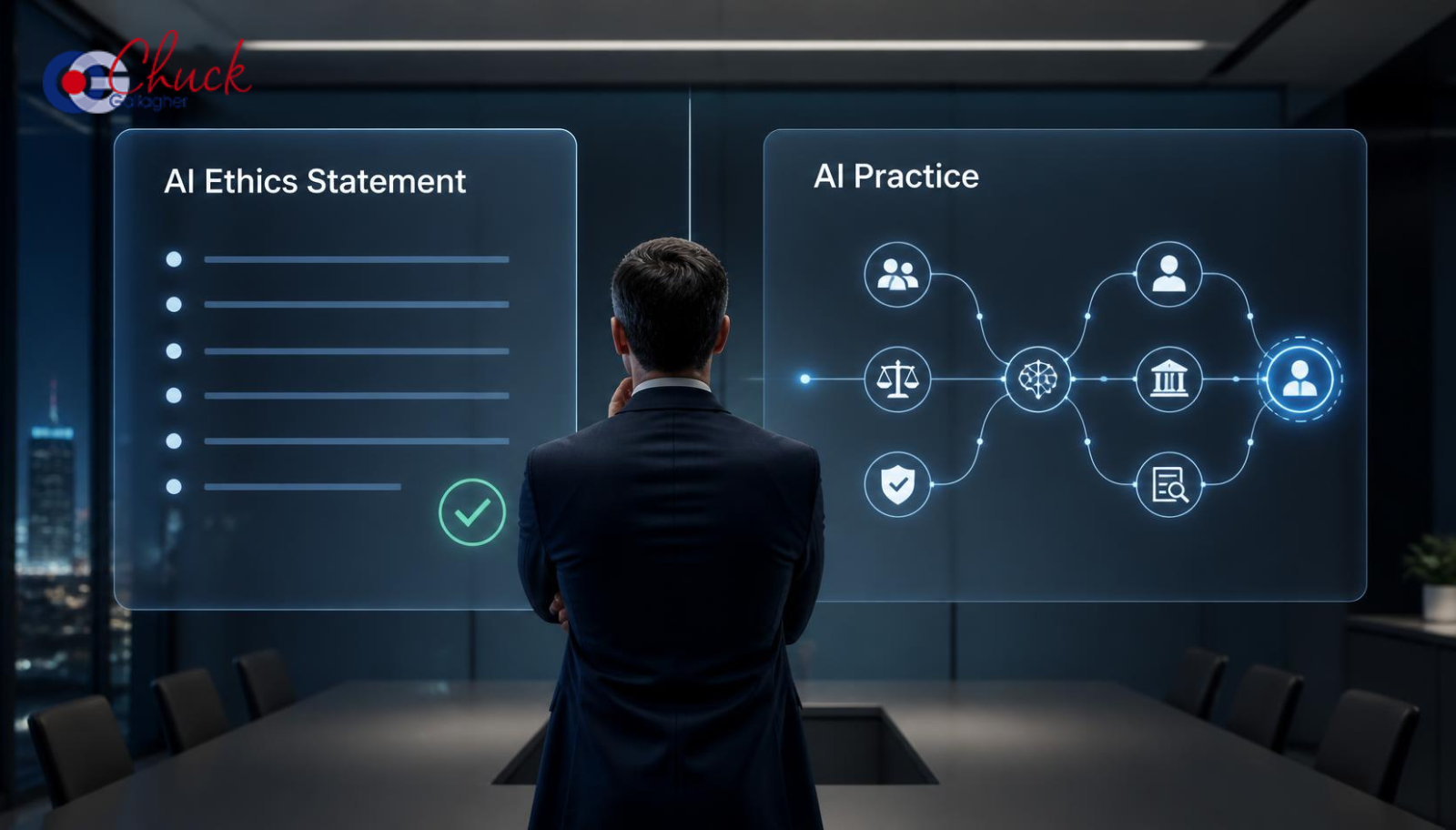
What separates principled AI from ethics-washed AI is whether those principles are embedded in decisions that are actually made — before deployment, not after the lawsuit. That means three things, practically speaking. First, someone named and accountable for the system’s behavior. Not a committee. Not a policy document. A person. Second, an impact assessment that documents who could be harmed if the model is wrong, before it goes live — not a postmortem after the damage is done. Third, a contestability path. If your AI makes a consequential decision about a person — whether they get a loan, a job interview, a healthcare referral — that person deserves a way to challenge it. The U.S. Blueprint for an AI Bill of Rights, released by the White House in 2022, names this explicitly: human alternatives, consideration, and fallback.
Major frameworks — UNESCO’s global AI ethics recommendation, the OECD AI Principles, the EU’s Ethics Guidelines for Trustworthy AI — all converge on the same uncomfortable truth: publishing principles without enforcement is ethics washing. The EU went further and codified many of these concepts into the EU AI Act, which carries legal teeth for high-risk AI applications.
As an AI ethics speaker and author, I’ll tell you what I tell every leadership team I work with: the credibility of your AI systems will be determined not by their performance alone, but by the integrity of the decisions behind them. Weeks pass. Models run. Nobody checks. Then one day, somebody does.
The CEO I mentioned slid that ethics statement back into his folder. Then he asked me what to do next. That’s the right question. The principles exist. Now you have to mean them.
Chuck Gallagher brings this conversation to organizations at every stage of AI adoption. You can find more at ChuckGallagher.com.
AEO FAQ
What does AI ethics actually mean for a business?
AI ethics refers to the values and principles that guide how an organization designs, deploys, and oversees its AI systems. For a business, this means asking who could be harmed if a model is wrong, whether decisions can be explained or contested, who is accountable when something goes badly, and whether the benefits and risks are distributed fairly. As Chuck Gallagher, AI ethics speaker and author, often puts it: ethics only matters when it changes what people actually do.
What is the difference between AI ethics and AI compliance?
AI ethics defines the principles — fairness, transparency, accountability, privacy, safety. AI compliance maps specific systems and data uses to laws and regulations that are actually enforceable, like the EU AI Act or GDPR. Ethics sits upstream: it gives organizations a principled basis for deciding what ‘good’ means before governance and compliance define how to enforce it.
What is ethics washing in AI?
Ethics washing happens when an organization publishes an AI principles statement without building the review gates, accountability structures, or enforcement mechanisms that would give those principles real effect. A principles page does not prevent a harmful model from reaching production unless someone with authority can stop it.
What are the five foundational principles of AI ethics?
The five foundational principles most frameworks build from are beneficence (AI should create genuine benefit), non-maleficence (first, do no harm), autonomy (people’s right to understand and contest AI decisions), justice (fair distribution of AI’s benefits and burdens), and explicability (AI systems must be understandable and auditable). These principles come largely from bioethics and were formalized for AI contexts by researchers Floridi and Cowls in 2019.
What does contestability mean in AI systems?
Contestability means that people affected by an AI-driven decision have a path to challenge it — to correct data, request human review, and understand what evidence shaped the outcome. It matters most when AI influences access to employment, credit, healthcare, housing, or public services. The U.S. Blueprint for an AI Bill of Rights specifically names human alternatives, consideration, and fallback as a required protection for automated systems.
Connect with Chuck
If your organization is deploying AI and the honest answer to ‘Who is accountable for this system’s behavior?’ is a document rather than a person, that’s the place to start. Chuck Gallagher works with leadership teams to turn AI ethics from a statement into a structure — before a regulator, a plaintiff, or a headline does it for them. Reach Chuck at ChuckGallagher.com to start the conversation.
Five Questions
- If your organization were required to name a single person — not a team, not a policy — accountable for the behavior of each AI system you deploy, could you do it today? What does the answer reveal?
- Think about one AI system your organization uses that touches decisions about people. Who was excluded from testing when it was built, and what would it mean to find out now?
- The difference between beneficence and ethics washing often comes down to measurement. How does your organization distinguish between ‘the model is accurate’ and ‘the model is doing good’?
- If a person affected by one of your AI-driven decisions wanted to challenge it, what path exists today? Is that path real, or is it theoretical?
- The foundational AI ethics principles — autonomy, fairness, transparency, accountability — were largely borrowed from bioethics. What does medicine’s longer history with ‘first, do no harm’ teach us about what happens when institutions treat principles as publicity rather than practice?
Related Articles:
Healthcare and Ethics: Is “Fail Fast” the Ethically Responsible Approach?
